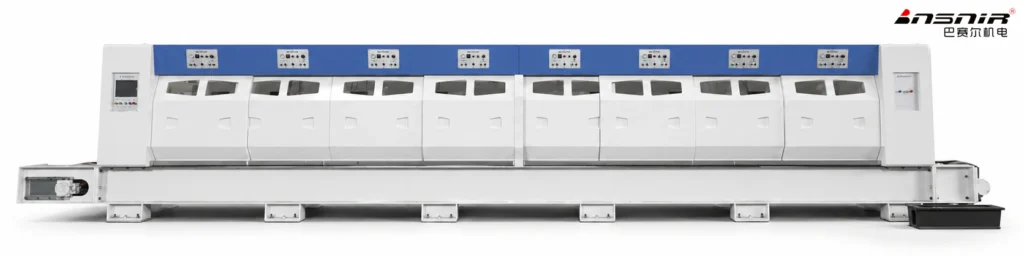
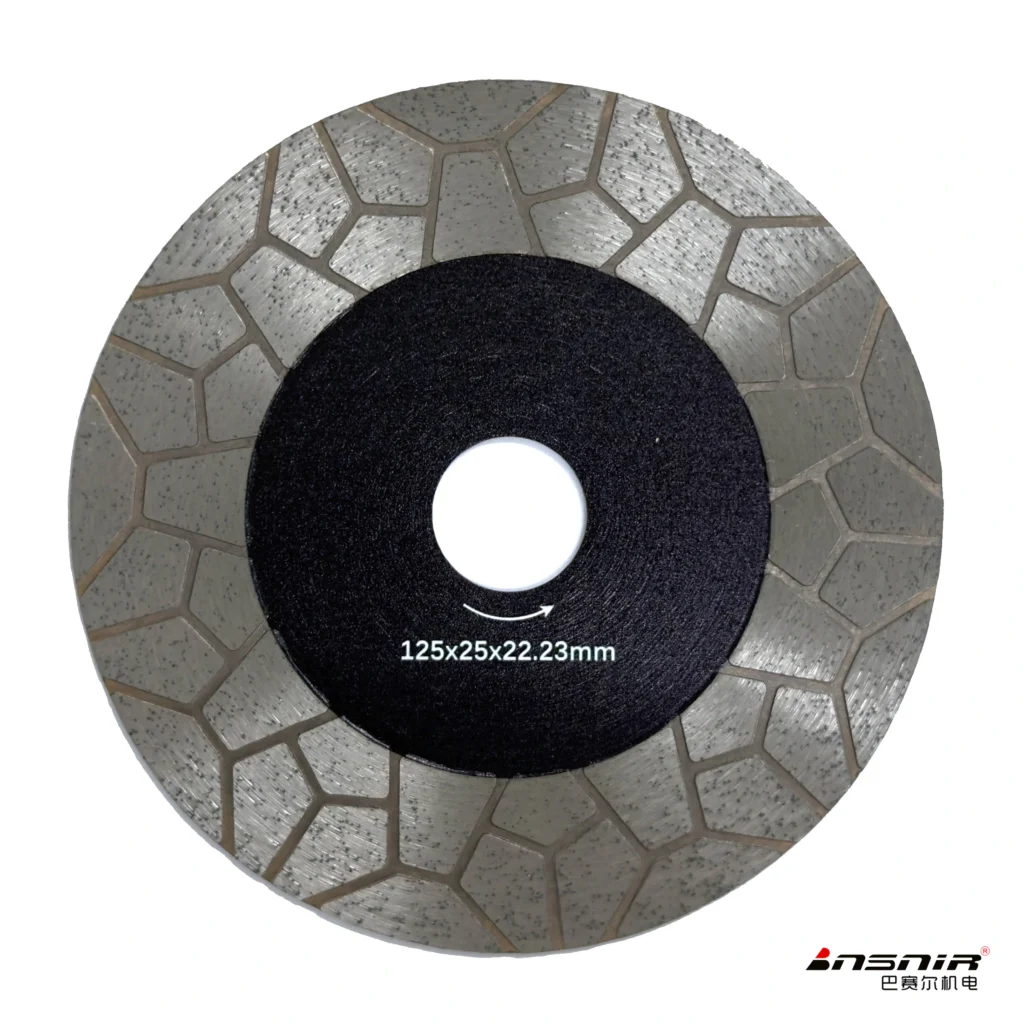
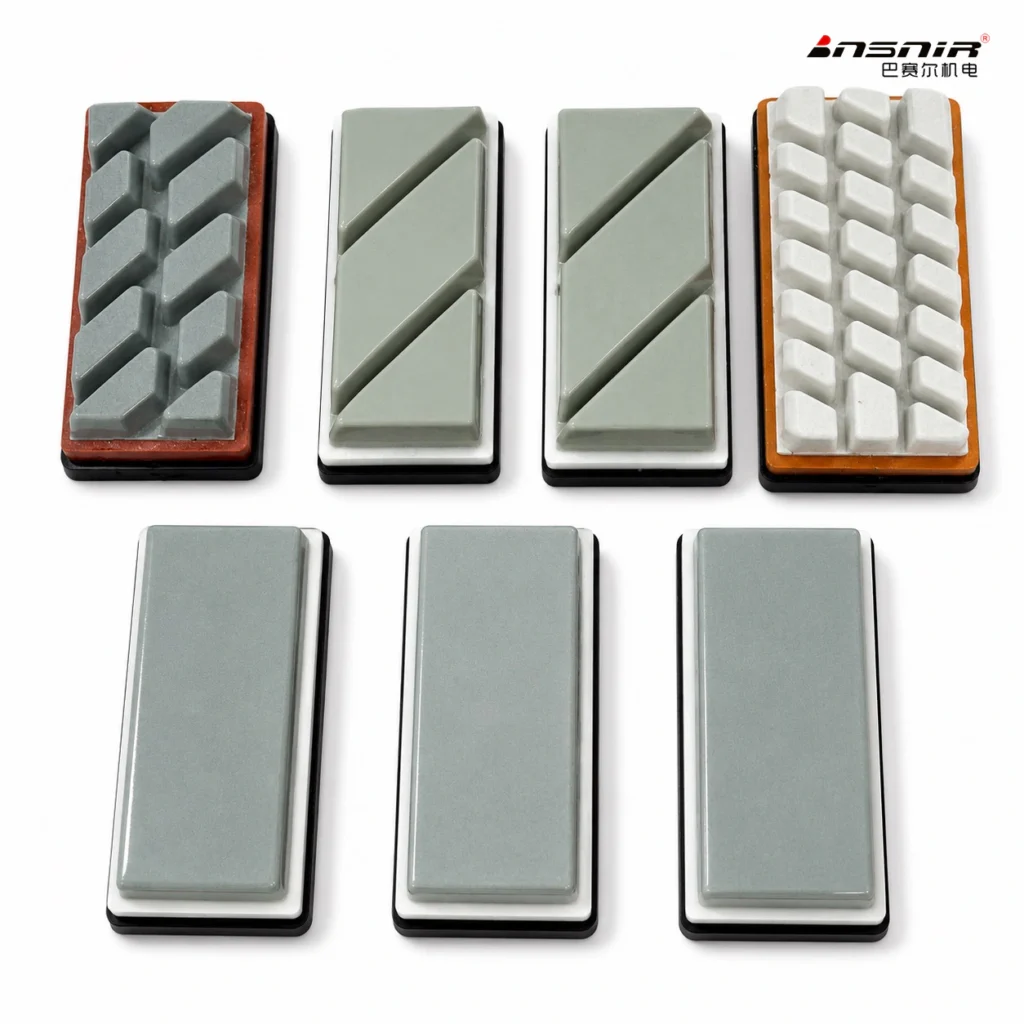
Select a tile finishing machine and its consumables as one system, starting from the incoming tile condition and the finished output you must accept, not from the machine list. The deciding facts are the tile material, format and thickness arriving at the station, the dimensional and surface targets leaving it, the required line speed, and whether the operation runs wet or dry. Once those are fixed, the machine defines how the tile is held, fed and supported, and the tool package defines how much material comes off and what surface remains; a mismatch in either half shows up as the same symptom at the next station.
Define the finished output before selecting the package
Start by writing down two states: what the tile looks like when it enters the machine, and what it must look like when it leaves. Incoming conditions include material type, format, thickness, edge condition and the dimensional allowance available for removal. Finished output means the target dimension and squareness, the edge geometry, and the surface state, whether that is a honed or polished gloss, a lappato partial polish, or a matte or textured finish. Only with both states defined can you say what the operation actually has to do.
From there, the operation, the tool duties and the machine interfaces follow as one working system. A squaring line, for example, has to remove a defined amount per side at the required speed, which sets the number of heads, the wheel duty and the extraction or water handling needed; a polishing line has to carry the surface through a sequence of removal, refining and buffing steps, which sets head count and the abrasive sequence. Specify the machine alone and you can end up with a correct frame, feed and head arrangement while the removal or finish task is assigned to a tool package that cannot deliver it at speed, or that leaves a surface the next station cannot work with.
Keep the boundary of the offer clear while you do this. A finishing-equipment and tooling package covers the operation it is configured for and the tools that perform it. It does not imply supply of the surrounding plant, handling conveyors you have not specified, or treatment chemistry; if sealing, anti-slip or similar treatment is part of your finished-output definition, say so explicitly rather than assuming it travels with a finishing machine.
Check physical fit and process suitability separately
| Check | Compare | What the check establishes |
|---|---|---|
| Mounting and dimensions | Exact tool and machine documentation | Whether the tool physically fits the proposed machine configuration |
| Tool duty | Intended tool duty and the required finishing operation | Whether the tool is intended for the task being assigned to it |
| Material range | Documented tool suitability and the incoming tile material | Whether the proposed tool covers the material to be processed |
| Wet or dry suitability | Tool and machine instructions and the proposed process conditions | Whether the proposed combination suits the wet or dry operation |
Physical fit and process suitability are two different questions, and a tool can pass one while failing the other. Fit asks whether the tool mounts on the proposed machine configuration and clears the surrounding geometry. Suitability asks whether that tool is intended for the duty you are assigning, covers the tile material you are running, and is rated for wet or dry operation as the line is configured. Settle both before anyone starts arguing about grit sequence, bond hardness or price per piece, because a price comparison between tools that cannot both do the job is meaningless.
Use the actual tool and machine documentation for these checks rather than a shared family name. Product families regroup tools by duty and by process, so a name that appears in both a dry-squaring and a wet-squaring listing may cover different constructions. The Surfaces Group ceramics catalogue is a useful illustration of how a manufacturer separates polishing, lapping, satin-finishing and treatment duties, and keeps distinct tool families for dry and wet squaring; the specific sequences and effects in any such catalogue are that supplier’s own and not a universal recipe. Match each proposed tool to its stated mounting, dimensions, duty, material range and wet or dry suitability in the documents that apply to the exact tool and the exact machine.
FEPA’s general safety principles for abrasive products reinforce the same discipline from the safety side: identify the product and its condition, confirm it is suitable for the intended use, follow the mounting indications and supplier instructions, and keep guarding and workpiece support within the process risk assessment. Those are general principles; the mounting arrangement, permitted speeds and handling for a specific wheel, block or Fickert come from the tool and machine instructions for that combination. For dry squaring the extraction interface at the grinding heads is part of this check, because a tool rated for dry work still depends on dust being removed at the head; for wet work, the water supply and slurry path are part of the same assessment.
Compare packages on the same tile and quality task
| Trial element | Basis for comparison | Evidence to retain for each package |
|---|---|---|
| Incoming tiles | Representative tiles with comparable incoming conditions and allowances | The tile inputs used in the trial |
| Finished-quality task | The same finished-quality criteria and surface target | Accepted output against those criteria |
| Tool sequence | Each package’s proposed sequence for the agreed task | Tool identities and their sequence |
| Operating conditions | Each package’s permitted operating conditions; unlike systems need not use identical settings | The conditions used to obtain the recorded output |
Two packages can only be compared if they run representative tiles and are judged against the same finished-quality criteria. Fix those two things first: the tiles, with their incoming condition and available allowance, and the definition of an accepted tile leaving the machine. Without that, a package that was given more allowance to remove, or a looser surface target, will look better for reasons that have nothing to do with the machine or the tools.
What should differ between the packages is how each one gets there. Each supplier proposes its own tool sequence and its own permitted operating conditions, and forcing unlike systems onto identical settings tests nothing useful. A lappato package built around elastic abrasive blocks and a package built around a different step progression will reach a comparable gloss through different numbers of heads and different pressures; both are legitimate, so record each package’s sequence, the tool identities, and the conditions actually used to obtain the output you accepted.
Keep the record at tile level as well as package level. For each package, note which tiles went in, what came out, and which of those tiles met the criteria. A squaring trial benefits from separating machine variables, wheel variables and tile-input variation so that a dimensional result can be attributed to the right cause, and a lappato trial benefits from treating wear stability as part of the quality task rather than a separate question. If a package wins on one tile format and loses on another, that is a result worth having, not noise to average away.
Test repeatability and line interfaces
One acceptable tile is a sample; a package is accepted on repeated output. After a demonstration produces tiles that meet the criteria, keep running and look at whether later tiles match the first ones, and at what the tools look like as the run continues. Abrasive condition changes during a run, and a sequence that is marginal on removal or on surface uniformity will drift before anything breaks. Inspect tool condition at the end of the run and compare the last accepted tiles with the first.
The applicable line interfaces belong in the same trial. Check how tiles enter and leave the machine relative to your existing handling, whether the cleaning or drying arrangement between stations leaves the surface in the state the next operation needs, and whether the utility interfaces behave under continuous running: extraction airflow at the heads for dry squaring, process water supply and slurry removal for wet work, and the electrical supply and control connections the machine requires. A package that holds dimension perfectly but discharges slurry faster than the plant can handle is not a working configuration.
Treat the trial’s coverage as the limit of what it shows. If the run used one material, one format range and one finish target, that is what the result supports; a different thickness, a different body or a different surface target reopens the question. For automation and control scope, IEC 62381:2024 describes factory and site acceptance and integration testing of process-industry automation systems against the applicable specifications, which is a useful model for structuring staged testing, while the machine performance tests and the tile-quality values themselves have to be agreed separately in the project’s own test plan. Where the trial leads to a release or acceptance decision, that decision rests with the project’s approved acceptance procedure and its designated approver.
Compare cost per accepted output
Compare packages on the cost of producing accepted tiles, not on the price of a set of tools. Put the included tool cost, the accepted output achieved in the trial, the labor and downtime for tool changeouts, and the rejected material inside the same boundary for every package, then compare. A cheaper abrasive set that is replaced more often, or that produces a higher reject rate at the surface inspection, can cost more per accepted square meter than a set with a higher purchase price.
Changeout work deserves its own line because it consumes production time as well as spend. A sequence with more heads to re-dress or more frequent tool replacement removes line hours, and the value of those hours depends on your throughput requirement, which is why the cost comparison only makes sense once the required line speed is fixed.
Keep demonstrated figures separate from assumed ones. Output and tool condition observed during a trial are measured results for those conditions; projected tool life over months, utilization assumptions and reject rates at other formats are estimates. Label them as such in the comparison, and if a supplier’s cost advantage depends on an assumption you cannot verify, ask what measurement would confirm it rather than accepting the projection as a result.
Retain the tested configuration for handover and reorders
When you accept a package, the handover record has to identify the exact combination that was tested, because that identity is what you will reorder against and what you will compare future results to. Record the machine configuration as built, including head count and arrangement; the tool identities and the sequence in which they were fitted; the qualified operating settings; the retained sample tiles; the acceptance results obtained; and the replacement-tool requirements, with the specification needed to reorder each item rather than a description. A tool recorded only as a medium-grit lappato block cannot be reordered reliably.
Keep the trial conditions with the record. The material, format, thickness and finish target the package was accepted on define the range the record covers, so when a new tile body or a new format arrives, you know which part of the configuration has to be re-examined rather than re-testing everything. The same applies in reverse: if a supplier proposes a tool substitution, the record tells you what the substitute has to match.
Final release of the package, and any broader performance commitment attached to it, follow the project’s agreed acceptance decision rather than the handover paperwork itself. Before a supplier discussion on either equipment families or consumable families, have the tile material, format and thickness ranges, the dimensional and surface targets, the required line speed, and the existing handling, water, extraction and electrical interfaces written down; those five items let a supplier configure a package you can actually test instead of quoting a machine and leaving the tooling to be resolved later.
Frequently Asked Questions
Q: Can we keep our existing consumables when buying a new tile-finishing machine?
A: Include them as a candidate package only after checking their exact identity, mounting, dimensions, intended duty, material range and wet or dry suitability against the new machine. Stock availability or a shared tool-family name does not establish compatibility. If they pass those checks, include the proposed combination in the trial for your required finished output.
Q: What if the demonstration tiles are easier to process than our normal incoming tiles?
A: Keep the demonstration result limited to the inputs it actually covered. Compare its tile conditions and allowances with your intended production inputs, identify the differences, and arrange representative trial coverage before applying the result to those other conditions. An acceptable finish on the demonstration tiles does not settle that wider decision.
Q: Does a machine-and-consumables offer also cover everything needed to connect it to our line?
A: Do not assume that it does. Identify the applicable transfer, cleaning and utility interfaces, then clarify what the offer includes and what the project must provide separately. A finishing-equipment offer also does not establish complete-plant or treatment-chemistry supply.
Q: Can we reorder a different tool from the same family after the package has been accepted?
A: Do not treat the family name as proof that the replacement preserves the accepted combination. Compare the proposed replacement’s exact identity and documented suitability with the handover record, including its duty and position in the tool sequence. If it differs from the tested configuration, establish whether the existing acceptance evidence covers that change or whether further qualification is needed.