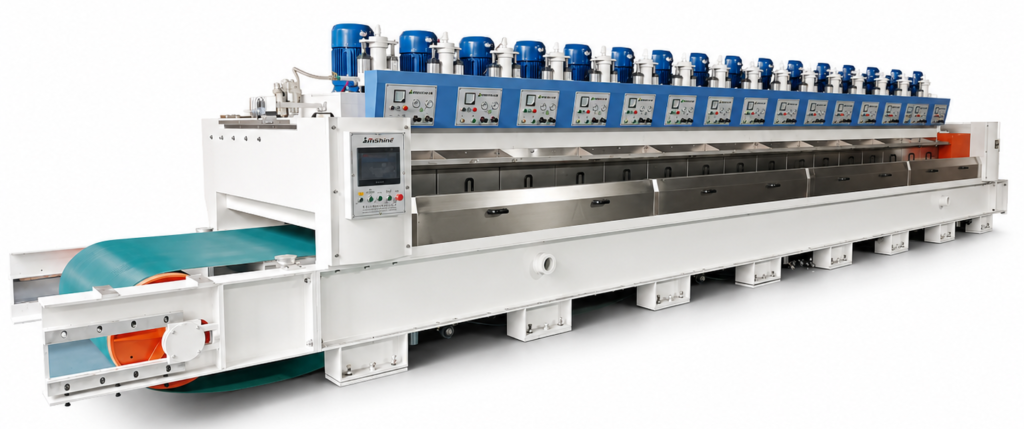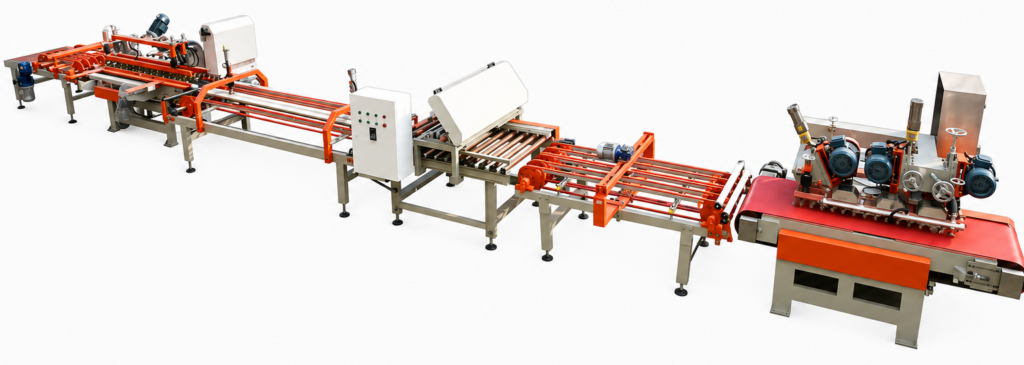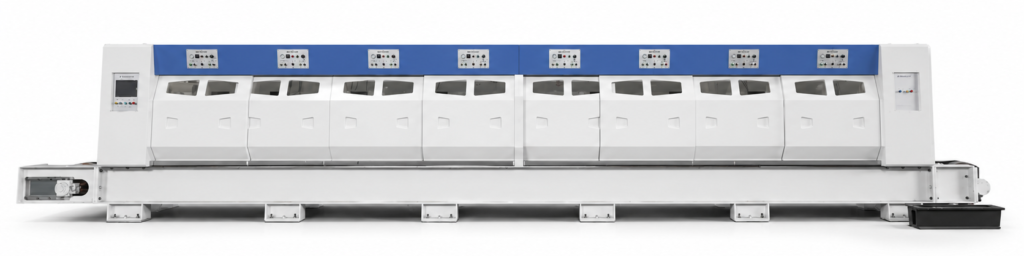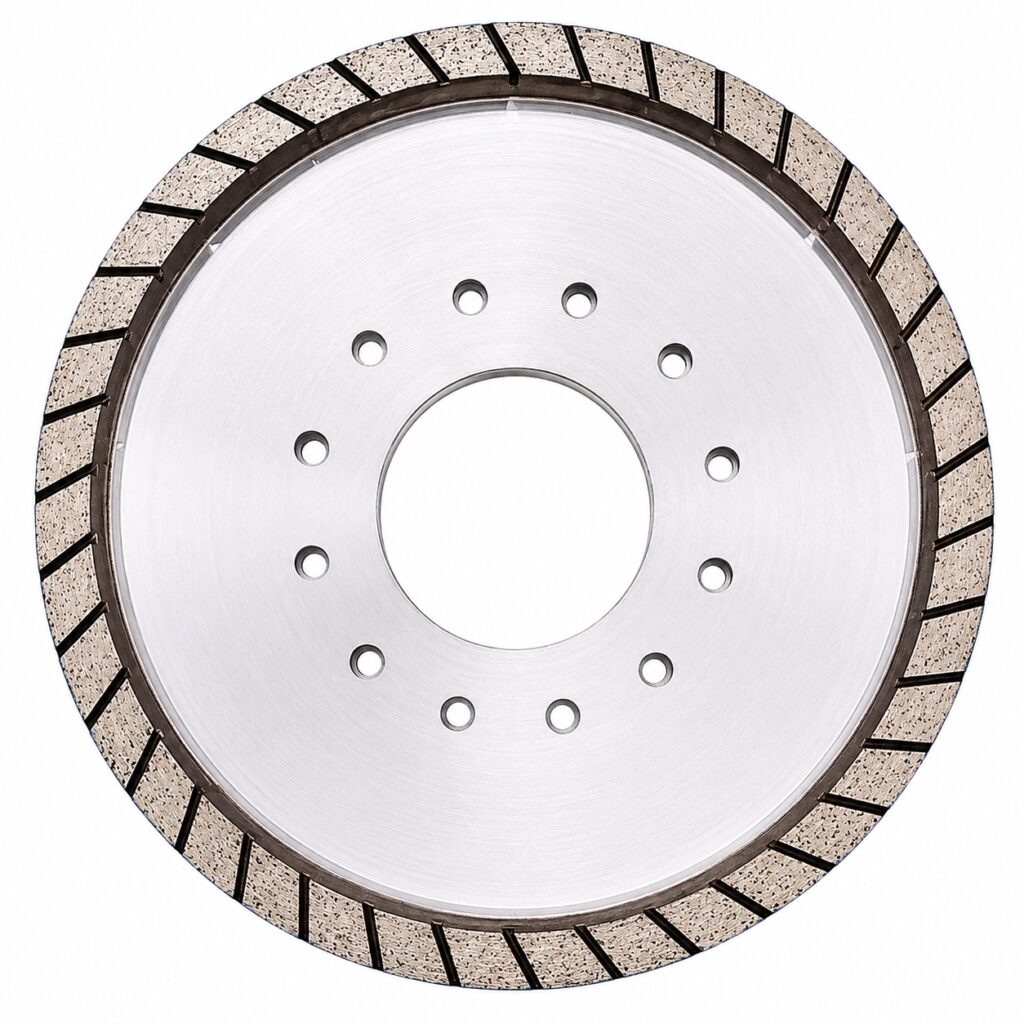
Running a lappato finish on a tile body that carries a thin decorative glaze, using the same abrasive staging and removal depth you would apply to a full-body porcelain, is a fast path to shade change and batch rejection. The consequence is not cosmetic ambiguity—it is a production halt while the process is rebuilt around a glaze thickness that was never measured. Both routes serve legitimate factory applications, but the structural difference between a surfaced glaze and a through-body porcelain dictates every meaningful processing decision, from abrasive selection to acceptable finish tolerances. The practical judgment is whether the tile you are processing has any depth margin to work with, and that question must be answered before a single head touches the surface.
Material Structure Behind Each Polishing Route
The operating difference between the two routes comes down to where the design lives in the tile cross-section. In a glazed lappato tile, the decoration exists only in a thin glassy layer on the surface. Polishing targets the raised areas of that glaze, intentionally leaving recessed areas matte, producing the characteristic patchy gloss-and-matte appearance. Because the glaze is thin and the body beneath it carries no decorative content, the usable processing depth is narrow. In a full-body porcelain, the coloured raw materials run through the entire cross-section, so the surface and a cut through the tile body look consistent. The design does not sit in a surface layer that can be polished away.
That structural difference defines everything downstream. For lappato, the polishing process buffs the top portion of the glaze without fully removing it—the intent is a semi-polished result, not a high-gloss finish. For full-body porcelain, the process can remove material to achieve flatness and gloss without affecting colour continuity, because the design persists at any practical removal depth. The two routes are not interchangeable configurations of the same process; they are different strategies built around where the tile’s appearance is stored.
| Characteristic | Glazed Tile (Lappato Route) | Full-Body Porcelain (Polishing Route) |
|---|---|---|
| Glaze Layer | Present: thin glassy decorative glaze over body | Absent: entire tile is a single coloured porcelain body |
| Colour & Pattern Location | In the glaze layer only (surface decoration) | Throughout the full tile cross‑section |
| Polishing Target Layer | Top portion of the glaze – buffed, not fully removed | Surface of the porcelain body, allowing controlled depth removal |
| Depth Control Requirement | Must stay within glaze thickness to avoid exposing body | Depth limited only by final dimensional tolerance; colour remains consistent deeper down |
| Risk of Unwanted Exposure | High: over‑polishing removes decoration and exposes the clay body, causing shade change | Low: colour is continuous so significant removal does not change appearance |
The depth-control requirement in the table is the most consequential column for process planning. On a glazed tile, safe removal depth is bounded by glaze thickness, which can vary across the tile face and between production lots. On a full-body tile, removal depth is bounded by final dimensional tolerance, not by decoration survival. That asymmetry is why applying a full-body removal strategy to a glazed lappato tile produces irreversible surface damage rather than a finish adjustment.
Glaze Exposure Risk During Surface Removal
The risk of glaze exposure is not a marginal concern at the edge of the process window—it can occur from a single parameter mismatch early in the abrasive sequence. Three specific decision errors are responsible for most exposure failures on glazed tiles.
| Process Decision | Risk for Glazed Tile | Potential Outcome |
|---|---|---|
| Using a full‑body removal depth | Exceeds glaze thickness and exposes the body | Decoration loss, shade change, batch rejection |
| Applying uniform full‑surface pressure | Polishes recessed areas as well as raised areas | Loss of the lappato matte/gloss contrast; surface appears fully glossy |
| Employing a coarse abrasive sequence | Aggressive removal through the glaze layer | Glaze thinning, possible decoration exposure, pitting |
Applying uniform full-surface pressure on a lappato tile removes the matte recesses as well as the raised gloss zones, collapsing the finish into a flat gloss that cannot be recovered without rebuilding the surface texture.
The coarse abrasive risk is the most operationally misunderstood. A process engineer moving from full-body polishing to a lappato line may carry over the same opening grit because the tile surface looks similar. But aggressive removal that is acceptable on a through-body porcelain—where you are simply cutting down bulk material—can thin the glaze on a decorated tile to the point where the body below becomes visible. Once the decorative layer is compromised, the tile cannot be reworked; the batch must be assessed for rejection or downgrade.
The lappato finish also presents a specific evaluation challenge: patchy gloss, fine pitting, and a slight crackled texture are normal features of the surface, not defects. Distinguishing between an acceptable semi-polished result and actual glaze damage requires a reference sample, not just a visual scan. Without that reference, a line operator may either accept a damaged surface as normal variation or flag a correct lappato finish as a processing fault.
Full-Body Porcelain Geometry and Process Freedom
Through-body porcelain offers a process freedom that glazed lappato cannot match: the ability to remove material across the surface without altering the appearance. Because the colour and pattern of a through-body tile permeate the entire cross-section, a cross-section of the tile shows the same visual composition as the surface. This is a structural design feature, not a quality grade, and it has direct consequences for how a polishing line can be configured.
On a full-body tile, the polishing sequence can be planned around dimensional requirements—achieving flatness, removing kiln surface variation, or reaching a target gloss level—without simultaneously managing a decoration survival constraint. If a head configuration removes slightly more material than expected in one pass, the colour result is unchanged. That tolerance margin allows the process to be optimised around surface quality and throughput without the overriding concern that characterises lappato work.
Through-body colour continuity is a planning criterion for depth removal, not an argument that full-body polishing is simpler—the surface still requires a managed abrasive sequence to achieve consistent gloss.
This process freedom should not be read as unlimited latitude. Material removal rates still need to be controlled for dimensional consistency, abrasive wear management, and machine load. The distinction is that on a full-body tile, exceeding the intended removal depth by a small margin typically does not create a surface appearance problem—it becomes a dimensional and tooling cost question rather than a decoration exposure event.
Abrasive Staging for Different Surface Layers
The starting point for abrasive selection on each route is determined by what the surface needs to have removed and how much depth is available to do it. Those two variables point toward different staging strategies.
For full-body polishing, the sequence can open with abrasives capable of cutting through kiln skin and surface variation, then work through intermediate grits to refine the surface before finishing with fine polishing stages. The process is iterative material removal with each stage preparing the surface for the next. The through-body structure means that deeper cuts at early stages do not create appearance risk, so the abrasive sequence can be designed primarily around removal rate and surface quality targets.
For glazed lappato, the approach must be fundamentally more restrained. The objective is not progressive material removal to expose a clean body surface—it is selective polishing of raised glaze features without penetrating into the body below or flattening the matte recesses. Coarse abrasives that would be appropriate as an opening stage on full-body porcelain are typically incompatible with lappato work, where an aggressive early stage can remove the decorative layer entirely rather than refining it. Abrasive selection on a lappato line is constrained by glaze hardness, glaze thickness, and the requirement to preserve the textural contrast between polished and unpolished areas.
The practical implication for a production engineer moving tiles between lines is that the abrasive deck configured for full-body polishing is not a starting point for a lappato setup—it is a mismatch that needs to be rebuilt. The bond type, grit progression, and head pressure all need to reflect the surface layer being worked, not carried over from a route designed for unrestricted depth removal.
Trial Information Suppliers Need from the Buyer
A common source of avoidable delay at the trial stage is a buyer providing a tile name or a visual reference photograph without any structural information. Without cross-section data and glaze specifications, a supplier configuring a lappato process cannot determine the safe operating depth—they are working with unknowns that will only become visible when the surface fails.
| Information Required | Why It Matters | Risk If Missing |
|---|---|---|
| Glaze thickness and tile cross‑section | Defines the safe removal depth for lappato | Over‑polishing exposes decoration, causing shade change and batch rejection |
| Glaze composition or hardness class | Influences abrasive grit and pressure selection | Inconsistent finish or glaze surface damage |
| Approved reference surface sample | Provides a clear visual target for gloss and matte pattern | Subjective disputes over final appearance; trial may be deemed unacceptable |
Receiving a tile name without a glaze cross-section is not a starting point for a trial configuration—it is an invitation to discover the glaze thickness by removing it.
The approved reference surface sample is the most frequently omitted item and often the one that causes the most downstream friction. Without a physical reference, both parties are evaluating the trial result against different mental targets. The supplier may be measuring gloss and pitting against technical process expectations; the buyer may be comparing against a memory of a previously approved batch. That gap does not resolve itself through additional trials—it requires a physical reference standard to be agreed before the trial begins.
Glaze composition or hardness class matters because it influences how the surface responds to a given abrasive under load. A glaze that is harder or softer than assumed can cause the actual removal rate at the first processing stages to diverge from the intended process, either under-polishing the raised areas or cutting through to the body. Where that information is unavailable, the trial itself becomes exploratory, which lengthens the approval timeline and increases the number of sample batches needed.
Route Approval Through Surface and Color Checks
Route approval is not completed by running a trial and confirming that no obvious damage occurred. The specific acceptance criteria for each route differ enough that a visual check without a defined reference and approval structure can pass a failing surface or reject a correct one.
The approval checks for each route reflect their different surface structures and failure modes.
| Approval Factor | What to Confirm on Trial Tiles | Note on Tolerances (Lappato Context) |
|---|---|---|
| Gloss Uniformity | Consistency of shine across the tile surface and between tiles | For lappato, uneven shine, pitting, and a slight crackled effect are normal and not defects. For full‑body polished, shine tolerance may vary slightly between production lots. |
| Colour Stability | No shade change relative to approved reference | Shade shift can indicate excessive glaze removal on lappato. Full‑body is inherently stable if removal depth is uniform. |
| Decoration Exposure | No visible loss of the decorative pattern | On lappato, the decoration must remain intact; any exposure of the underlying body is unacceptable and grounds for batch rejection. |
| Surface Marks | Absence of deep scratches or inconsistent texture | Light normal pitting and fine crackled lines may appear on lappato; deep, isolated scratches suggest abrasive staging error. |
For lappato, the critical check is decoration integrity and colour stability, not gloss uniformity. Uneven shine, fine pitting, and a crackled texture on the polished areas are characteristic of the lappato finish and should not be treated as evidence of a processing problem. What constitutes failure is a shade shift relative to the approved reference—which indicates that glaze removal reached the body—or the absence of the matte-gloss contrast that defines the finish. Those two failure signals require a physical reference sample, not a general judgment of surface appearance.
Shade change on a lappato trial tile is not a cosmetic variance to negotiate—it is confirmation that the process exceeded the safe removal depth and the abrasive staging needs to be reset.
For full-body polished tile, colour stability is inherently managed by the through-body structure, but lot-to-lot gloss variation remains a practical tolerance factor in production. That variation does not indicate a process failure; it is a normal characteristic of polished porcelain production. The relevant check is whether the variation falls within the agreed tolerance of the approved reference, not whether every tile matches exactly. Distinguishing between acceptable lot variation and an abrasive staging problem requires that the reference gloss level and its tolerance band are defined and agreed before the approval check is run.
Before specifying either route, confirm the tile cross-section, glaze thickness, and a physical approved reference sample are in hand. For lappato work, those inputs directly bound the process parameters; without them, any trial configuration involves assumptions about glaze depth that may not survive contact with the actual surface. For full-body porcelain, the structural latitude is genuine, but the abrasive staging still needs to be validated against the target surface quality and dimensional tolerance, not inherited from a different tile type.
The two routes present different risk profiles, different abrasive requirements, and different approval criteria. The decision is not which approach produces a better surface in the abstract—it is which approach is structurally matched to the tile being processed, and whether the trial has been run with enough information to confirm the result before production begins.
Frequently Asked Questions
Q: Can I use the lappato process to deliver a high-gloss, fully polished finish on a glazed tile?
A: No. The lappato route intentionally buffs only the raised portions of the glaze to create a semi-polished patchwork of gloss and matte areas. Applying uniform full-surface pressure or extending the abrasive sequence to achieve a complete gloss will remove the matte recesses, homogenise the surface, and typically expose the body—resulting in an unrecoverable shade change, not a premium finish.
Q: If the glaze on my tile measures significantly thicker than the typical specification, does that mean I can safely use a more aggressive opening grit?
A: Not automatically. A thicker glaze increases the total material above the body, but the decorative layer—the coloured or patterned portion—may still be concentrated near the very top of the glaze. Removing substantial depth without knowing where the decoration sits risks cutting into undecorated glaze or exposing the body, even if the overall thickness is high. A cross-section analysis is the only way to confirm whether that extra depth is usable polishing margin.
Q: After a lappato trial is approved, what line parameters require the closest ongoing attention during full production to keep the finish consistent?
A: Monitor head pressure uniformity, abrasive wear progression, and glaze thickness lot-to-lot variation continuously. Abrasive loading changes can alter the polishing intensity on raised areas, while slight shifts in glaze thickness between batches may push the process outside the narrow safe depth window. Using lappato-specific elastic abrasives that conform to surface texture—such as those purpose-built for this application—helps maintain the gloss-matte contrast without flattening the recesses. Regular side-by-side checks against the approved physical reference sample are the only reliable way to detect drift before it becomes a shade failure.
Q: When planning a new product line, how do we weigh the design flexibility of glazed lappato against the wider processing window of full-body porcelain?
A: The trade-off depends on your production line’s ability to consistently hold the narrow lappato process band across multiple tile batches. Glazed lappato gives you rapid design changes and visual variety, but every new artwork or glaze lot reopens the safe-depth question and demands a dedicated trial. Full-body porcelain removes that surface survival constraint, making long-running production more predictable at the cost of design variety. If your operation can maintain tight incoming-glaze control and structured trial protocols, the design advantage of lappato is worth the discipline; if uncontrolled glaze thickness variation is common in your supply chain, the process risk may repeatedly erode that advantage.
Q: Is the upfront effort of arranging cross-section measurement and a physical reference sample really justified for a short lappato trial run?
A: Yes. A single batch of tiles with unrecognised glaze thinning during polishing can result in full rejection or costly downgrading—the financial impact of which typically dwarfs the cost and time of a proper pre-trial measurement and reference sample agreement. The reference sample not only defines the acceptable gloss and pitting range but also anchors the approval decision for both parties, preventing rework loops and subjective disputes that delay shipping. Skipping these steps turns the trial into an unguided exploration where the first reliable indication of the depth limit is a failed surface.