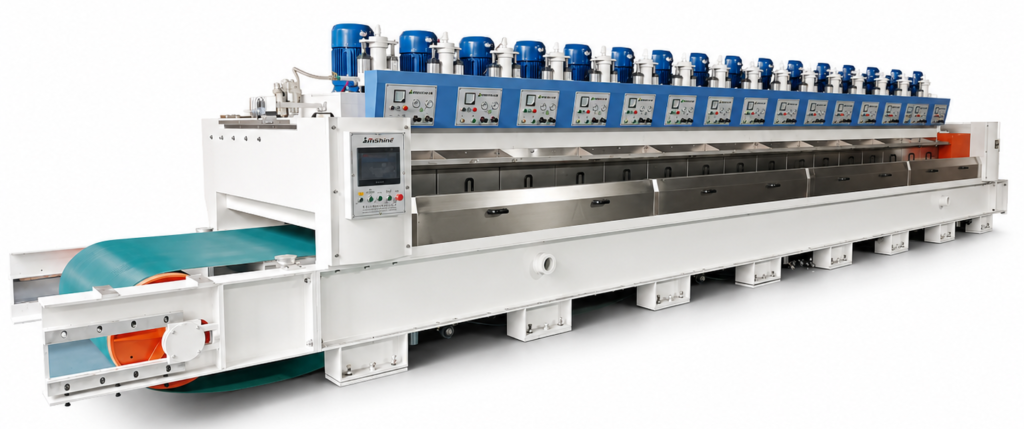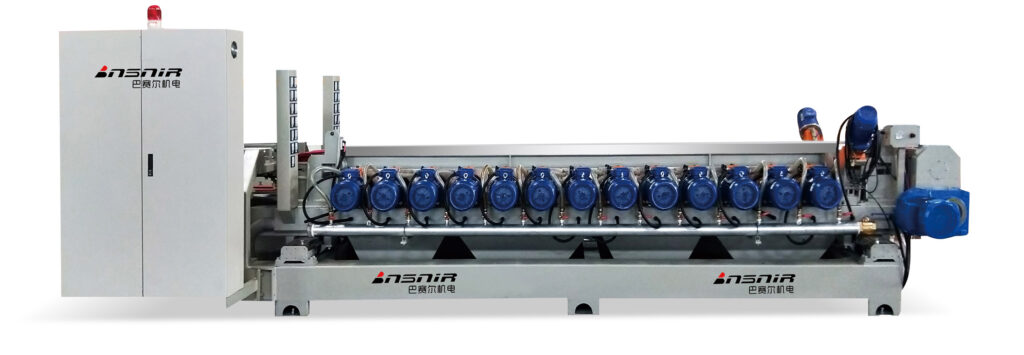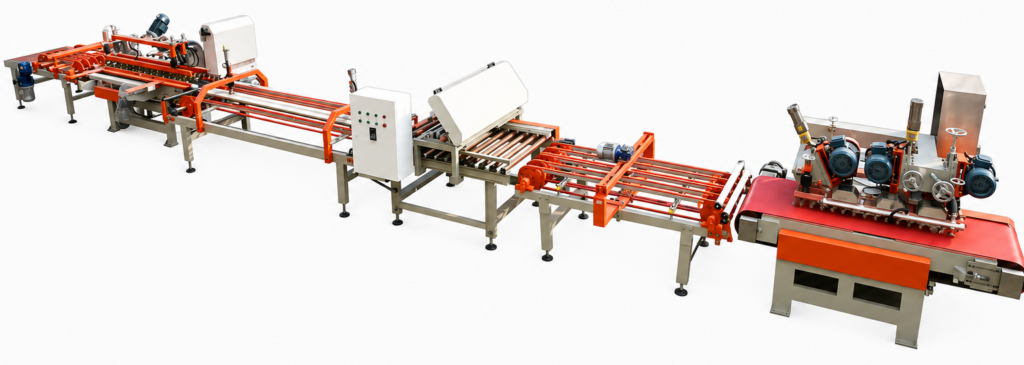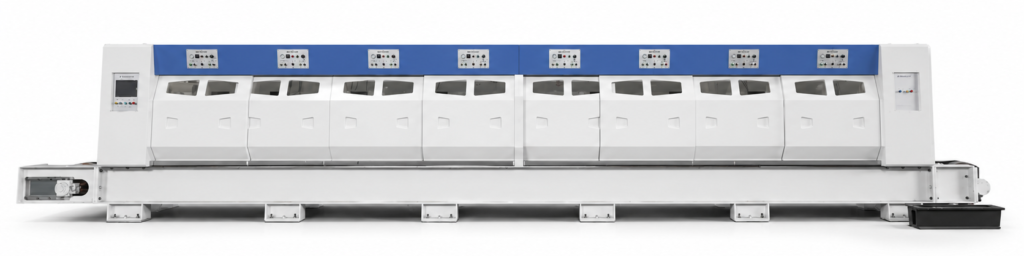
A polishing or lappato line that runs cleanly in the first hour often starts showing gloss bands, periodic scratches, or surface unevenness within a single shift—problems that trace back not to abrasive selection but to how tiles enter the process and how each head is loaded relative to the one before it. By the time a quality check catches the variation, several hundred tiles may already be through the line. The cost is not just the reject pile; it is the rework time, the slurry waste, and the disruption to a production schedule built around a stable surface finish target. Getting the process right means understanding each stage as a mechanical and quality dependency, where a decision made at the conveyor affects what the final head can achieve, and where a single misaligned position will repeat the same defect on every tile that passes over it.
Tile Support and Conveying Before Abrasive Contact
Consistent abrasive contact depends entirely on how well the line holds each tile before a single head touches the surface. This is not a secondary mechanical concern—it is the enabling condition for everything downstream. A tile that rocks, vibrates, or shifts laterally during transport will not receive uniform head pressure, and the resulting contact variation will produce gloss inconsistency or surface waviness that no downstream polishing stage can fully correct.
The key mechanical requirements at this stage are flatness of the conveying surface, lateral constraint through guides or side rails, and vibration damping sufficient to prevent tile bounce under head pressure. Where vacuum-belt or suction-pad systems are used, the holding force must remain consistent across the full tile format; a tile that is held firmly at the center but poorly at the corners will deflect differently under abrasive contact than a fully supported tile, and that deflection difference will show up as a visible ring or halo pattern in the polished surface.
The decision that matters here is whether the support system is matched to the tile format and body type currently running. Large-format porcelain tiles introduce different deflection risks than smaller, thicker body tiles. Changing formats without re-checking guide clearance, suction zone coverage, and belt tension is one of the more common sources of latent line instability—one that does not always surface immediately but creates cumulative defect exposure as production continues.
Sequential Heads and Progressive Surface Refinement
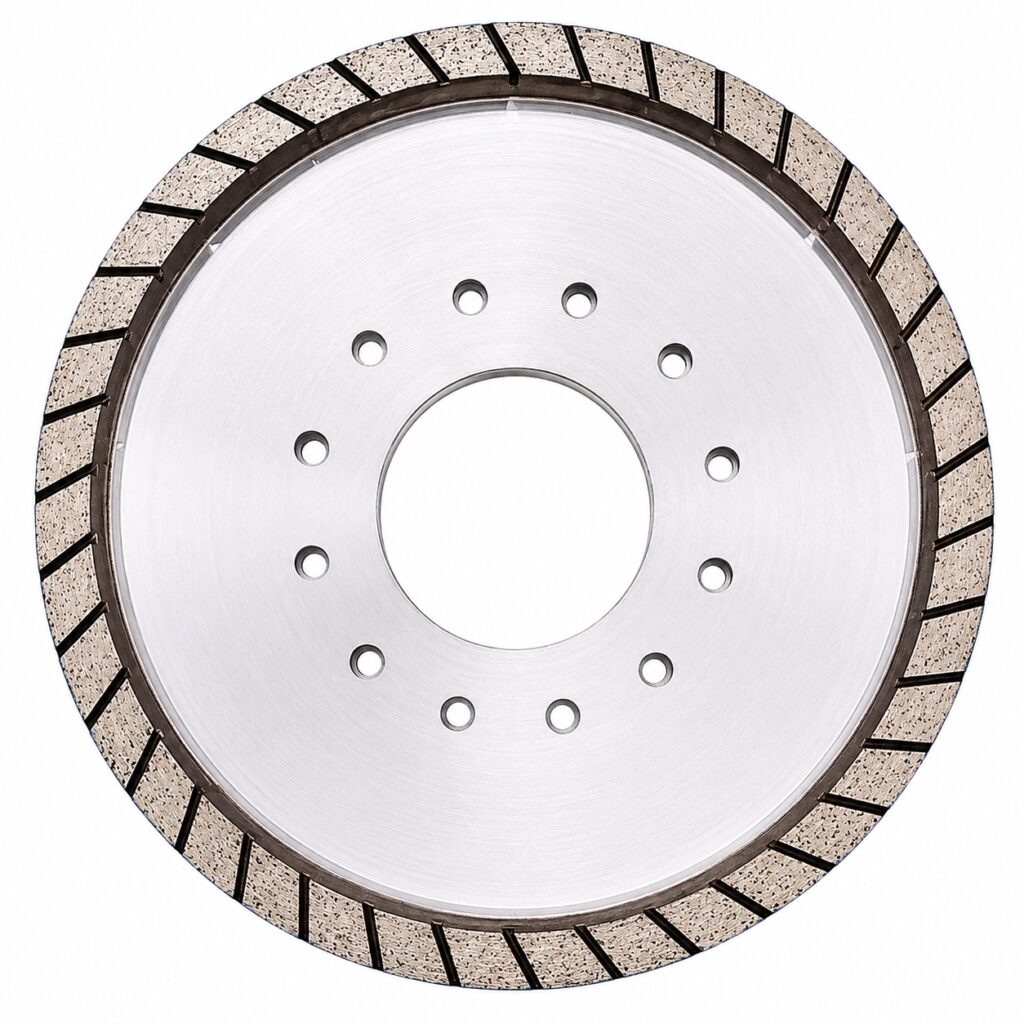
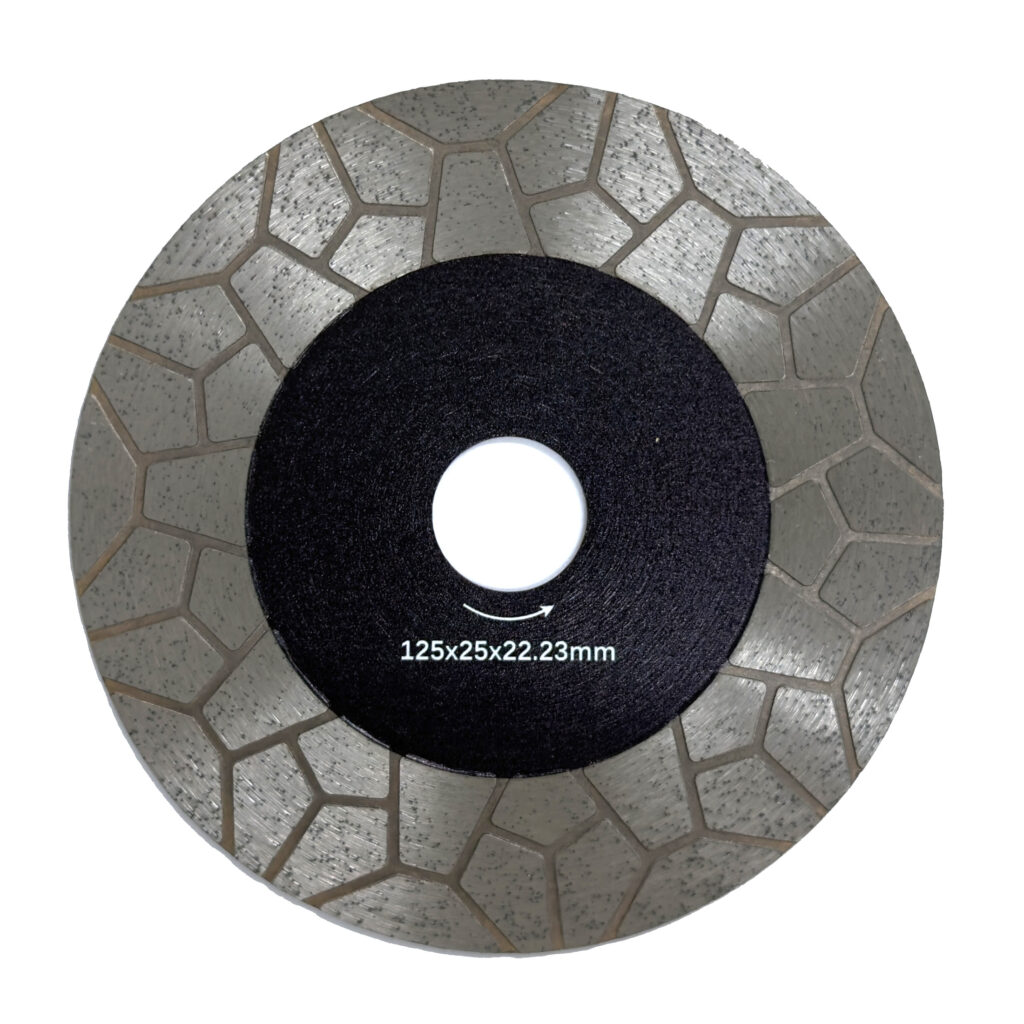
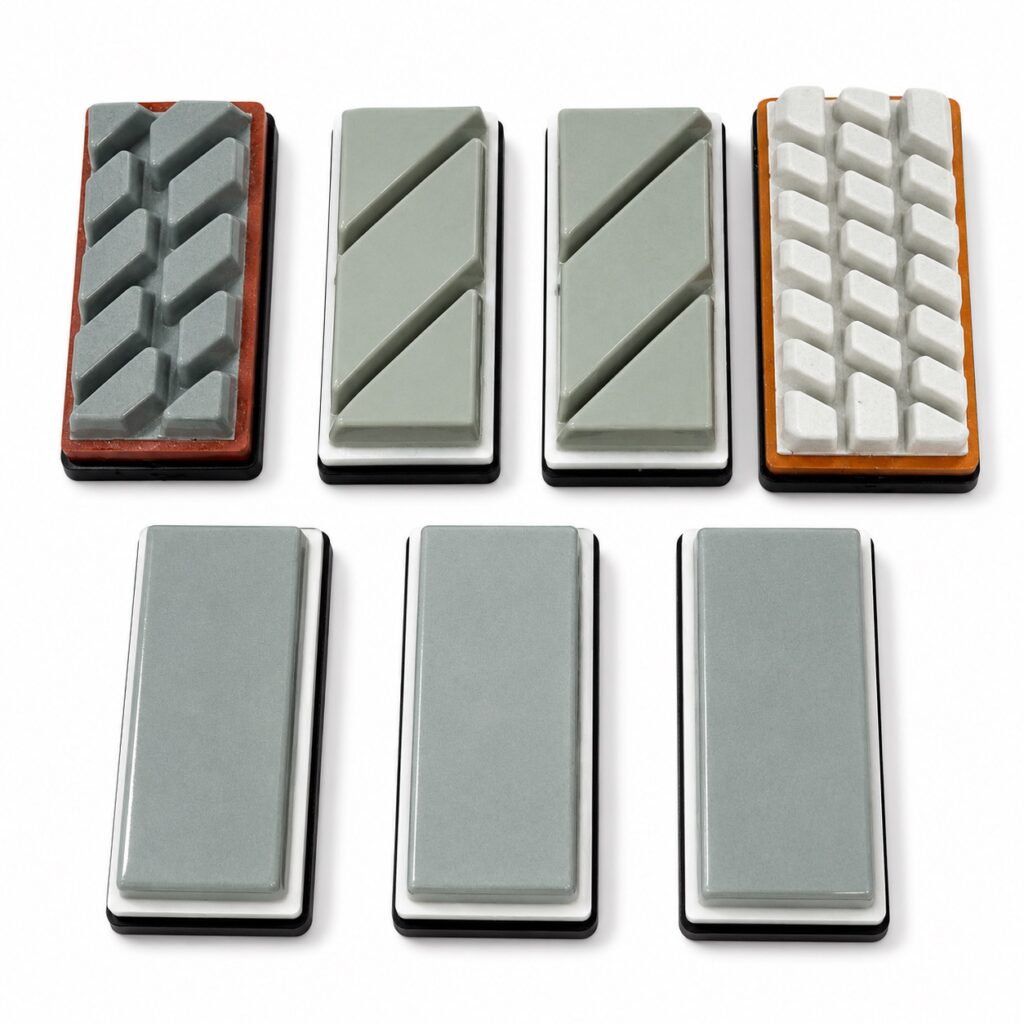
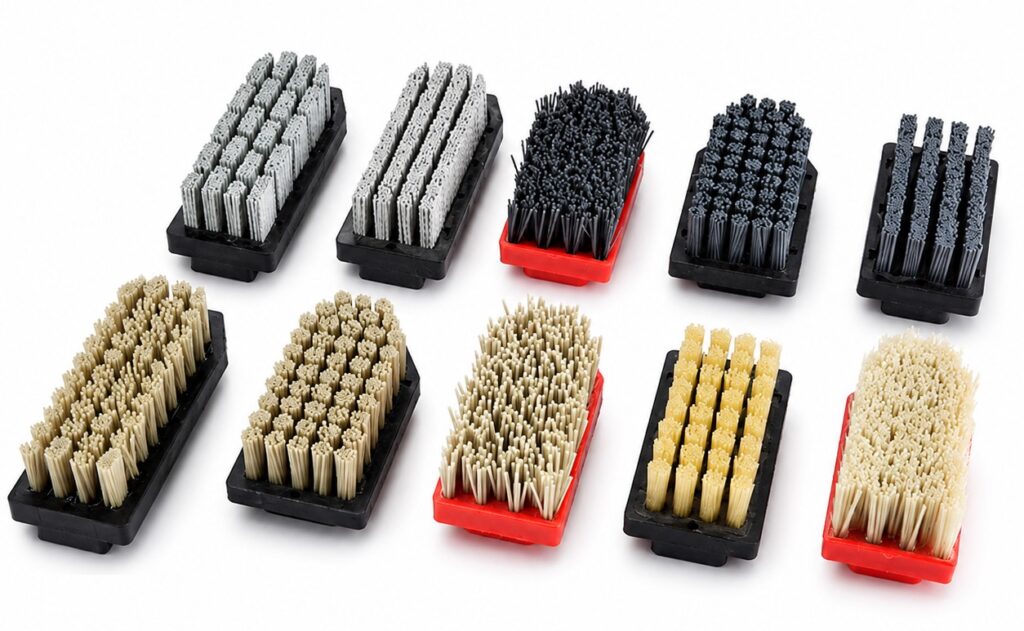
The logic of a polishing line is cumulative scratch reduction: each head refines the surface left by the previous one, and the final result is only achievable if every intermediate stage removes the right amount at the right depth. Skipping a grit stage, running a worn abrasive past its useful life, or applying too much pressure at an early head does not just affect that head’s output—it loads the downstream stages with more work than they were designed to carry.
The following parameters illustrate the contrast between the primary grinding stage and the progressive polishing sequence typical on a line with 8–12 heads. These figures are representative of how one equipment supplier frames the design range; they should not be treated as fixed targets for all lines or body types.
| Parameter | Primary Grinding | Progressive Polishing Heads |
|---|---|---|
| Abrasive type | Diamond wheels | Abrasive sequence (120–3000 grit) |
| RPM | 1,800–2,400 | Set per head (varies with grit) |
| Material removal | 80–120 µm (total) | 10–15 µm per head |
| Coolant flow | 15–25 L/min | Not separately specified |
| Objective | Remove 80–120 µm to flatten surface and eliminate saw marks | Progressively reduce scratch depth by 60–80 % per step and build gloss |
The primary grinding stage is where the majority of material is removed and where surface flatness is established. Running it at insufficient depth leaves residual kiln undulation or texture that the polishing heads cannot overcome—because those heads are designed for a 10–15 µm removal range per step, not for correcting geometry errors in the hundreds of microns. Conversely, over-cutting at primary grinding increases slurry volume, accelerates abrasive wear on the first polishing heads, and can introduce sub-surface micro-cracking in denser porcelain bodies that only becomes visible after the surface is opened up by later fine-grit stages.
Within the polishing sequence itself, the 60–80% scratch depth reduction per step that a correctly matched abrasive delivers is the mechanism by which gloss builds progressively. If one head delivers less than its expected reduction—because the abrasive is glazed, the coolant supply is insufficient, or the head pressure is set below the design contact load—the next head receives scratches too deep for its grit rating to close. The result is a surface that looks acceptable at 8 heads but has residual scratch structure that colorimetric sensors will detect as gloss variation, typically showing as dull patches that correlate with the position of the underperforming head.
Washing Between Processing and Inspection
Washing serves a precise functional role: it removes abrasive slurry and loose particles from the tile surface before any quality measurement is taken. This matters because slurry contamination on the surface scatters light differently than a clean polished face, making gloss readings unreliable and masking both high and low spots in surface roughness. A tile that reads acceptable through a film of residual slurry may fall outside target once clean.
The decision point here is not whether to wash—that is standard on any modern finishing line—but whether the washing stage is positioned correctly relative to the inspection point and whether the tile surface is sufficiently dry before it reaches optical sensors. Wet surfaces produce inconsistent gloss readings even when the tile is within specification. Lines that push production speed by reducing dwell time between the wash station and the inspection gate create a systematic measurement error that makes the process appear less stable than it actually is, or conversely, approves tiles that are marginally out of spec.
Washing also prevents cross-contamination between grit stages on lines where intermediate inspection occurs. Coarse abrasive particles carried forward on a tile surface can score work done by a finer head, introducing a scratch pattern that is inconsistent with the expected output of that stage. Treating washing as a maintenance-light ancillary function—skipping nozzle checks, tolerating blocked jets, or allowing flow rate to drop without triggering an alarm—tends to produce defect patterns that look like abrasive or head problems but are actually contamination problems.
Format Changes Across Mechanical and Quality Settings
Format changes create more line instability than most production schedules account for, because they require simultaneous adjustment across mechanical, abrasive, and quality-reference domains. Changing one element without the others leaves the line in an internally inconsistent state that will produce rejects until the full adjustment is complete and validated.
On the mechanical side, guide width, belt or suction zone configuration, and head clearance heights must match the new tile dimensions. On the abrasive side, head pressure settings, RPM, and in some cases the abrasive set itself may change depending on whether the new format runs a different body type or surface texture. On the quality-reference side, the inspection window, gloss reference tiles, and roughness targets may all need to be updated if the new format has different specification limits. Lines with recipe-based or semi-automated changeover controllers reduce the risk of partial adjustment, but they do not eliminate the need to verify that the saved recipe was validated for the current tile body and finish, not just for the previous run of the same nominal format.
The consequence of treating a format change as a purely mechanical adjustment—moving guides and changing head heights without re-validating quality parameters—is that the line may run stably in the mechanical sense while producing a finish that falls outside the commercial specification for that tile. This is especially common when switching between a standard polished tile and a lappato finish within the same format, because the abrasive set, head sequence, and target gloss level are all different even though the tile dimensions are the same. The format change looks complete from the machine side but is incomplete from the process side.
Repeating Defects That Reveal a Line Position
A defect that appears at the same location across every tile through a line is not a random quality problem—it is a diagnostic signal pointing to a specific position in the process. The periodic nature of the defect is the distinguishing characteristic: random variation appears without pattern, while a structural problem at one head or one section of the conveyor reproduces the same mark at the same cross-tile position on every piece.
The most common forms are gloss bands, periodic scratches, and chatter marks. A gloss band running parallel to the direction of tile travel typically indicates a head with uneven abrasive contact across its working width—caused by worn segments on one side, inconsistent bond-to-surface contact, or lateral misalignment of the head relative to the tile path. A periodic scratch pattern, where scratches appear at regular intervals along the tile’s travel direction, usually points to a damaged abrasive segment rotating into and out of contact, or to a foreign particle embedded in one position of the belt or roller system. Chatter marks—shallow, evenly spaced surface undulations—often indicate mechanical resonance between head vibration and conveying speed, and can shift in spacing when production speed changes.
The practical diagnostic approach is to note the distance between repeating marks along the travel direction and compare it to the circumference of rotating components at that head. If the spacing matches a head’s rotation period at current line speed, the cause is likely at that head. Modern lines with inline sensors can help narrow the search by flagging which head position shows anomalous loading or vibration, but even without sensor data, the geometric relationship between mark spacing and component dimensions is a reliable field method for locating the source. Once the position is identified, the decision is whether to correct during the current shift—replacing the worn segment or realigning the head—or to run to a planned maintenance window with adjusted head settings that reduce but do not eliminate the defect.
Production Release After Stable First-Off Tiles
Releasing full production from a tile polishing or lappato line before first-off tiles demonstrate stable, repeating results across the entire usable surface is one of the higher-cost decisions a production manager can make. The defects that appear after release are rarely new problems—they are the same problems present in the first-off tiles that were not looked for carefully enough, or that appeared only in tile number three or four as the line settled into its operating state.
The quality targets for premium polished tiles provide concrete release criteria. These figures come from commercial technical guidance and should be cross-checked against the specific product specification before being adopted as line release thresholds.
| Quality Parameter | Target | Monitoring Instrument |
|---|---|---|
| Gloss (60° geometry) | 85–95 GU | Colorimetric sensor |
| Gloss variation across tiles | ±3 GU max | Colorimetric sensor |
| Surface roughness (Ra) | 0.1–0.5 µm | Laser profilometer |
| Surface roughness (Rz) | <2.0 µm | Laser profilometer |
The ±3 GU gloss variation limit across individual tiles is particularly important to check on first-off tiles because it reveals whether the head sequence is running consistently across its full width, not just at the center of the tile path. A line can produce average gloss within the 85–95 GU range while showing variation across a single tile that exceeds the ±3 GU target—meaning the average measurement passes but the surface appearance in service is unacceptable. This requires that first-off checks sample gloss at multiple positions across the tile face, not just at a single center-point reading.
Advanced controllers with laser profilometers and colorimetric sensors can measure Ra, Rz, and gloss continuously and adjust processing parameters in response to drift. This capability reduces the interval between process drift and correction, but it does not replace the judgment decision at first-off: the question is not only whether the current tile is within spec but whether the process has reached a stable state where subsequent tiles will remain within spec without intervention. A line that requires frequent automatic correction to stay within target is not a stable line—it is a line where the underlying setup has not been completed correctly, and the control system is compensating for a mechanical or abrasive problem that will eventually exceed its adjustment range.
The decisions that determine line performance are mostly made before full production speed is reached: how tiles are supported, how each head is loaded relative to the previous one, how washing is timed relative to inspection, and whether format changes are validated across all three domains—mechanical, abrasive, and quality reference—before the first production tile is counted. A repeating defect that survives first-off release will not self-correct; it will multiply. Before accepting any line configuration as production-ready, confirm that first-off tiles show stable gloss and roughness readings at multiple surface positions, that no periodic defect pattern is present, and that the process state is consistent rather than held in range by continuous controller intervention. Those checks apply equally at initial line commissioning, after format changes, and after any abrasive set replacement.
Frequently Asked Questions
Q: What if my factory runs a single-head polisher or manual finishing station instead of a multi-head line—do the core principles still apply?
A: Yes, the underlying mechanical requirements still matter. Flat tile support, consistent abrasive contact, and a clean, dry surface before inspection remain essential for any polishing process. However, the progressive scratch reduction logic depends on a sequence of heads—without it, you cannot achieve the same gloss ceiling in a single pass, and you may need multiple passes or accept a lower final gloss level.
Q: After the first-off tiles pass inspection and full production starts, what ongoing records are most useful for preventing future line drift?
A: Record head pressures, abrasive wear indexes, gloss readings taken at multiple tile positions, and wash-station flow rates for each shift. Tracking these parameters lets you spot gradual changes before they turn into repeating defects, giving you the lead time to schedule corrective maintenance rather than reacting after reject tiles appear.
Q: Is there a line-speed threshold where the washing and drying stages can no longer support reliable gloss inspection?
A: There is no fixed number because it depends on dryer capacity and sensor tolerance, but the practical threshold is straightforward: if tiles reach the inspection gate still damp or with visible water beads, the gloss and roughness readings are no longer trustworthy. Even a thin film of residual moisture scatters light differently and can mask shallow scratches, turning inspection into a source of systematic error rather than a quality gate.
Q: How does a lappato line configuration differ from a full-polish line for the same tile format?
A: The mechanical conveying and support structure may be identical, but the abrasive sequence and targets diverge sharply. A lappato finish typically uses fewer polishing heads, stops at a coarser final grit (e.g., 800–1500 instead of 3000), and targets a semi-gloss or satin sheen near 20–40 GU, while a full polish continues through fine grits to reach 85–95 GU. Head pressures, coolant flows, and inspection gloss references all change to match that lower-sheen, textured result.
Q: At what production volume does a fully instrumented polishing line with inline monitoring become a worthwhile investment over a simpler setup?
A: The decision turns on whether the cost of rejects and rework outweighs the capital outlay. For factories with consistent daily output in the thousands of square meters, the ability to catch and correct drift automatically—and to release full production only after stable first-off tiles—usually pays back by improving grade-out rates. Basair’s integrated polishing machines are engineered for exactly that mid-to-high-volume environment, where unreliability in inspection or finish consistency directly cuts into margin.