
Tile transport belts carry tile or a support fixture through surface contact. A replacement must be identified from the complete belt geometry, joint, top and bottom surfaces, drum/support arrangement, tracking method and real wet or dry operating conditions.
This page defines the evidence needed to identify a transport-belt family. It does not infer belt material, hardness, load rating or universal machine compatibility from the visible color or surface texture.
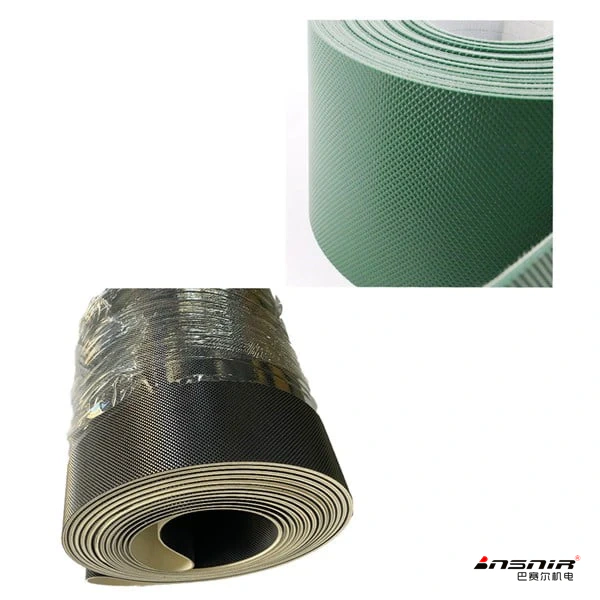
First confirm that the belt carries the tile by surface contact
| Belt function | Replacement page | Primary interface |
|---|---|---|
| Carries tile through a flat, coated or textured surface | Continue with this transport-belt page | Joint, contact surface, underside, drums/support, tracking and process exposure |
| Closed toothed loop positively engaging pulleys | Endless timing belts | Pitch/profile, tooth count or pitch length, width and pulley flanges |
| Open toothed strip fixed at both ends | Open-ended timing belts | Effective length, end clamps, direction and tensioning allowance |
The legacy BASAIR source page published an 800–2200 mm belt-width reference. This is only the range shown on that older family page. It is not a current availability statement, a load rating or evidence that the requested width suits the existing conveyor.
Measure the complete belt, not only the visible top surface
- Record the belt’s total endless length or ordered cut length, width and total thickness, with units and measurement method.
- Photograph and measure the joint or splice. State whether it is mechanical, bonded or another observed construction without guessing hidden reinforcement.
- Photograph the tile-contact top face, underside, both edges and a clean cross-section if an existing offcut is available.
- Measure any ribs, guides, perforations, cleats or edge features from a defined datum.
- State the installed travel direction and whether the same face contacts tile throughout the path.
Do not infer material formulation, hardness, tensile capacity, allowable loading or chemical resistance from color and texture. Those properties require the current belt identity or an engineered selection based on the actual process.
The drums, support bed, tracking and process are part of the match
| Area | Record | Why it matters |
|---|---|---|
| Drums and support | Drive/tail drum diameter and face, wrap, slider bed or rollers, spacing and transitions | Bending, underside contact and support differ between conveyor layouts |
| Tracking and tensioning | Crowned/flat drums, edge guides, tracking ribs, adjustment travel and current setting | The replacement must follow the actual guidance and adjustment scheme |
| Tile and speed | Tile material, size, thickness, surface condition, orientation, spacing and actual line speed | Contact and positioning duties cannot be inferred from belt width alone |
| Environment | Dry dust or wet operation, slurry/water contact, cleaning method and temperature if relevant | Actual exposure must be known before construction is selected |
Show where the belt sits on the squaring and chamfering line. If it belongs to a wider conveyor and positioning system, provide paired-belt spacing, datum/positioning responsibility and speed relationship. Use the machine, tool and spare-part matching guide when the transport belt must be checked with adjacent line components.
Information needed for engineering confirmation
- Machine manufacturer/model, machine nameplate or serial/line identity, exact belt location and quantity
- Current belt code and full dimensions: length, width, thickness and feature positions
- Joint/splice construction and measured geometry
- Top and bottom surfaces, edges, guides/ribs/holes/cleats and travel direction
- Drive and tail drums, support bed/rollers, wrap and transition details
- Tracking method, tensioning method, adjustment travel and current setting
- Tile type, dimensions, surface condition, spacing and actual line speed
- Wet/dry state, slurry/water/dust exposure, cleaning method and observed failure
- Wide installation photo, both belt faces, joint close-up, dimension sketch and operating video if safe
Send transport-belt evidence for engineering review
Final belt construction and fit depend on the measured belt, conveyor interface, tile contact, tracking/tensioning and operating environment.