
Tile transport belts carry tile or a support fixture through surface contact. A replacement must be identified from the complete belt geometry, joint, top and bottom surfaces, drum/support arrangement, tracking method and real wet or dry operating conditions.
This page defines the evidence needed to identify a transport-belt family. It does not infer belt material, hardness, load rating or universal machine compatibility from the visible color or surface texture.
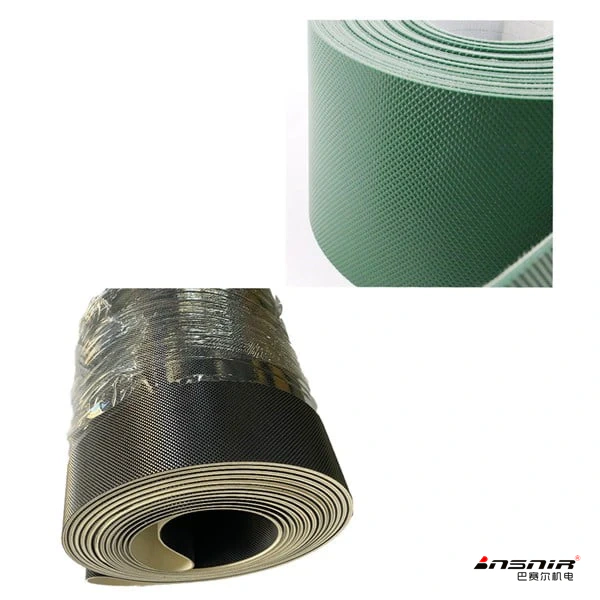
First confirm that the belt carries the tile by surface contact
| Belt function | Replacement page | Primary interface |
|---|---|---|
| Carries tile through a flat, coated or textured surface | Continue with this transport-belt page | Joint, contact surface, underside, drums/support, tracking and process exposure |
| Closed toothed loop positively engaging pulleys | Endless timing belts | Pitch/profile, tooth count or pitch length, width and pulley flanges |
| Open toothed strip fixed at both ends | Correias dentadas sem extremidades fechadas | Effective length, end clamps, direction and tensioning allowance |
The legacy BASAIR source page published an 800–2200 mm belt-width reference. This is only the range shown on that older family page. It is not a current availability statement, a load rating or evidence that the requested width suits the existing conveyor.
Measure the complete belt, not only the visible top surface
- Record the belt’s total endless length or ordered cut length, width and total thickness, with units and measurement method.
- Photograph and measure the joint or splice. State whether it is mechanical, bonded or another observed construction without guessing hidden reinforcement.
- Photograph the tile-contact top face, underside, both edges and a clean cross-section if an existing offcut is available.
- Measure any ribs, guides, perforations, cleats or edge features from a defined datum.
- State the installed travel direction and whether the same face contacts tile throughout the path.
Do not infer material formulation, hardness, tensile capacity, allowable loading or chemical resistance from color and texture. Those properties require the current belt identity or an engineered selection based on the actual process.
The drums, support bed, tracking and process are part of the match
| Area | Registro | Por que isso é importante |
|---|---|---|
| Drums and support | Drive/tail drum diameter and face, wrap, slider bed or rollers, spacing and transitions | Bending, underside contact and support differ between conveyor layouts |
| Tracking and tensioning | Crowned/flat drums, edge guides, tracking ribs, adjustment travel and current setting | The replacement must follow the actual guidance and adjustment scheme |
| Tile and speed | Tile material, size, thickness, surface condition, orientation, spacing and actual line speed | Contact and positioning duties cannot be inferred from belt width alone |
| Environment | Dry dust or wet operation, slurry/water contact, cleaning method and temperature if relevant | Actual exposure must be known before construction is selected |
Show where the belt sits on the linha de esquadria e chanfro. If it belongs to a wider conveyor and positioning system, provide paired-belt spacing, datum/positioning responsibility and speed relationship. Use the guia de compatibilidade de máquinas, ferramentas e peças de reposição when the transport belt must be checked with adjacent line components.
Informações necessárias para a confirmação técnica
- Fabricante/modelo da máquina, placa de identificação da máquina ou número de série/identificação da linha, localização exata da correia e quantidade
- Código atual da correia e dimensões completas: comprimento, largura, espessura e posições das características
- Construção da junta/emenda e geometria medida
- Superfícies superior e inferior, bordas, guias/nervuras/orifícios/saliências e direção de deslocamento
- Tambores de acionamento e de cauda, base de apoio/rolos, detalhes de enrolamento e transição
- Método de alinhamento, método de tensionamento, curso de ajuste e configuração atual
- Tipo de ladrilho, dimensões, condição da superfície, espaçamento e velocidade real da linha
- Estado úmido/seco, exposição a lama/água/poeira, método de limpeza e falha observada
- Foto ampla da instalação, ambas as faces da correia, close-up da junção, esboço das dimensões e vídeo de operação, se for seguro
Envie evidências da correia transportadora para análise de engenharia
A construção final e o ajuste da correia dependem da correia medida, da interface do transportador, do contato das placas, do alinhamento/tensionamento e do ambiente operacional.