
Send my timing-belt measurements
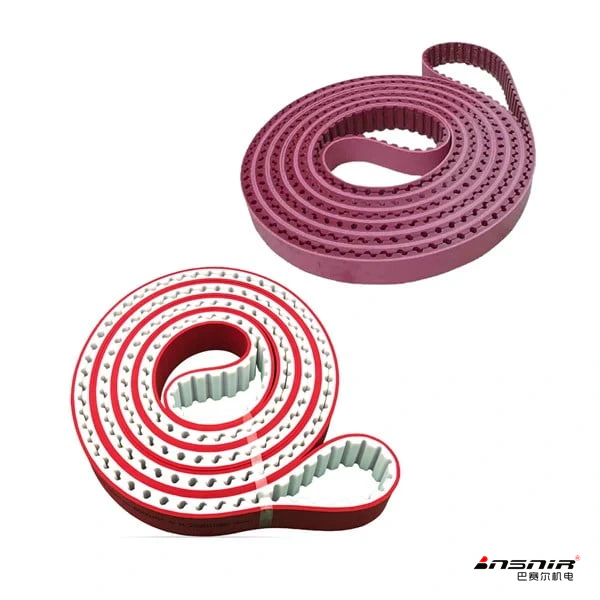
Start with the machine model or station, old belt marking, tooth count, tooth pitch/profile and belt width. Add clear belt and pulley photographs.
Endless timing belts are closed-loop toothed belts for synchronous industrial drives. BASAIR helps match replacements by tooth pitch/profile, tooth count, width, construction and exact machine position. A familiar color, machine brand or old printed reference is not enough to approve a replacement.
Start with teeth, pitch and width
- Mark one tooth and count every tooth around the loop.
- Measure over several tooth spaces and divide by the number of spaces. Record the tooth profile too.
- Measure width at an undamaged point; photograph the tooth cross-section beside a scale.
Nominal pitch length = tooth pitch × tooth count. Outside circumference around the belt back is a different measurement: label it explicitly, and do not substitute it for pitch length.
A closed toothed loop differs from an open-ended belt clamped at its ends and from a surface-contact tile transport belt. Confirm the family using the comparison table below.
Measure circumference without confusing outside length and pitch length
The preferred identity for a toothed loop is its pitch length. If the tooth pitch/profile is known, count every tooth around the loop and record the count; pitch multiplied by tooth count provides a check of nominal pitch length. Measure pitch over several tooth spaces, then divide by the number of spaces to reduce single-tooth error. Photograph the tooth cross-section beside a scale because belts with a similar pitch can still have different profiles.
If using a flexible tape around the relaxed belt back, label the result explicitly as outside circumference. Do not report it as pitch length. Do not stretch the belt while measuring. If the belt cannot be removed, follow the machine’s safe isolation procedure and document the installed measurement method; an estimated lay-flat length alone is not a sufficient replacement identity.
- Measure belt width and total thickness at an undamaged location.
- Record tooth pitch, tooth height, tooth shape and total tooth count.
- Photograph the back layer or cover, tooth face, edges and any visible reinforcement or coating; submit any known material/construction designation from the belt code or drawing rather than guessing from color.
- State whether each dimension comes from a new spare, a worn belt, a drawing or the machine.
This page is for product-family identification and evidence collection. BASAIR confirms a proposed belt only after the belt, pulleys, tensioning arrangement and operating position have been checked together.
Confirm that the requirement is an endless timing belt
| Observed construction | Correct path | Decisive evidence |
|---|---|---|
| Closed loop with teeth engaging toothed pulleys | Continue with this endless timing-belt page | Tooth count or pitch length, pitch/profile, width, thickness and machine position |
| Toothed strip with two ends fixed in clamps or a carriage | Open-ended timing belts | Ordered length, effective installed length, end fixing and cutting allowance |
| Flat or textured belt carrying the tile by surface contact | Tile transport belts | Joint, top/bottom surfaces, drums, support bed, tracking and environment |
The legacy BASAIR source page published a 40–150 mm belt-width reference. Treat this only as a range previously shown for that source family, not as a current stock list, a complete size range or evidence that a measured belt will fit.
The pulley, flanges and tensioner are part of the match
Photograph the driving and driven pulleys, including tooth form, tooth count if available, face width and flange arrangement. Record whether one or both sides have flanges, how the belt is guided and how much tension adjustment remains. Show idlers and the tensioner with their positions and diameters. A belt that matches the removed loop can still track incorrectly if its width, tooth form, backing or pulley guidance differs.
Mark the exact position on the squaring and chamfering line or other machine. For belts used within a complete conveyor and positioning system, also state paired-belt spacing, travel direction, speed relationship and whether the belt indexes a mechanism or carries the tile.
The machine, tool and spare-part matching guide can be used when the belt request must be checked together with the machine station and tooling.
Information needed for engineering confirmation
- Machine manufacturer/model, machine nameplate or serial/line identity, and exact station
- Current belt code, requested quantity and observed failure
- Tooth count, pitch/profile, tooth height, belt width and total thickness
- Pitch length and/or outside circumference, with the measurement method clearly named
- Known material/construction designation, back layer/coating, visible reinforcement and clear photos of all surfaces
- Pulley teeth, face width, flanges, idlers, tensioner and available adjustment
- Left/right or upper/lower location, travel direction, line speed and wet/dry exposure
- Wide installation photo, dimension sketch, close-ups with scale, and a short operating video if safe and available
Send endless-belt measurements for engineering review
A replacement is approved only after the loop identity, tooth/pulley interface, machine position, tensioning and operating conditions have been confirmed.