A tile’s surface treatment station sits between two processes that are usually planned in detail—polishing or lapping, and sorting or packing—yet the treatment step itself is often specified last, as if it were a fixed accessory rather than a configuration decision. Whether that station protects the surface, corrects it, or does neither depends on what the tile looks like when it arrives, and that in turn depends on choices made upstream. Getting the handoff wrong does not usually show up until the line is running and the interfaces it depends on are already fixed in steel and controls.
Why Surface Condition Determines the Treatment Handoff
A treatment station cannot be specified correctly in isolation because its job depends entirely on the state of the tile that reaches it. Polishing and lappato, protective treatment, transport, and quality control are separate functions, and each needs a defined interface rather than an assumed continuity from the previous step. Where the incoming surface still carries processing residue or moisture, the treatment station may need to address that condition before any protective or cosmetic function can be meaningful. Where the incoming surface is already clean and stable, the same station may only need to apply a protective layer and pass the tile onward.
This distinction matters because a treatment station designed around the wrong assumption will either duplicate work that happened earlier in the line or leave a condition unaddressed that the next station is not built to handle. If the station is configured to apply a protective coating but the tile arrives with residue the coating cannot bind to correctly, the result traces back to a handoff that was never defined, not to a defect in the treatment equipment itself. Conversely, if a station carries cleaning or drying capability that the incoming surface condition does not require, that capacity sits idle while adding footprint and coordination points to the line without a corresponding function.
The practical implication is that the treatment station’s specification depends on characterizing the surface at the exact point it enters that station, under the conditions the plant actually runs, not under an assumed or ideal condition. A buyer evaluating equipment for this station needs to ask what condition the tile is expected to be in in the project’s own process, because that answer determines whether the station needs cleaning duty, drying duty, protective-application duty, or some combination, and it determines where the boundary with the upstream process sits. Two lines running comparable tile can require different treatment-station configurations if their upstream polishing or lapping processes leave the surface in different states. The station is not a fixed component type; it is a function whose scope is set by what arrives at its inlet.
Polishing and Lappato Boundaries Before Treatment
The boundary between the polishing or lappato process and the treatment station is a process boundary, not a physical gap on the layout drawing. Polishing and lappato are surface-finishing operations that establish the tile’s final texture and gloss characteristics; treatment, by contrast, acts on the surface that process has already produced, either to protect it, modify its handling behavior, or prepare it for the next stage. Where these two functions are treated as one continuous operation, the risk is that a condition introduced by the finishing process is carried into the treatment station as a baseline assumption, when it should instead be confirmed as a process output to be managed, not assumed away.
This boundary carries practical weight because the method used to finish the surface changes what the surface looks like when the treatment station receives it. A surface finished one way can leave different residues, textures, or moisture conditions than a surface finished a different way, even where the final visual result is comparable. The treatment station does not know which finishing route produced the tile in front of it unless that information is built into the line’s configuration. A related article on how a ceramic tile polishing and lappato line works addresses the finishing side of this boundary; the treatment side is a separate configuration question that depends on what that finishing process is confirmed to output.
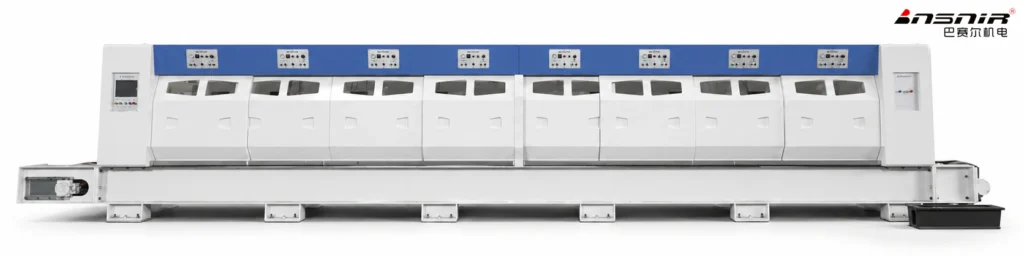
Where lines are built with polishing and lappato capability under BASAIR’s line polishing equipment, the interface to the treatment station becomes one of the project variables that configuration review needs to account for, because the finishing method is defined by that equipment and its settings, not by the treatment station downstream. The buyer’s task is to confirm what surface condition the finishing step is expected to deliver under the project’s actual settings, and to carry that confirmed condition forward as the treatment station’s design input, rather than treating the boundary as self-evident.
Cleaning and Drying Duties That Depend on the Project
Whether a treatment station needs a cleaning duty, a drying duty, both, or neither is a project-specific question, not a default feature of the station type. The surface a tile presents when it leaves the finishing process and reaches transport toward treatment can carry residue, moisture, or neither, depending on the finishing method, the water or coolant use in that process, and how the tile has been handled in between. A treatment station built with cleaning capacity addresses a condition that may or may not be present in a given project; a treatment station built with drying capacity addresses a different condition that likewise depends on project specifics.
Assuming these duties are needed, or assuming they are not, without characterizing the actual incoming surface, creates two distinct risks. Specifying a duty that is not required adds equipment, footprint, and a function that needs maintenance and monitoring without addressing an actual problem. Omitting a duty that is required leaves the treatment function working against the condition it was not designed to manage, which affects how well the subsequent treatment step performs regardless of how well that step itself is configured.
This is also where the order of operations at the treatment station is a project decision rather than a fixed sequence. Roller application and brushing are two distinct duties that may be used at this stage, and the surface and material in front of the station determine which function is needed, in which order, and whether both are required at all. Supplier equipment examples that show a particular sequence of these duties, such as those described in SIMEC’s brushing and treatment machine reference, describe that supplier’s own configurations for the surfaces and materials covered there; they do not establish that any particular order or combination of roller application and brushing applies universally across other materials or lines. A buyer referencing that kind of material should treat it as one illustration of how these duties can be arranged, to be evaluated against the project’s own surface condition, not adopted as a standard sequence.
Transfer, Controls, Inspection, and Reject Interfaces
| Interface to map | Existing-line information to establish | Decision boundary |
|---|---|---|
| Tile transfer | Transfer height at the treatment station and adjacent equipment | Whether the physical handoff fits the existing line layout |
| Speed coordination | How treatment-station speed is coordinated with adjacent equipment | Where operating coordination is needed across the handoff |
| Inspection access | Inspection access around the treatment and transfer area | Where the line layout can accommodate the intended quality-control access |
| Reject handling | The reject-handling path associated with inspection | How the existing layout accommodates rejected-tile handling |
Once the treatment station’s duty is defined, it still has to physically and operationally connect to the rest of the line, and that connection involves several distinct interfaces that do not resolve themselves through the station’s internal design. Tile transfer into and out of the station has to align with the height and handling of the adjacent equipment; a station that performs its treatment function correctly but sits at an incompatible transfer height creates a handling problem at the boundary regardless of what happens inside the station itself.
Speed coordination is a separate interface from transfer height. A treatment station’s internal cycle time has to work with the speed of the equipment feeding it and the equipment receiving its output; where these are not coordinated, the mismatch shows up as either a bottleneck or as idle capacity at the treatment station, independent of whether the treatment process itself is correctly specified.
Inspection access is a further interface, and it is shaped by where in the line quality control needs visibility into the tile. If inspection needs to occur after treatment to catch any condition the treatment process might introduce or obscure, the layout needs physical access at that point, which is a layout decision, not an automatic feature of the treatment station. Reject handling follows directly from inspection: wherever inspection identifies a tile that does not meet the project’s criteria, the line needs a defined path for that tile to leave the normal flow without disrupting the stations around it. Reject handling that is not planned as part of the treatment-station interface tends to be improvised around whatever space is left over, which constrains how inspection and rejection can actually function in practice. A buyer reviewing a treatment station as part of a line design needs to confirm each of these interfaces against the existing layout, because the station’s nominal capability does not establish that it will fit the specific line it is being added to or reconfigured within.
Downstream Sorting and Packing Information for Line Design
The treatment station’s output becomes the input that sorting and packing have to work with, and that handoff carries its own set of conditions that need to be confirmed rather than assumed. If the treatment process leaves tiles in a state that affects how they can be gripped, stacked, or scanned, sorting equipment downstream needs to be configured with that condition in mind, because sorting equipment designed around an untreated or differently treated surface may not handle the treated surface the same way.
Packing carries a related but distinct consideration. Where treatment changes how tiles interact with each other in contact, such as through a protective layer that affects surface friction or tackiness, the packing stage needs to account for that change, because packing processes designed around untreated tile characteristics are built around a different surface condition than the one the treatment station is producing. This is a project-specific confirmation rather than a general rule about treatment and packing: whether the change matters, and how much it matters, depends on the specific treatment applied and the packing method the project uses.
For line design purposes, these two downstream handoffs mean that the treatment station cannot be finalized without also confirming what the sorting and packing stages expect to receive. Where the project is adding a treatment station to an existing line that already has defined sorting and packing equipment, the practical task is to characterize what those existing stages were designed around, and compare that against what the treatment station will actually output under the project’s chosen configuration. Where the sorting or packing stages are also being specified as part of the same project, the opportunity exists to coordinate their design directly against the treatment station’s confirmed output, rather than treating the two as independently fixed. Equipment such as BASAIR’s waxing and surface treatment machine enters this coordination as one configurable element whose output characteristics need to be confirmed against the sorting and packing equipment the project specifies, so that the full handoff from treatment through to final packing is based on matched expectations rather than assumed compatibility.
Frequently Asked Questions
Q: Does a line that already polishes or laps tiles also need a surface-treatment station?
A: Not automatically. Polishing or lappato and protective treatment are separate duties. Define the surface condition leaving polishing and the treatment the project requires before deciding whether a separate station belongs in the line.
Q: Should roller application and brushing be specified as a standard pair?
A: No. They can serve different duties depending on the tile surface and treatment material. Ask for a process proposal that states which duty each operation serves and whether both are needed, rather than assuming a supplier example sets the station order.
Q: When should cleaning or drying be included before treatment?
A: Include a duty only when the incoming tile condition does not meet the condition required for the selected treatment. Compare those two conditions, then identify which station would provide any necessary cleaning or drying in the proposed line.
Q: How can we compare two treatment-station proposals on the same basis?
A: Give both suppliers the same incoming finish, intended treatment, existing layout, and transfer and speed information. Ask each to state its assumptions for cleaning or drying, application or brushing, inspection and reject handling, and the handoff to sorting and packing; compare the complete line scope rather than the machine name alone.