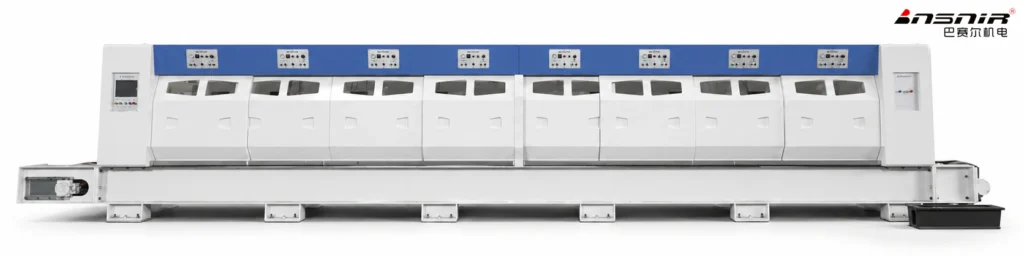
Tiles entering a polishing line do not arrive with identical flatness or surface condition, and the infeed is where that variation first meets the machine. When contact at the infeed becomes unstable, the question is whether the tile, the transfer interface, or a machine setting is responsible — and that question has to be answered before anyone adjusts the line.
Incoming-tile flatness signals that affect line contact
Flatness and surface condition entering the polishing line are properties of the tile as pressed and fired, not properties the polishing line creates. Where incoming tiles carry bow, warpage, or surface irregularity that varies by production batch or format, that variation reaches the infeed before any polishing head engages the surface. A production or process engineer evaluating contact instability at the infeed needs to know whether the signal they are seeing originated upstream, because a machine adjustment cannot correct a condition that was already present in the tile.
Mapping this baseline means recording flatness and surface condition by format, separately from any observation made once tiles are moving through the line. If flatness is only assessed after tiles have passed through transfer and support stations, any distortion introduced by those stations becomes mixed with whatever distortion the tile already carried. Separating the two requires looking at representative tiles before they enter the infeed zone, under conditions that match what the line will see in production, not an isolated sample pulled for inspection.
Format matters here because flatness behavior does not scale uniformly. A given firing and pressing variation can produce a different flatness outcome depending on tile dimensions, and a format that tolerates minor bow without affecting contact at one width may show contact instability at a different width under the same source variation. Where a line processes multiple formats, treating flatness as a single fixed property of “the tile” rather than a property that varies by format width risks misattributing a format-specific limitation to the line itself.
The practical consequence is sequencing: flatness and surface condition should be characterized by format before infeed and polishing behavior is interpreted. Where that mapping has not been done, any later diagnosis of contact instability is working from an incomplete baseline, because it cannot distinguish a tile-side condition from a line-side condition. This baseline does not by itself identify the cause of instability — it only establishes what the tile looked like before the line had a chance to affect it, which is the reference point every later observation depends on.
Support and transfer points to map before trials
Between the point where a tile leaves upstream handling and the point where it engages the polishing heads, it typically passes across multiple support and transfer points — surfaces or mechanisms that carry the tile, hand it from one conveying section to another, and keep it tracking toward the polishing station in a consistent position. Each of these points is a place where contact can degrade even if the tile’s original flatness was acceptable.
A support point that does not carry the tile evenly across its width can introduce a local lifting or rocking effect at the leading or trailing edge, independent of how flat the tile was before reaching that point. A transfer point — where the tile moves from one conveying mechanism to another — can introduce a discontinuity in support if the two mechanisms are not matched in height, speed, or timing. Tracking mechanisms, which keep the tile aligned as it advances, can mask or expose contact problems depending on how tightly they constrain tile position relative to the support surface beneath it.
The reason to map these points before running trials is that instability observed during a trial will appear at a location, and that location is often assumed to be the cause. A tile that shows contact loss at a particular support station may be losing contact because of that station, or it may already have been marginal in flatness and the station is simply where the resulting gap becomes visible. Without a documented map of where support changes, where transfers occur, and where tracking constraints tighten or loosen, a trial result can only point to a location, not a cause.
This mapping should be done independent of any single trial run, as a description of the line’s physical support and transfer path. Once that map exists, an observation that contact becomes unstable at a specific position can be checked against what that position actually does — whether it supports, transfers, or tracks the tile — rather than treated as self-explanatory. The location of instability is a starting point for investigation, not a conclusion about what caused it.
Tracking observations across widths formats and line positions
A single observation of contact instability, recorded once, at one format and one line position, does not establish whether the cause is tied to that format, that position, or neither. Building an interpretable picture requires recording observations across the range of widths and formats the line actually processes, and across the different positions along the infeed and transfer path where contact has been seen to vary.
The reason width and format matter independently of line position is that a support or transfer point may behave acceptably for one format and poorly for another, depending on how tile dimensions interact with the spacing, speed, or geometry of that station. If observations are only taken for one format, a conclusion drawn from that format cannot be extended to others without separately confirming that the same support and transfer conditions apply. A format that tracks well through a given transfer point does not confirm that a different format, narrower or larger, will behave the same way at that point.
Line position matters for a related but distinct reason: instability at one position can be a downstream consequence of a condition introduced earlier in the path, rather than something originating at the position where it becomes visible. Recording observations only at the position where instability is most visible, without also checking upstream positions, risks treating a symptom as the source.
Tracking these observations over time and across conditions — rather than relying on a single pass — allows a pattern to emerge: whether instability recurs consistently with a particular format regardless of position, consistently at a particular position regardless of format, or only under a combination of the two. That pattern is what separates a format-specific tile condition from a position-specific line condition, and it is also what tells a project team whether a fix needs to address tile sourcing, line configuration, or both. Without tracking across this range, any single observation remains anecdotal relative to the line’s actual operating variety, and a configuration change made on the basis of one format or one position may not resolve — or may even appear to worsen — performance for others.
Polishing results that separate interface limits from machine settings
| Evidence to compare | What it helps assess | Interpretation limit |
|---|---|---|
| Incoming flatness and surface condition mapped by format before polishing | Whether observed variation is already present in the tiles entering the line | Do not attribute incoming variation to polishing settings alone. |
| Support, transfer, and tracking observations where contact becomes unstable | Whether the infeed or transfer interface may contribute to contact variation | The location of instability alone does not prove its cause. |
| Polished surface results for representative formats under documented infeed and polishing conditions | Whether surface changes can be compared within the recorded operating window | Keep machine-adjustment potential separate from incoming-tile quality and transfer-interface limits. |
Once contact instability has been mapped at the infeed and tracked across formats and positions, the next judgment is whether polishing results downstream reflect a limit coming from the infeed interface or a limit coming from the polishing machine’s own settings. These are different categories of limitation, and they call for different responses.
An interface limit exists when the support, transfer, or tracking mechanism cannot deliver the tile to the polishing heads with the contact consistency those heads require, regardless of how the heads themselves are configured. A machine-setting limit exists when the heads are configured — pressure, speed, abrasive selection, or sequence — in a way that does not suit the tile or the format being run, even though the tile arrived with stable, consistent contact. Polished surface results can look similar in both cases: inconsistent gloss, uneven stock removal, or localized surface defects can result from either an interface problem or a setting problem, which is why the result alone does not identify the cause.
Separating the two requires comparing polished outcomes for representative formats under documented infeed and polishing conditions, so that any surface difference can be referred back to a known and recorded operating window rather than to an assumed or remembered one. If infeed conditions were not documented at the time a polishing result was produced, that result cannot later be used to argue for or against a machine-setting change, because there is no record of whether the infeed delivered consistent contact during that run.
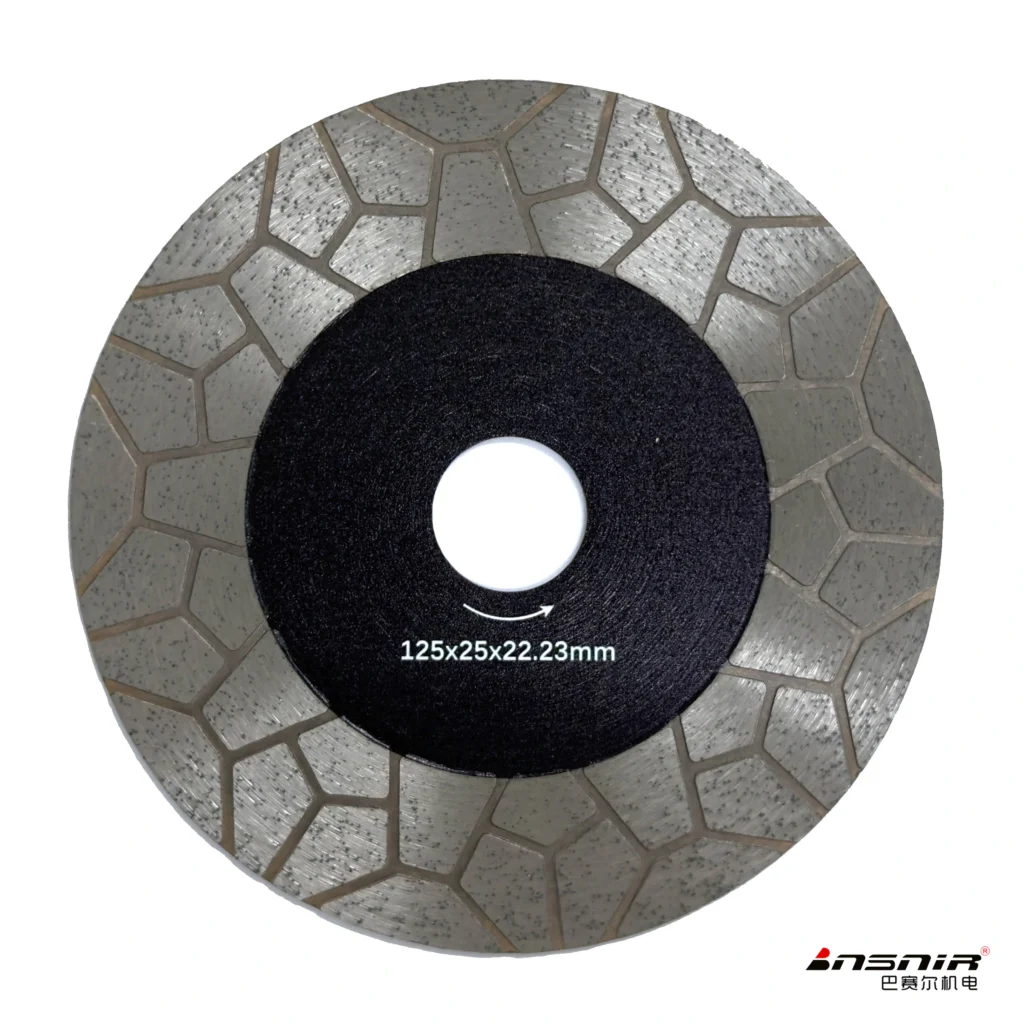
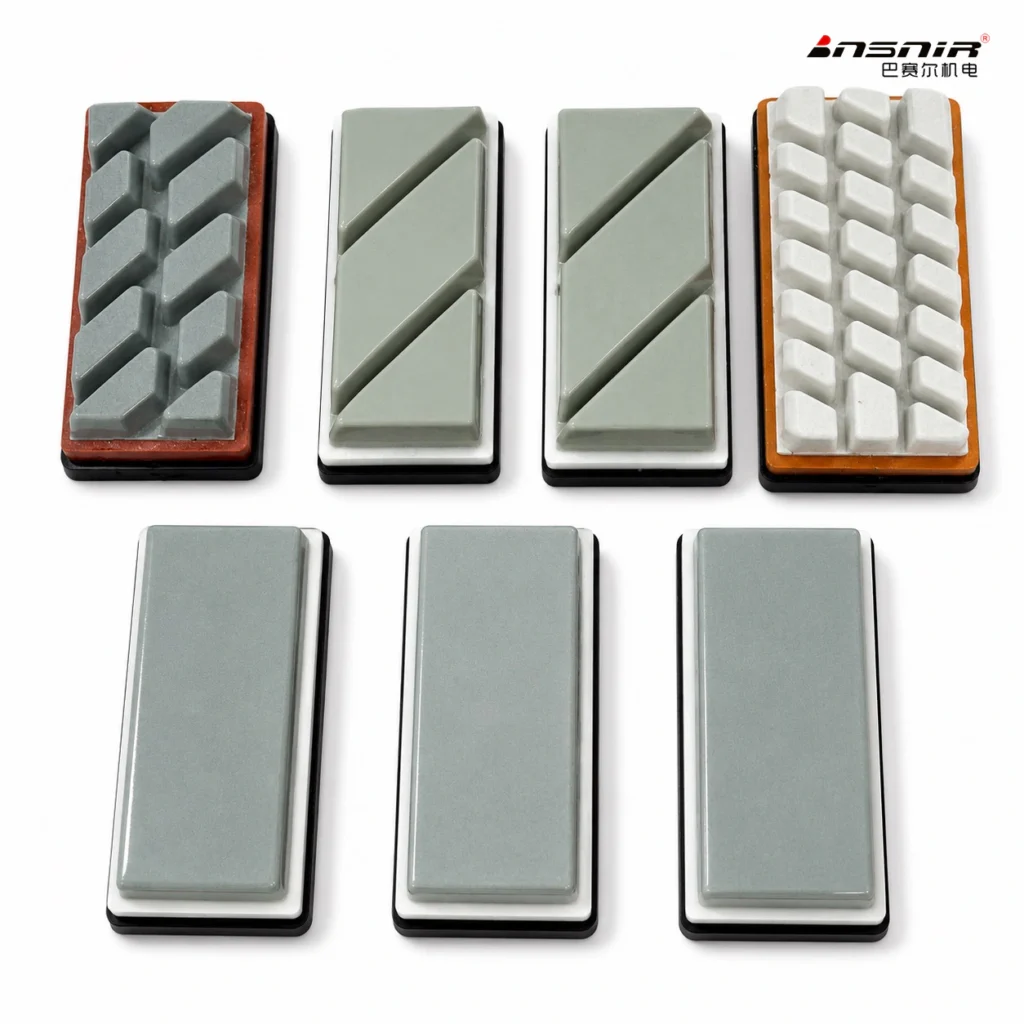
Where the mapped incoming-tile flatness and the support-and-transfer observations already point to an interface-side irregularity, adjusting machine settings to compensate addresses a symptom rather than the condition producing it — and that adjustment may need to be revisited every time tile sourcing or format changes, since it was tuned to compensate for an interface limit rather than to suit the tile. Where incoming flatness and transfer behavior have been confirmed stable across the formats in question, and a polishing result still varies, the evidence points toward machine-setting adjustment as the relevant lever rather than the interface. BASAIR’s project review of a ceramic tile line polishing machine configuration works from the incoming-tile and infeed evidence the project team supplies, since the configuration appropriate to one combination of format and infeed condition does not necessarily suit another. Keeping machine-adjustment potential analytically separate from incoming-tile quality and transfer-interface limits is what allows a polishing result to be traced to its actual source rather than corrected by trial substitution.
Acceptance evidence for stable infeed contact
Deciding that infeed contact is acceptable for production — rather than marginal or intermittently unstable — depends on which of the preceding evidence categories has actually been assembled, not on whether a single trial run looked satisfactory. A trial that produces acceptable polished results for one format, on one day, under unrecorded infeed conditions, does not constitute acceptance evidence for the line generally.
Where the incoming-tile flatness baseline has been mapped by format, where support, transfer, and tracking observations have been recorded at the positions where instability has appeared, and where polishing results have been compared for representative formats under documented infeed and polishing conditions, a project team has the basis to say which contact behavior belongs to the tile, which belongs to the transfer interface, and which responds to machine-setting adjustment. That basis is what supports an acceptance judgment that will hold as formats or tile batches change, rather than one that applies only to the specific samples tested.
Where any one of these three evidence categories is missing — no documented flatness baseline, no recorded support and transfer observations at the relevant positions, or no comparison of polishing results across formats under known conditions — an acceptance judgment based only on the remaining evidence risks attributing contact stability (or instability) to the wrong source. A line accepted on the strength of one format’s results may show different behavior once a different format or a different incoming-tile batch is run, if the format-dependence of support and transfer behavior was never checked.
For a project team preparing to confirm infeed contact as stable, the exact information still needed is whichever of these three categories has not yet been documented for the formats and conditions the line will actually run in production — not a general confidence that the line “looked fine” during a limited trial. Where the project’s existing line interface is already fixed and only the polishing configuration is open for review, as in reviewing a tile line polishing machine for a defined infeed and transfer setup, the incoming-tile and interface evidence becomes the input that configuration review has to work from, rather than a separate question to defer.
Frequently Asked Questions
Q: Should uneven polishing prompt an immediate machine-setting change?
A: First check whether the same variation is visible on tiles entering the line. If it is, separate that incoming condition from any change that appears during polishing; test a setting change only against representative tiles with the infeed and polishing conditions recorded.
Q: What if contact becomes unstable only with one tile format?
A: Treat that format as a separate trial case rather than applying its result to the whole line. Compare its incoming flatness and surface condition with its support and tracking observations, then check whether the proposed adjustment also works for the other required formats.
Q: Does instability at a transfer point prove that the transfer equipment is at fault?
A: No. The location identifies where to investigate, not the cause. Record tile condition before that point and observe support, transfer, and tracking on both sides of it under the same documented trial conditions before assigning a corrective action.
Q: How should a buyer define a useful infeed acceptance trial?
A: Agree on the tile formats, incoming-condition records, contact observations, and polished-surface outcomes to compare before the trial. Set project-specific acceptance criteria for those observations; a tile flatness test method does not itself establish a tolerance or guarantee for this line.