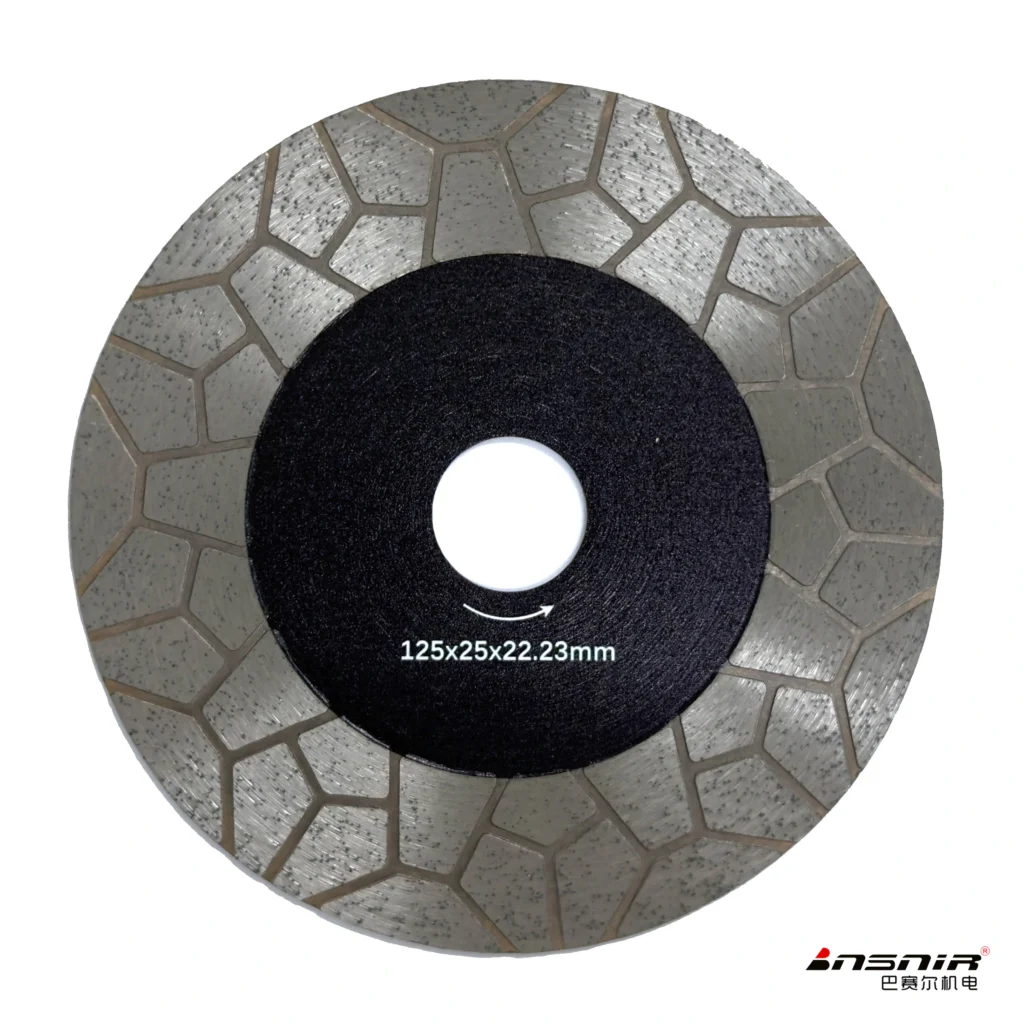
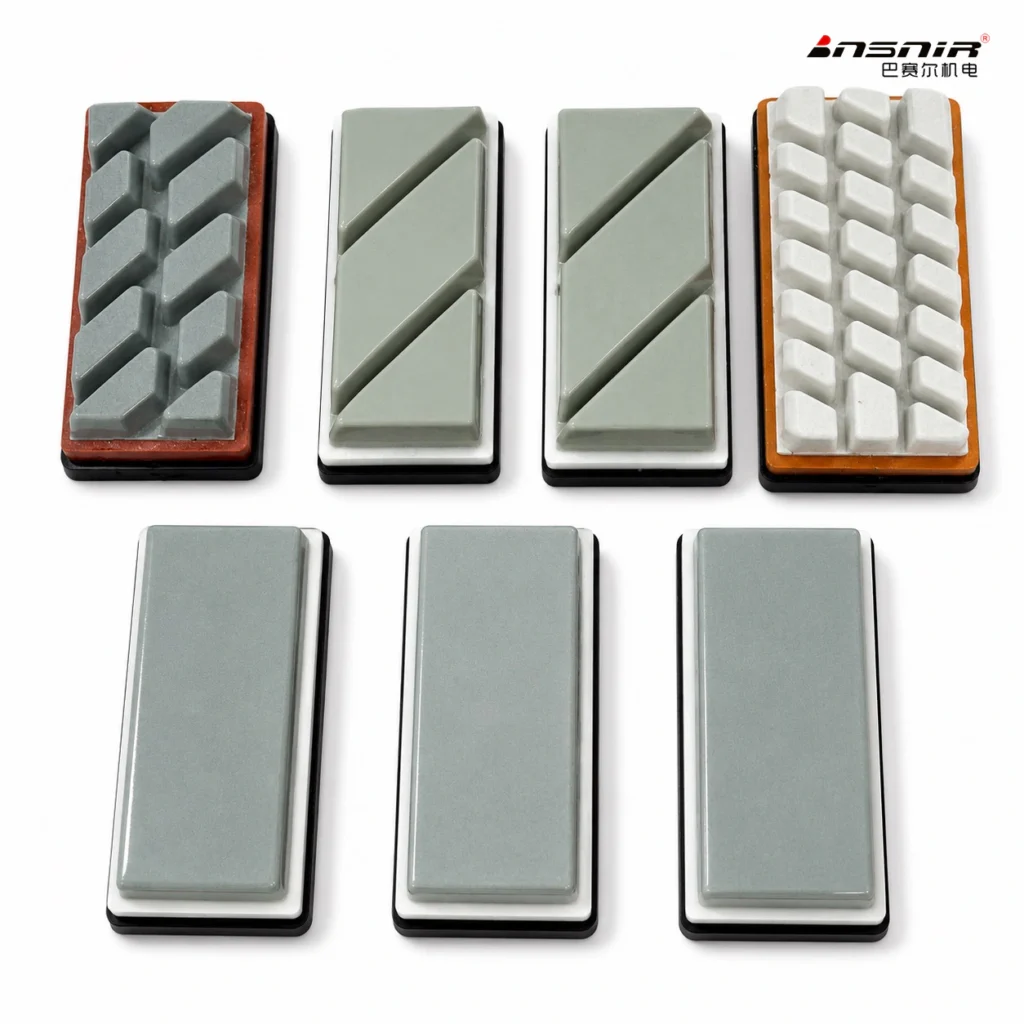
A squaring wheel that performs well on one tile format can behave differently on the next order if the body, the incoming edge, or the removal load has shifted. The practical question for a production or purchasing manager is not whether a wheel is labeled correctly for squaring duty, but whether its cutting action and finish have been confirmed against the specific tile and line conditions it will face. That confirmation has to start before a trial candidate is chosen, not after.
Tile and removal inputs that define the wheel duty
| Duty input | What to record | Selection boundary |
|---|---|---|
| Tile body | The actual body, including whether the range includes dense porcelain, glazed ceramic, or both | The same wheel label does not establish process fit across different tile bodies |
| Incoming edge condition | The actual edge condition and its variability | The trial must represent the edge variation expected in production |
| Removal per side | The actual removal required from each side | The candidate must be evaluated at the intended removal load |
| Required edge condition | The project-specific edge and finish target | Cutting action alone does not establish that the required finish is achieved |
The tile itself sets the baseline demand on any squaring wheel. Dense porcelain bodies generally require a different cutting action than glazed ceramic, because the bond and the diamond concentration that clear material efficiently in one body may wear, glaze, or chip differently in the other. Where a production range mixes both body types, or where a single body type still carries variable density between batches, the wheel’s duty is not one condition but a range of conditions, and a wheel proven on one part of that range has not been proven on the rest.
Incoming edge condition adds a second variable that is easy to underweight. A wheel that produces an acceptable result on a consistent, well-formed incoming edge may respond differently when the incoming edge varies in straightness or in the amount of material already lost to prior handling. If the actual production line delivers tiles with meaningful edge variability, the wheel candidate needs to be evaluated against that variability directly, not against a single best-case edge sample. A trial run on optimally prepared input tiles answers a narrower question than the production line will actually ask.
Removal per side is the variable that most directly determines cutting load. A wheel selected and configured for a light removal duty is being asked to do different work than the same wheel would do under a heavier removal requirement, because the volume of material removed per pass changes the heat generated at the contact zone, the wear rate on the abrasive layer, and the finish left behind. Recording the actual removal per side that the project requires, rather than an assumed or historical figure, is what allows a candidate wheel to be matched to the real duty instead of a similar one.
Finally, the required edge condition is the target the whole duty definition serves. A wheel can demonstrate strong cutting action and still fail to meet a project-specific edge or finish requirement if that requirement was not defined before the trial began. Cutting action and finish are related but not identical outcomes, and confirming one does not confirm the other. The buyer’s task at this stage is to write down the body, the incoming edge condition, the removal per side, and the required edge condition as a defined duty, because every later step in wheel selection depends on that duty being explicit rather than assumed.
Machine interfaces and utilities that limit the candidate set
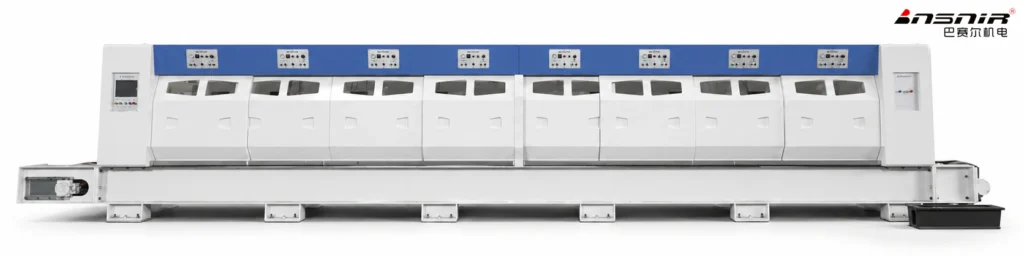
A tile body and removal duty define what the wheel needs to do; the machine interface defines what the wheel is physically permitted to do. Squaring and chamfering machines constrain candidate wheels through the mounting geometry, the available spindle configuration, the position sequence within the machine, and the cooling or dust-handling arrangement already built into the line. A wheel that matches the tile duty on paper still needs to fit the interface it will actually run in.
Cooling and dust arrangement matters because squaring is a material-removal process that generates heat and debris at the cutting zone, and the method used to manage that heat and debris changes the working environment the wheel experiences. A wheel configured with a bond and structure suited to one cooling or dust-handling arrangement is being tested under different conditions if the production line uses a different arrangement. Where the actual arrangement has not been recorded, a trial result risks describing performance under conditions the production line will not reproduce.
Wheel position within the machine sequence is a related constraint. A squaring and chamfering machine line typically runs multiple wheels in sequence, each handling a different stage of edge formation, and a wheel’s required cutting action changes according to where in that sequence it sits. A wheel positioned early in the sequence may be asked to remove more material under rougher incoming conditions, while a wheel positioned later may be asked to refine an edge that has already been substantially shaped. Selecting a wheel without confirming its intended position risks matching it against the wrong stage of the process.
These interface constraints narrow the candidate set before cutting performance is even considered. A wheel that is dimensionally or mechanically incompatible with the machine’s mounting or spindle configuration is not a candidate regardless of how well its abrasive characteristics might suit the tile duty. The buyer’s task here is to confirm which interfaces are fixed by the existing line and which remain open, because that determines whether the selection process is choosing among wheels that fit an established configuration or whether the configuration itself is still under review as part of the equipment and abrasive discussion.
Position-level cutting and finish requirements across the sequence
Cutting and finish requirements are not uniform across a squaring and chamfering sequence, even when the tile duty and the machine interface are both held constant. A position responsible for initial squaring is generally judged on how consistently and cleanly it brings a variable incoming edge to a controlled dimension, while a position further along the sequence may be judged on how well it refines geometry or prepares the edge for a subsequent finishing stage. Treating every position in the sequence as though it shares the same cutting and finish requirement risks approving a wheel for a task it was never actually tested against.
This distinction matters because a wheel’s cutting characteristics and its finish characteristics do not necessarily move together. A wheel configured for aggressive, consistent material removal at an early position may not be the right candidate for a later position where the priority shifts toward edge condition rather than volume of removal. Conversely, a wheel that produces a fine finish under light removal may not sustain that finish quality if asked to take on a heavier removal duty earlier in the sequence. The buyer’s task is to identify, for each position under review, whether the requirement being tested is primarily a cutting requirement, a finish requirement, or both, since a trial that only confirms one does not confirm the other.
Because these requirements are project-specific to the sequence design of the actual line, they cannot be generalized from a wheel’s nominal description or from its performance at a different position. A wheel description that references squaring duty in general terms does not establish which position within a specific sequence it was evaluated against. Confirming the intended position, and the cutting or finish requirement attached to that position, is a precondition for interpreting any trial result as relevant to the project rather than to a similar but distinct application.
Trial controls for speed, input tiles, and inspection
| Trial control | Condition to represent | Interpretation limit |
|---|---|---|
| Line speed | The actual production line speed | The result supports the speed condition represented in the trial |
| Input tile set | The representative tile range, including body and incoming-edge variability | One easy format does not represent materially different tile bodies or removal loads |
| Removal duty | The actual removal per side | A different removal load is outside the represented duty |
| Wheel position | The actual position in the machine sequence | Cutting action and finish are established only for the represented position |
| Cooling or dust arrangement | The actual production arrangement | A different arrangement is outside the represented trial condition |
| Inspection target | The required edge condition and project-specific finish target | Approval is limited to the target checked in the trial |
A trial is only interpretable if the conditions it represents match the conditions the production line will actually apply. Line speed is one of the more direct controls in this respect, because the interaction between a wheel and the tile edge changes with the speed at which tiles move through the squaring position; a wheel evaluated at a different line speed than the one the project will run has been evaluated under a different duty, even if every other condition matches. Where the production line’s actual speed has not yet been fixed, the trial result should be understood as conditional on whatever speed was used, not as a general statement about the wheel’s capability.
The input tile set used in the trial carries a similar constraint. A trial run on a narrow or particularly favorable selection of tiles establishes a result for that selection, not for the full range the production line will process. If the representative range includes both dense porcelain and glazed ceramic, or includes tiles with meaningfully different incoming-edge variability, the trial needs to include that range for its result to extend across it. This is where the earlier duty definition and the trial design need to stay connected: the tile inputs recorded before selection are the same inputs the trial should be built around.
Removal duty, wheel position, and cooling or dust arrangement carry forward as trial controls for the same reason they mattered as interface constraints — a trial conducted under a different removal load, a different position, or a different cooling or dust arrangement than the actual production condition is testing a related but distinct configuration. The inspection target closes the loop: without a defined edge condition and finish target to inspect against, a trial can confirm that cutting occurred without confirming that the result meets the project’s requirement.
The value of formalizing these controls is that it separates the conditions the trial confirms from the conditions the project still needs to verify separately. A structured approach to keeping these variables from mixing is what distinguishes a trial that supports a real decision from one that produces an ambiguous result. When BASAIR reviews a project’s configuration, the trial controls the buyer has already recorded — the tile inputs, the line speed, the removal duty, and the inspection target — are what allow that review to be matched against an actual duty rather than a general product description.
Approval boundaries for the represented production range
| Trial coverage | Approval supported by the trial | Boundary |
|---|---|---|
| One easy tile format | The tested format under the represented duty | Do not extend the result to materially different tile bodies or removal loads |
| Representative tile range | The bodies, incoming-edge variation, removal per side, wheel position, line speed, cooling or dust arrangement, and edge target represented in the trial | Conditions outside the represented range remain project-specific and require separate confirmation |
Approving a squaring wheel means approving it for the range of conditions the trial actually represented, not for the general category of tile the wheel might plausibly handle. A trial conducted on one easy tile format, run at a convenient removal load, produces a result that is valid for that format and that load. Extending that approval to a materially different body, a different incoming-edge condition, or a heavier removal duty treats an untested condition as though it had been confirmed, which is a different claim than the trial supports.
The boundary works in both directions. Where the trial genuinely represented the production range — covering the body variation, the incoming-edge variability, the removal per side, the intended wheel position, the actual line speed, the cooling or dust arrangement, and the required edge target all at once — the approval can reasonably extend across that represented range, because the conditions that would otherwise be unconfirmed have already been included in the test. Where the trial covered only a narrower slice of that range, the approval should be limited to that slice, and any tile falling outside it remains a separate question requiring its own confirmation.
This distinction has a direct bearing on how a buyer sequences the decision. If the production range is genuinely narrow — a single body, a consistent incoming edge, a fixed removal duty — a single trial covering that range can support a full approval. If the range is wider, the buyer has two options: expand the trial to represent that wider range before approval, or approve the wheel only for the segment actually tested and treat the remaining segment as still open. Neither option is inherently preferable; the choice depends on how much of the production range the trial was designed to cover and how tolerant the project is of running additional confirmation before full approval.
The equipment side of the project — the squaring and chamfering machine line itself — interacts with this boundary because the represented range is partly a function of what the machine was configured to run during the trial. A wheel approved under one machine configuration has not been approved under a different configuration, even if the wheel itself is unchanged. Keeping the approval scoped to the tile range, removal load, and machine configuration actually represented in the trial is what keeps the resulting decision defensible when the production line later encounters a tile or a condition the trial did not include.
Frequently Asked Questions
Q: Can one diamond squaring wheel selection cover both dense porcelain and glazed ceramic tiles?
A: Only if the trial represents both tile bodies under the intended production duty. A shared wheel label alone does not establish fit, so approval should remain limited to the bodies, removal loads, and edge targets actually checked.
Q: What should a buyer prepare before comparing wheel candidates?
A: Prepare the actual tile bodies and incoming-edge variation, removal per side, wheel position, line speed, cooling or dust arrangement, and required edge condition. These facts define the duty that each candidate must be tested against.
Q: How can a trial avoid confusing a wheel difference with a machine or tile-input difference?
A: Keep the recorded production conditions consistent for the comparison and document the exact input tile set, removal duty, wheel position, speed, utilities, and inspection target. If several of these change together, the result cannot clearly support a wheel-selection decision.
Q: Does a satisfactory result at one line speed support approval at another speed?
A: No. The result supports only the speed condition represented in the trial, together with its associated tile range, removal duty, machine position, cooling or dust arrangement, and finish target.
Q: When should a buyer plan a separate confirmation trial?
A: Plan one when the production range introduces materially different tile bodies, incoming-edge conditions, removal loads, wheel positions, line speeds, cooling or dust arrangements, or edge targets. Those conditions fall outside the original represented duty until checked separately.