
Define the system from water sources, reuse duties and discharge limits
- Input
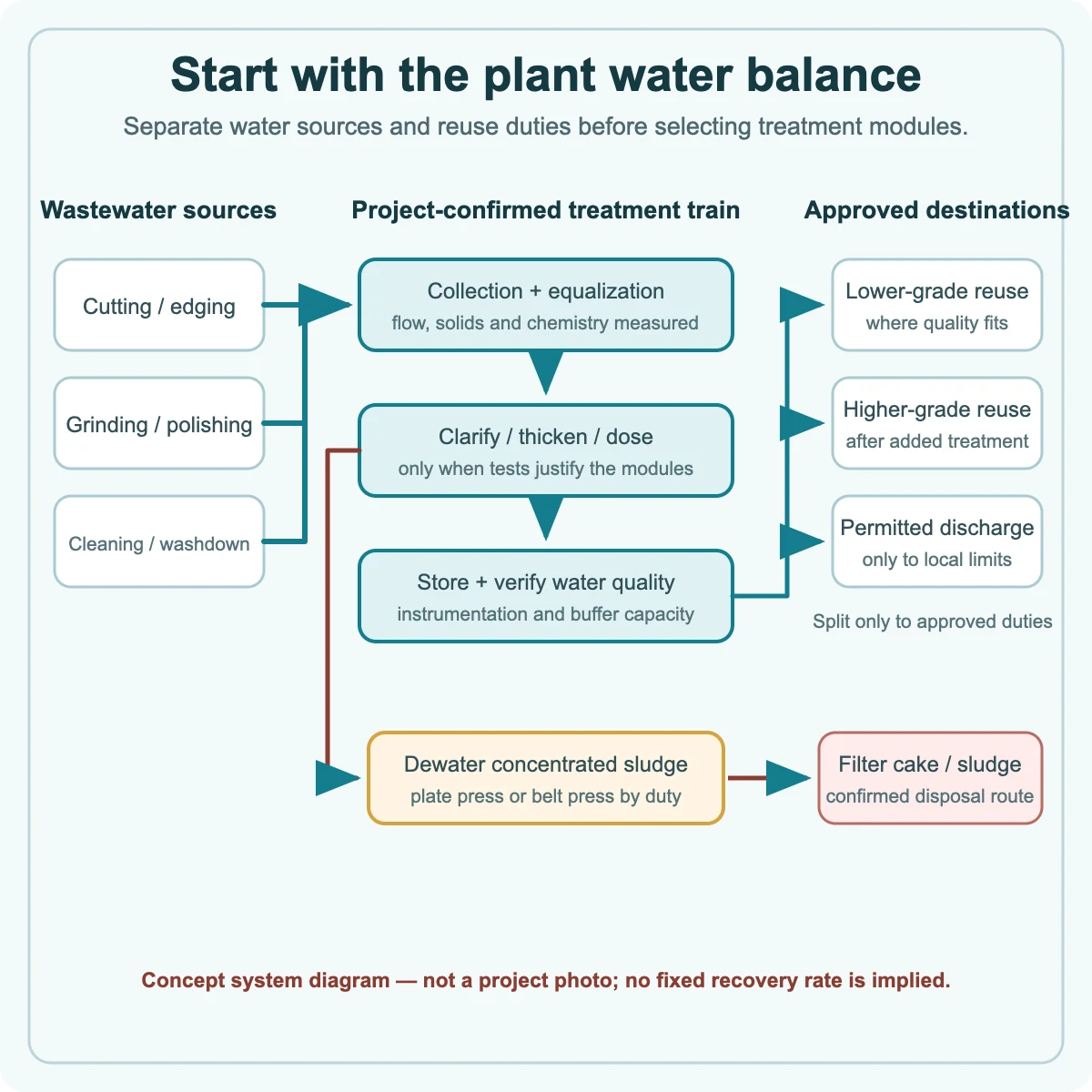
- A plant water balance covering each wastewater stream, flow and peak, solids, particle size, chemistry, operating schedule, current tanks and the water-quality requirement at every proposed reuse point.
- System action
- Separate or combine compatible streams, buffer the variation, remove or concentrate solids, dewater the sludge, store clarified water and route verified water only to duties whose quality requirements it meets.
- Output
- Project-defined reuse-water streams, filter cake or concentrated sludge with a confirmed disposal route, make-up water demand and any permitted discharge. There is no universal recovery percentage or outlet-water specification.
- Buyer
- Ceramic plants that can supply operating data and samples and need an engineering basis for integrating known dewatering modules with project-selected upstream and downstream treatment.
- Exclusion
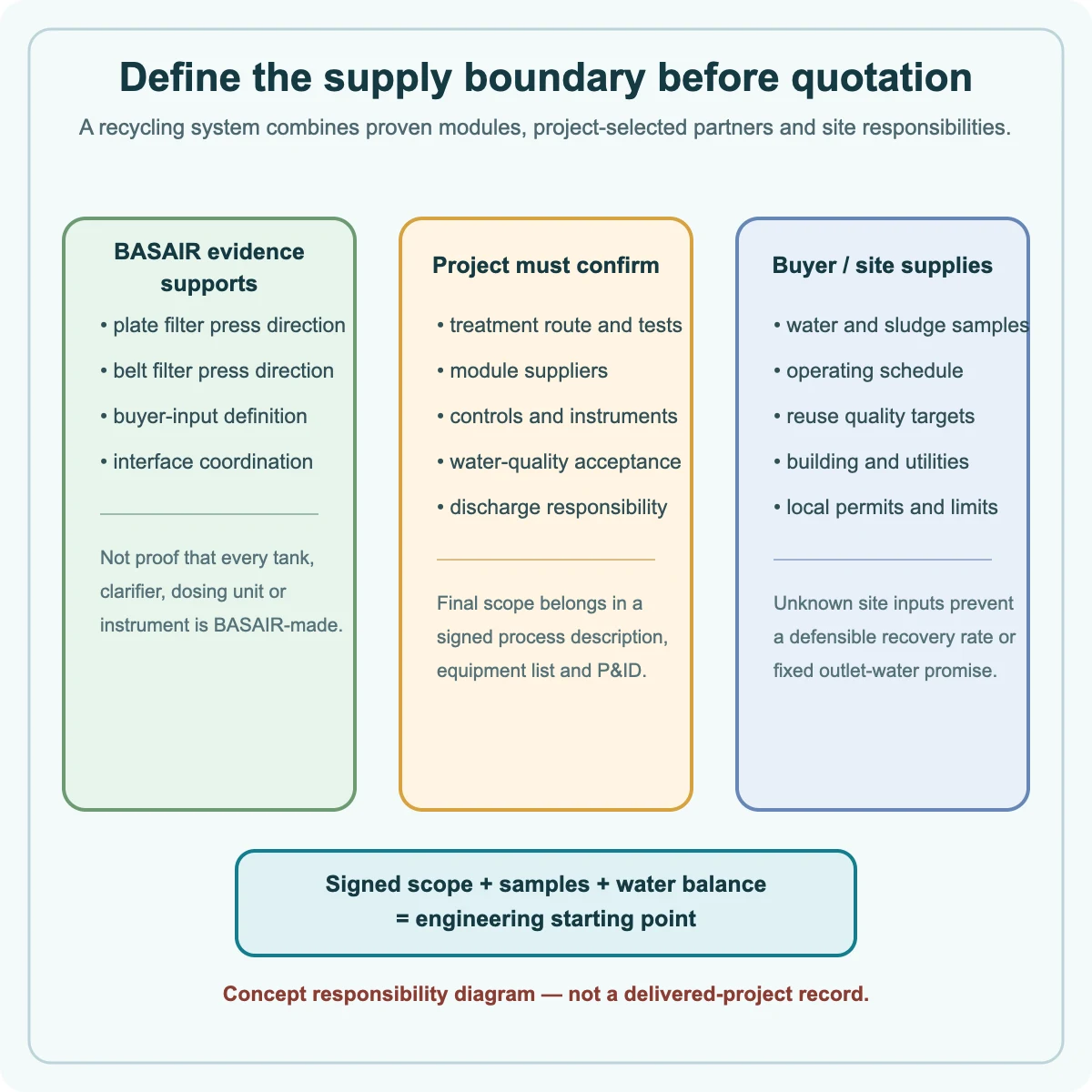
- This is not a fixed packaged model, a zero-liquid-discharge promise, a guarantee that every wastewater stream can be reused, or proof that all tanks, clarifiers, dosing units and instruments are manufactured by BASAIR.
Build the water balance before choosing equipment
Cutting, grinding, polishing and washdown water can carry different solids loads, sizes and chemicals. Combining every stream may simplify piping but can make treatment and reuse harder. Separating streams can preserve a cleaner fraction for simpler reuse, but adds tanks, controls and operating discipline. The route must be selected from samples and a mass-and-water balance, not from a generic flow diagram.
| Stream / duty | Data to measure | Decision it supports | Acceptance boundary |
|---|---|---|---|
| Cutting / edging wastewater | Hourly and peak flow, solids, particle distribution, pH, salts, additives and temperature. | Separate or mix; required buffering; sedimentation, clarification or direct dewatering route. | Water quality required by the exact cutting or cooling circuit. |
| Grinding / polishing wastewater | Abrasive fines, glaze/body solids, chemical residues, daily load and batch variation. | Need for coagulation/flocculation tests, thickening and filter selection. | Clarity, particle and chemistry limits at the selected reuse point. |
| Washdown and intermittent peaks | Cleaning schedule, peak volume, detergents, floor debris and stormwater separation. | Equalization volume, bypass/hold logic and whether a stream must be isolated. | No untreated overflow outside the approved site plan. |
| Reuse-water duty | Flow, pressure, temperature and limits for suspended solids, chemistry and microbial condition where relevant. | Direct reuse, added filtration/treatment or make-up-water blending. | Project-specific test method at each reuse point. |
| Sludge / filter cake | Dry solids, particle/chemical composition, cake target, handling and disposal requirements. | Batch plate press, continuous belt press or another project-confirmed route. | Handling, storage and legal disposal/reuse responsibility. |
Known BASAIR source directions: dewatering modules, not the whole plant
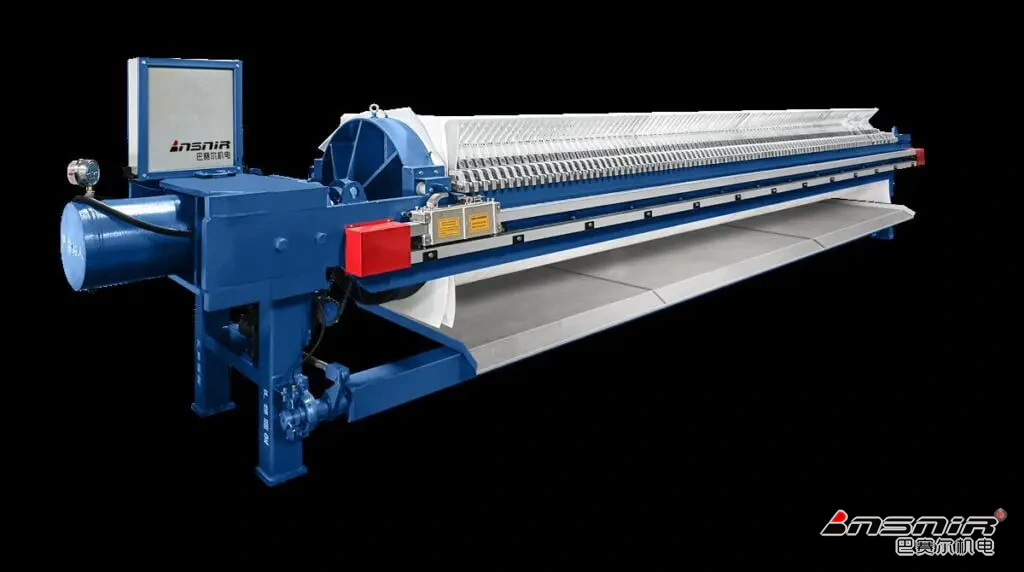
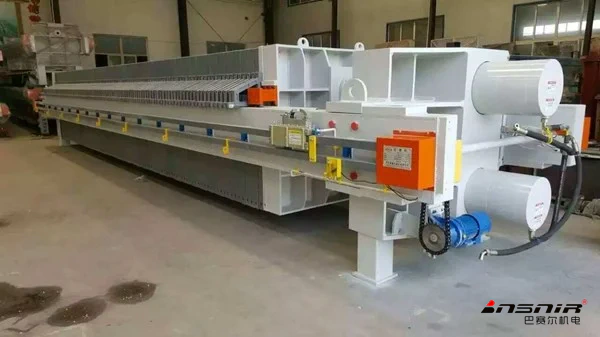
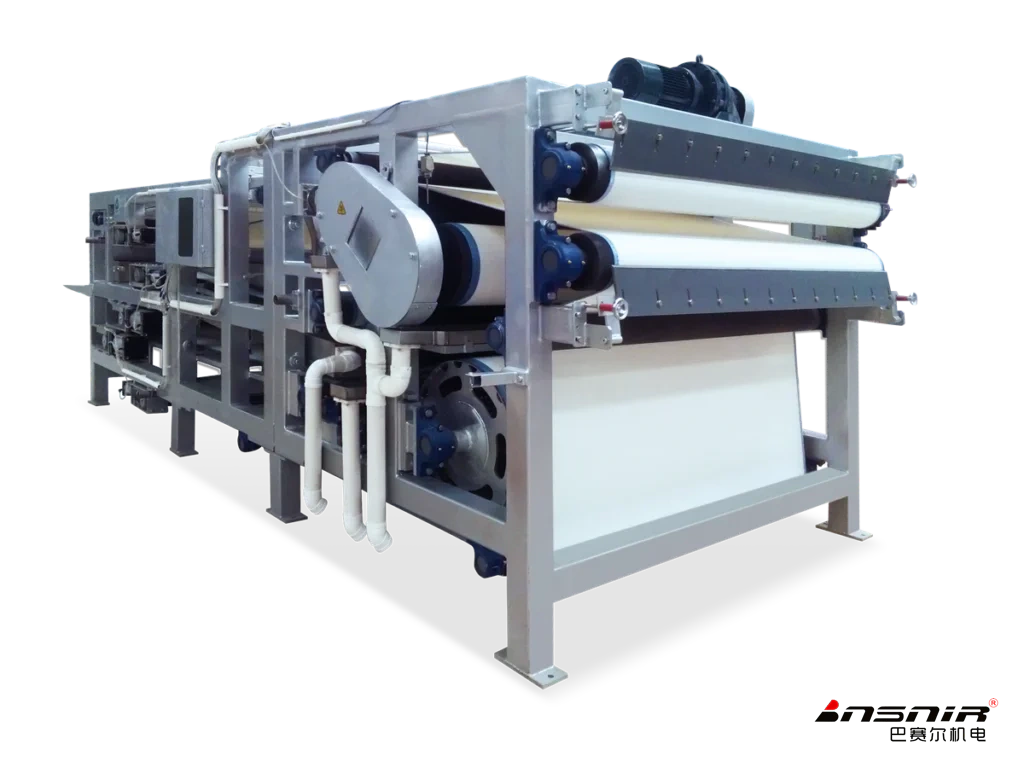
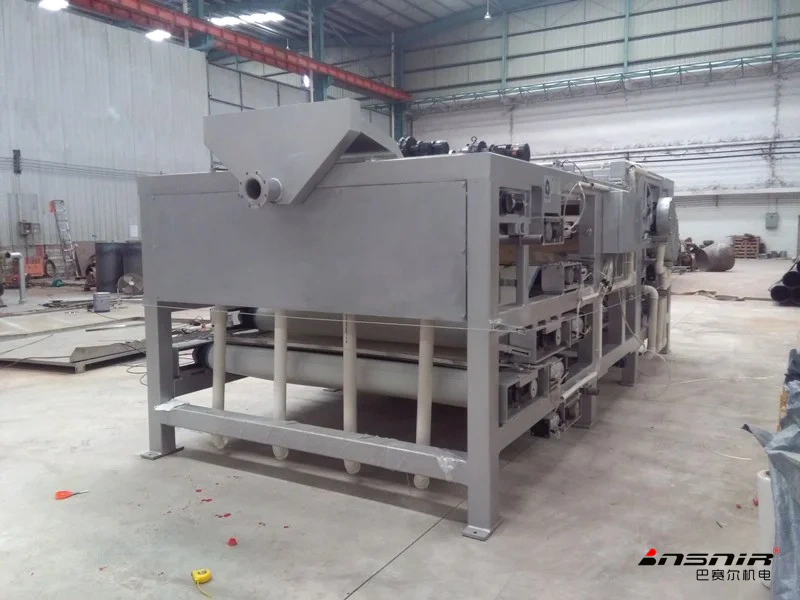
BASAIR-owned source pages support plate-and-frame filter-press and belt-filter-press product directions. They can anchor the sludge-dewatering part of a project, but they do not prove the final thickener, chemical dosing, tank, pump, instrumentation, reuse-water polishing or discharge scope.
Confirm each module and its responsibility
| Module decision | When it may be needed | What must remain project-confirmed |
|---|---|---|
| Collection and equalization | Flows or solids vary by machine, recipe, shift or cleaning event. | Tank responsibility, volume, mixing, materials, level control, overflow and civil works. |
| Clarification / thickening | Settling tests support separation of clearer overflow and concentrated underflow. | Supplier, structure, hydraulic loading, flocculant, overflow target and underflow control. |
| Chemical preparation / dosing | Jar tests show that conditioning improves the selected separation step. | Chemical/SDS, storage, preparation, maturation, dose control, containment and operator safety. |
| Sludge dewatering | Solids must leave the water loop as a manageable cake or concentrated product. | Plate or belt route, feed conditioning, batch/continuous duty, filtrate return, cake target and handling. |
| Reuse-water storage and polishing | Process demand is intermittent or a reuse point requires tighter water quality. | Buffer volume, additional filtration/treatment, instruments, sanitation where relevant and acceptance tests. |
| Discharge and residuals | A fraction cannot be reused or is lost through cake, evaporation, product and cleaning. | Local limits, permits, sampling, recordkeeping, residual disposal and responsible party. |
Use adjacent equipment pages without assuming unconfirmed modules
- Start from dust, sludge and water treatment equipment when the environmental-system boundary is not yet defined.
- Compare the batch filter press and continuous belt filter press by the actual slurry, cycle and cake duty.
- A vacuum ceramic disc filter, slurry thickener or clarifier, flocculant dosing system and homogenization or water tanks remain project-confirmed responsibilities; their inclusion is not implied by this page.
- Use the slurry dewatering and water reuse solution to coordinate the plant-wide route and interfaces.
Information required for a project water review
Please submit the following as one water-balance package rather than isolated equipment enquiries:
- Every water source and destination, with average, peak and daily flow by shift and recipe.
- Representative samples and laboratory data: suspended solids, particle distribution, settling, pH, salts/conductivity, temperature, chemicals and any reuse-sensitive contaminants.
- Water-quality requirement and demand pattern at each proposed reuse point; current make-up water and actual discharge.
- Current tanks, pumps, treatment units, pipe routes, elevations, layouts, controls and known bottlenecks.
- Sludge/cake target, storage, transport and legal disposal or reuse responsibility.
- Electric power, compressed air where required, wash water, drainage, ventilation, chemical handling, access, lifting and maintenance conditions.
- Local discharge limits, permits, sampling duties, site safety requirements and the responsibility matrix among buyer, BASAIR and any project partners.