
A filter press dewaters slurry in batches by filling a plate pack, separating liquid through filter media and forming solids into cakes. The press is one node in a slurry and process-water system. It must be selected from representative slurry data, batch volume, filtration behavior, cake handling and the required filtrate or return-water interface.
For the wider separation between dust collection, sludge dewatering and water reuse, start with dust, sludge and water treatment.
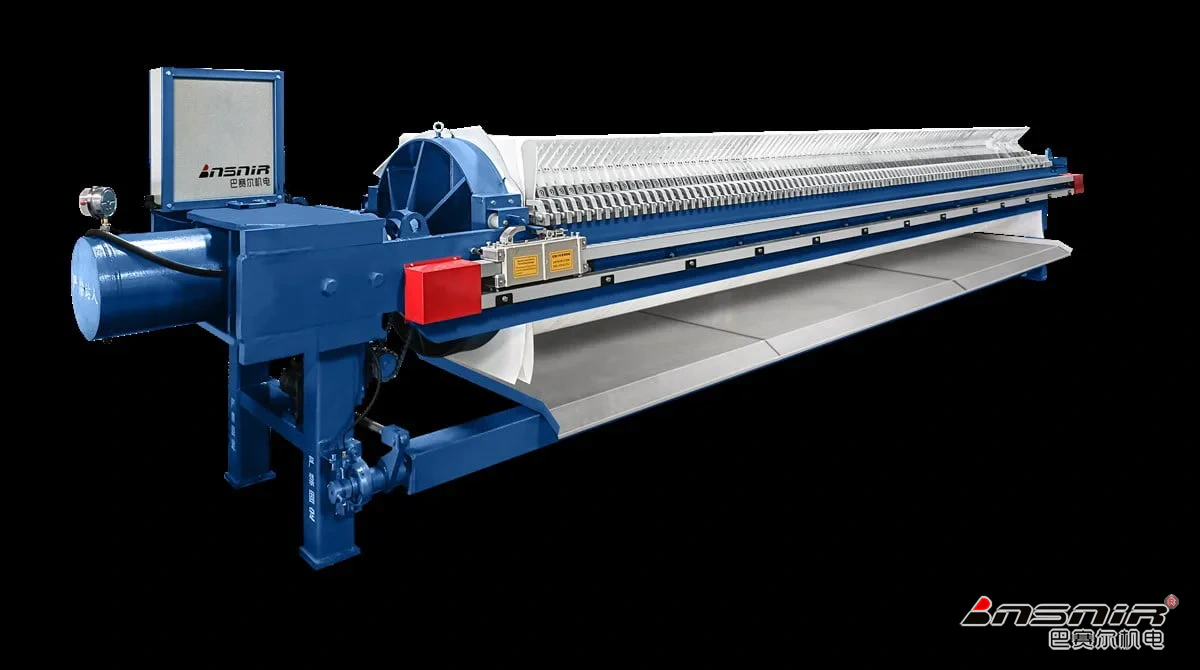
Define both outputs: cake and filtrate
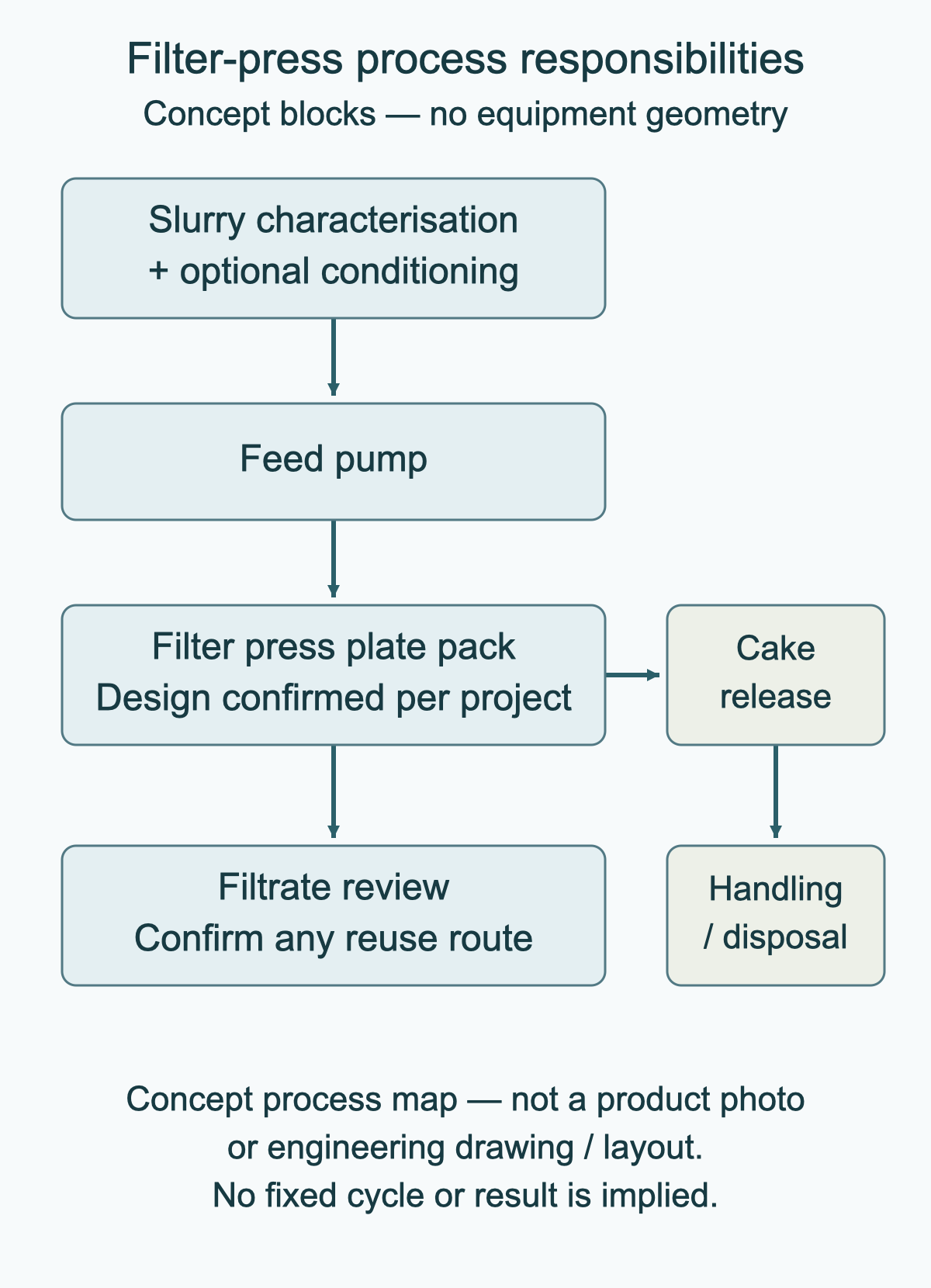
- Receive and condition slurry: collect a representative feed and keep solids sufficiently uniform for the batch.
- Feed the closed plate pack: the pump and control sequence fill the chambers under the selected conditions.
- Separate liquid: filtrate passes through the cloth and exits through the plate/manifold route.
- Complete the cycle: any additional squeeze, air blow or washing step applies only when included and validated.
- Open and discharge: release cakes, inspect cloth and prepare for the next batch.
- Route outputs: move cake for disposal or reuse and send filtrate to the confirmed tank or treatment step.
Use representative slurry, not a generic solids percentage
Provide the process source, flow and shift profile, solids concentration range, particle-size information, density, temperature, pH or relevant chemistry, abrasiveness and settling behavior. A single grab sample may not represent startup, cleaning, product changes or the end of a shift. The test plan should state how the sample was collected and mixed.
| Input | Why it matters | Project decision | Acceptance record |
|---|---|---|---|
| Solids and particle behavior | Affects filtration rate, cloth choice, cake release and pump duty | Test sample, cloth, chamber and conditioning route | Feed sample identity and test conditions |
| Batch volume and schedule | Defines required chamber volume and number of cycles | Press size, feed tank and operating schedule | Actual batch volume and complete cycle time |
| Cake handling target | Determines whether cake can release, move and meet its next step | Discharge height, tray/conveyor, labor and container | Cake condition measured by the agreed method |
| Filtrate destination | Controls tank, piping, monitoring and any further treatment | Return, clarification or discharge boundary | Filtrate observation/test under the agreed sampling method |
Select the plate pack and cloth as one filtration assembly
Confirm plate type, chamber depth, plate size and count, feed arrangement, cloth material and weave, gasket or sealing arrangement, manifold, wash access and the method used to shift plates. The filter cloth is not a universal consumable; its compatibility and release behavior must be reviewed against the slurry and cleaning method.
If a membrane squeeze, core blow, cloth wash or automatic cake-discharge function is proposed, list it separately with its utility and control interfaces. Do not assume those functions from the term “filter press.”
Compare the full batch cycle, not only filling time
Record closing, feeding, pressure development, filtration end point, optional treatment steps, depressurization, opening, plate shifting, cake release, cloth inspection/cleaning and preparation for the next batch. Labor and variability often sit outside the nominal filtration period.
No fixed cake moisture or capacity is promised here. Those results depend on representative slurry, conditioning, cloth, plate/chamber design, feed system, cycle endpoint and the agreed measurement method.
Connect the press to the surrounding water system
- Feed or equalization tank volume, agitation and low/high-level signals.
- Feed-pump curve, materials, control method and clean-out route.
- Filtrate tank, return-water quality requirement and further treatment if needed.
- Wash-water supply and wastewater destination for cloth or floor cleaning.
- Cake drop height, tray, conveyor, container and vehicle/forklift access.
- Electrical, hydraulic and compressed-air requirements for the selected functions.
The planned thickener and clarifier, flocculant dosing, slurry and water tanks and process-water recycling pages cover adjacent modules that remain project-specific. The complete route belongs to slurry dewatering and process-water reuse.
Information to send for filter-press selection
- Process source, slurry flow by shift and batch/continuous collection pattern.
- Representative sample data, solids range, particle information and chemistry.
- Existing tanks, pump, piping and floor plan.
- Required cake condition and the method used to measure or judge it.
- Cake destination, container, discharge height and available labor.
- Filtrate destination and required return-water or discharge condition.
- Available power, water, air, drainage and maintenance/plate-removal clearance.
- Required operating schedule and preferred automation level.