
A belt filter press is a continuous-feed mechanical dewatering machine that brings conditioned slurry through gravity drainage and progressively applied belt/roller pressure, then discharges separated cake while the belts are washed for reuse. Feed conditioning, belt behaviour, wash water, filtrate collection and continuous cake handling must be selected as one operating route.
BASAIR reviews belt-press configurations for the actual ceramic or stone-process slurry. Selection starts with representative feed information and conditioning trials, rather than a promised cake-moisture number. Feed variation, flocculation, belt choice, operating adjustment and downstream handling determine the appropriate configuration and test plan.
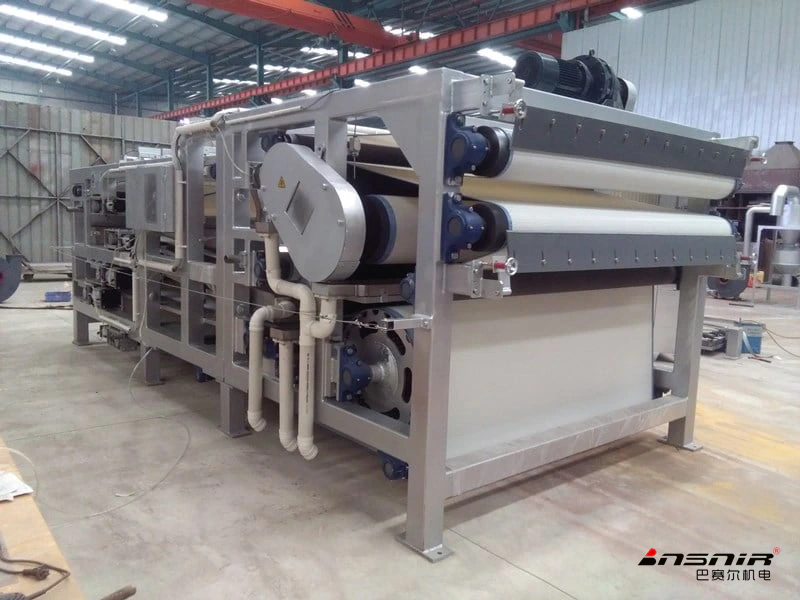
Follow the continuous route from feed to cake
Continuous operation requires more than a moving belt. Establish a sufficiently controlled feed and a conditioning arrangement that produces a drainable floc for the selected press. Gravity drainage removes freely draining water before the material enters the pressure stages. The belts then carry the material through progressively loaded zones; cake leaves the belts at the discharge boundary, and belt washing supports the next pass.
| Stage | Process responsibility | Confirm for selection |
|---|---|---|
| Continuous feed and flocculation | Present a controlled slurry feed and establish conditioning before drainage. | Flow/solids variation, feed pump, representative samples, chemical trial, mixing and conditioning time. |
| Gravity drainage | Release freely draining water while keeping conditioned solids on the belt. | Drainability, floc stability, feed distribution, belt medium and drainage collection. |
| Progressive pressure | Apply increasing mechanical loading through the selected belt/roller arrangement. | Belt speed, tension, roller arrangement, feed condition and trial-based operating settings. |
| Continuous cake discharge | Release cake to a defined conveyor, bin or other agreed handling route. | Cake release/handling behaviour, discharge height, removal duty and destination. |
| Belt washing and return | Clean the belt medium and collect wash drainage before the next pass. | Wash-water quality and duty, spray/cleaning access, collection, drainage and maintenance. |
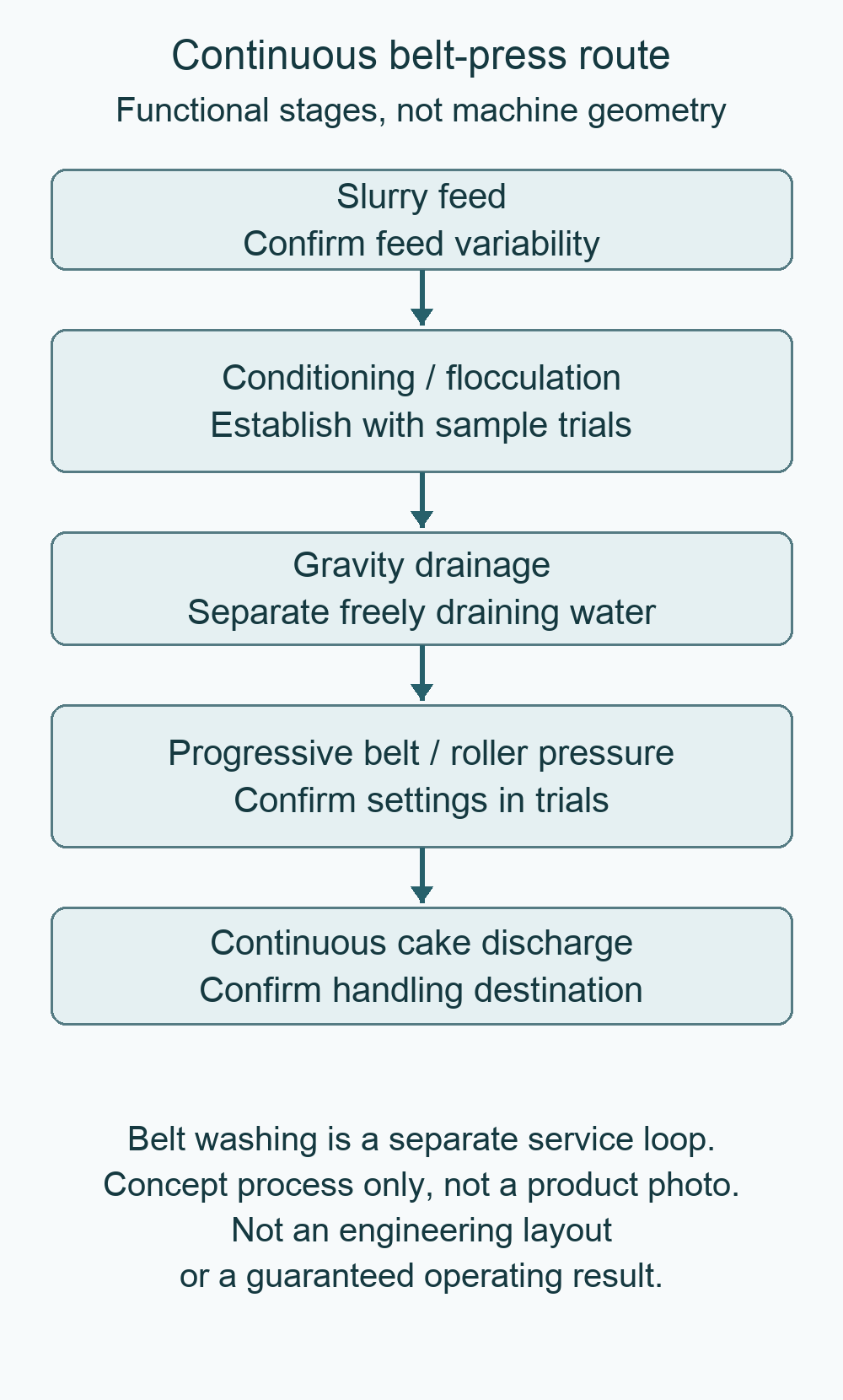
Choose the operating route, not a headline dryness claim
| Decision | Belt filter press | Batch plate filter press |
|---|---|---|
| Operating pattern | Coordinated continuous feed, drainage, pressing, washing and cake removal. | Defined fill/press/discharge cycle and enough upstream storage for that cycle. |
| Feed preparation | Drainable conditioned feed and controlled variation are central to the belt route. | Feed pump, plate/cloth arrangement and batch testing establish the appropriate route. |
| Service and handling | Continuous washing, drainage and cake handling must remain available during operation. | Plate access, cloth maintenance and batch cake removal need a defined working space. |
| Evidence for acceptance | Use representative slurry, a documented test method, agreed handling/filtrate criteria and operating conditions. Neither route has one universal cake-moisture result. | |
For a batch route, compare the slurry filter press. A vacuum ceramic filter uses a different filtering and separation route; it is not another name for a belt press. This page does not specify that alternative or imply that a machine can switch between those principles.
Confirm feed variability and flocculation with representative trials
Provide average and peak flow together with solids concentration and its variation. A liquid-flow figure without solids data does not describe the dewatering load. Include source processes, particle information, temperature, chemistry, interruptions and changes between products or shifts.
Use representative samples to establish whether and how chemical conditioning is required, including chemical selection, preparation, dose range for trials, mixing and floc behaviour under drainage and pressure. The final recipe is not copied from another plant. Keep the flocculant preparation and dosing system as an explicit supply and control interface, rather than assuming that a complete chemical package is included with every press.
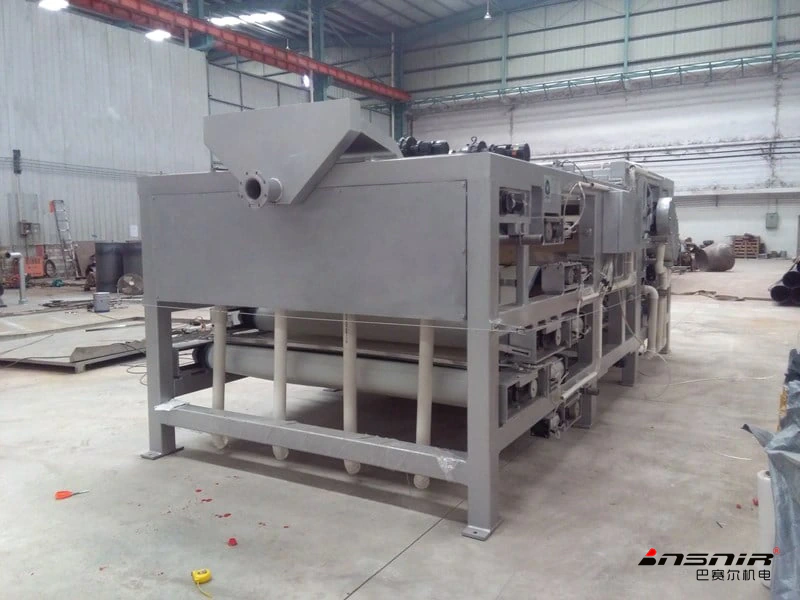
Select the belt and keep tension and tracking within the agreed operating setup
Specify belt medium, width, seam and replacement method against the feed and trial requirements. Confirm the roller arrangement and access, drive and speed-adjustment provision, belt tensioning and correction method, monitoring and response to tracking faults. These are configuration questions, not features inferred from the reference photographs.
Increasing tension or changing speed alone is not a reliable answer to poor cake release or drainage. Check feed variation, conditioning, distribution, belt cleanliness, roller condition and tracking together. Record settings and material conditions during trials so the acceptance discussion can be repeated under a defined duty.
Keep wash water, filtrate and continuous cake removal explicit
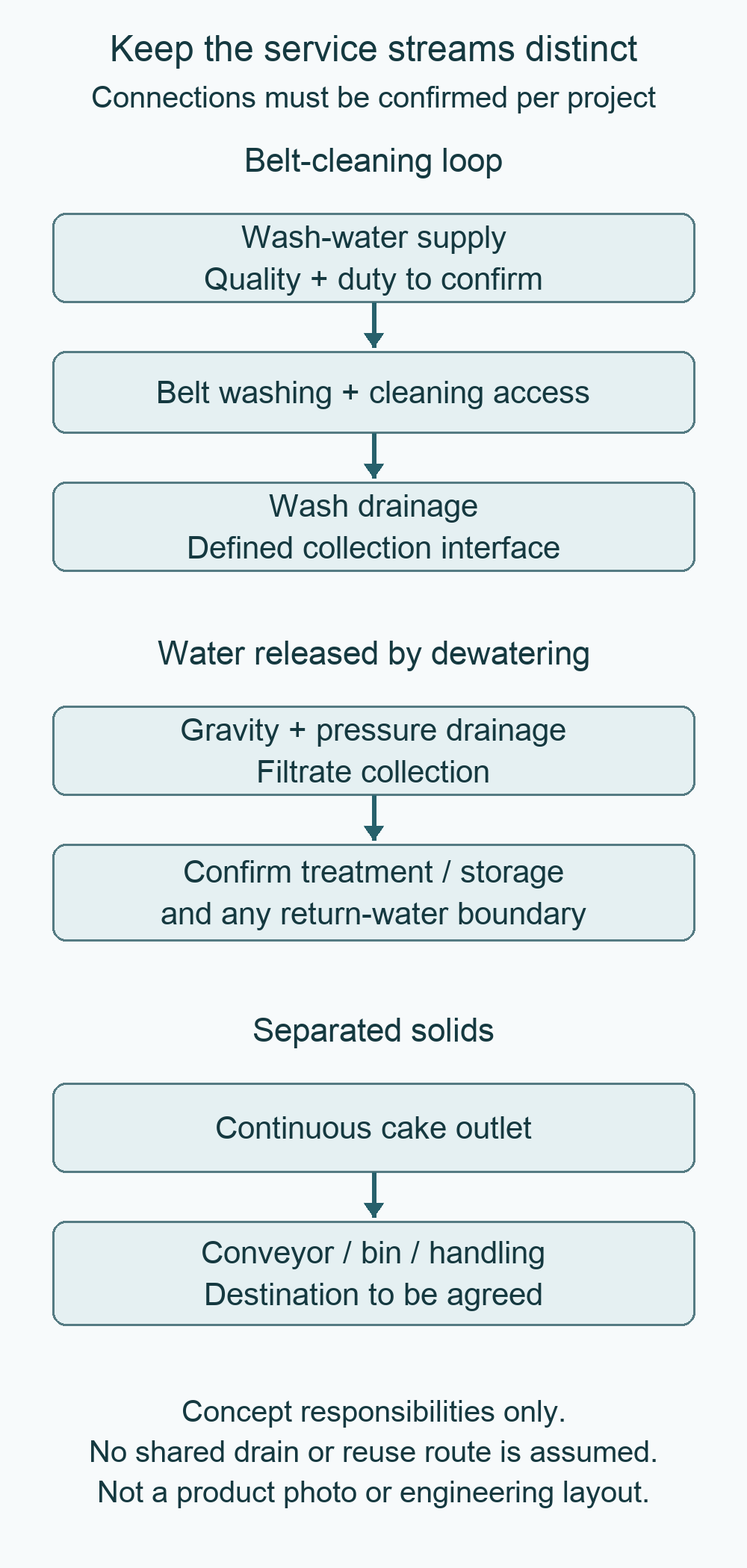
Confirm the required wash-water supply quality, pressure/flow duty, connection and availability for the selected washing arrangement. Define spray and cleaning access, wash drainage, process filtrate collection and where each stream goes. Do not assume that every drain can be combined or that filtrate is automatically suitable for direct process reuse.
Agree how cake leaves the machine continuously: conveyor or bin boundary, discharge height, duty, access and destination. Cake handling should be tested against the customer’s disposal or reuse task; this page promises no fixed moisture or material classification.
| Module | Boundary to confirm |
|---|---|
| Conditioning and dosing | Chemical supply/preparation, maturation, metering, mixing, control and operator responsibilities; actual suitability and supply need confirmation. |
| Slurry and water tanks | Buffer volume, mixing, levels, pumps, overflow and raw/filtrate/clean-water separation; confirm the actual tank/agitation supply. |
| Process-water recycling | Site water balance, quality at each return point, treatment, storage and discharge responsibilities; neither reuse ratio nor discharge acceptance is implied by the press. |
Plan operation, maintenance and the full working footprint
Include shift pattern, operator access and time for cleaning, inspection, belt changes, roller/bearing service and maintenance. Confirm the safe stop/isolation arrangement in the offered machine documentation. The layout must also cover feed/chemical equipment, wash-water services, drainage, conveyors or bins, lifting and removal routes; the machine outline alone is not the total working footprint.
For a complete route around the press, see the slurry dewatering and process-water reuse solution. Upstream buffering, chemical systems and the return-water arrangement remain independently confirmed project modules.
Information required for belt-press selection
- Slurry source, average/peak flow, solids concentration and variation across products and shifts
- Representative material samples, particle information, temperature and chemistry
- Conditioning/flocculation tests, chemical preparation and mixing information where available
- Continuous duty hours, interruptions, operator coverage and planned maintenance periods
- Requested belt/roller arrangement, belt medium/width and replacement requirements, or details of an existing press
- Tensioning, tracking, drive/control and monitoring requirements
- Wash-water supply, quality and connection; wash drainage and process-filtrate collection routes
- Required cake handling, discharge height, conveyor/bin boundary and destination
- Tank/pump/chemical interfaces, electrical and other utilities, drainage, foundation and working footprint
- Reuse points and quality requirements, overflow/discharge boundary, location and agreed sample-test/acceptance method
Request a belt-press selection review
Final feed range, conditioning, belt/roller arrangement, settings, wash-water duty, cake and filtrate results, utilities and acceptance depend on the actual slurry, trials, selected configuration and engineering confirmation.