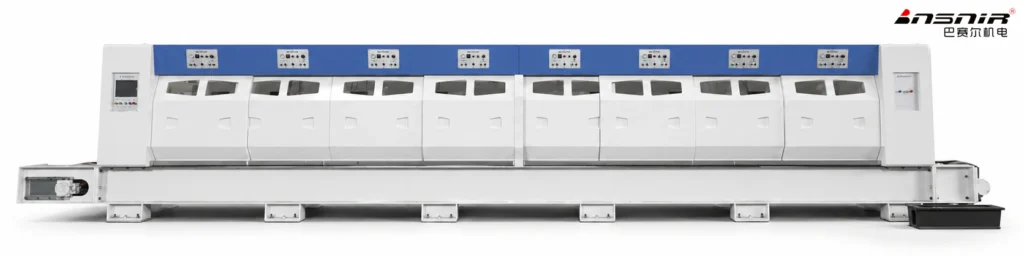
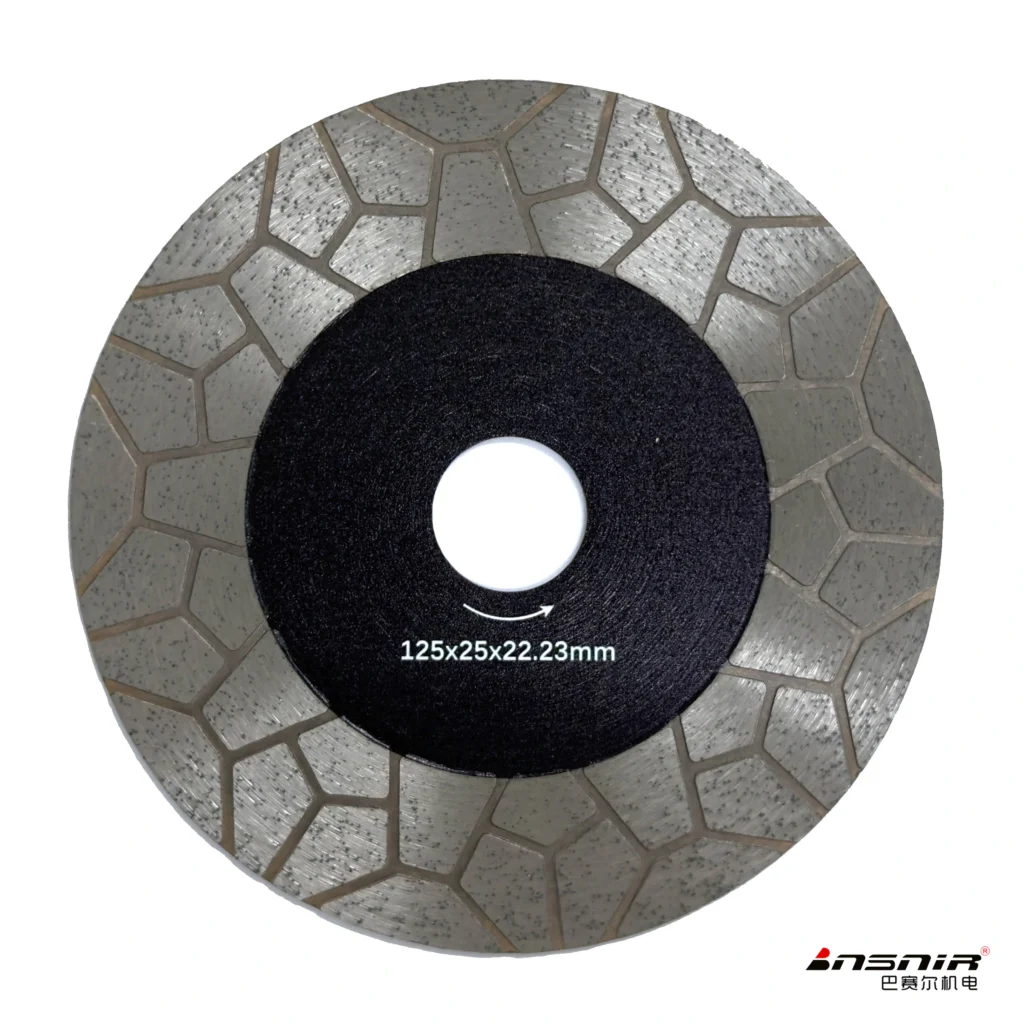
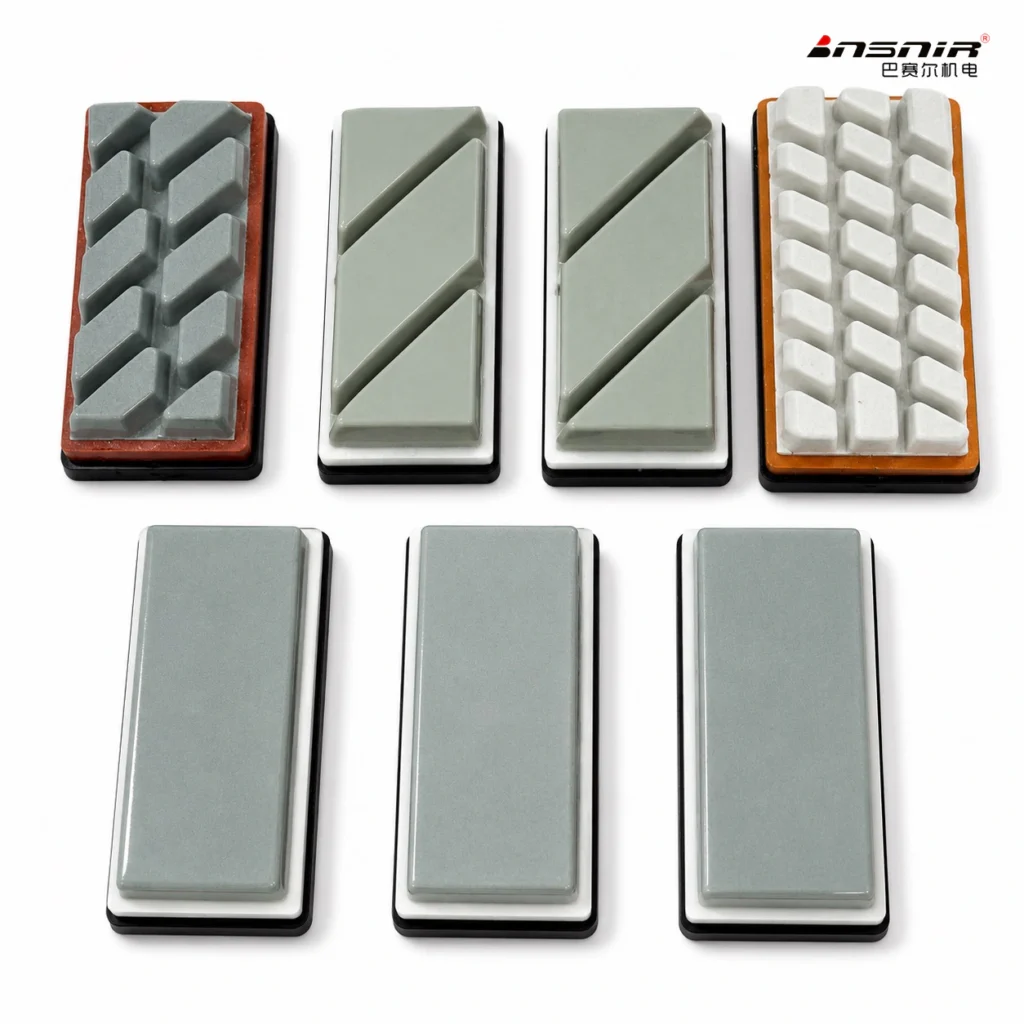
A worn Fickert brush does not announce its failure point. It degrades gradually in contact pattern and cutting behavior, and the finish it produces drifts with it, often slowly enough that the production team adjusts around it before anyone asks whether the brush itself has reached the end of its service life. Deciding when to pull a brush rather than compensate for it again is a judgment that depends on what the line is actually recording at each position, not on a generic sense that “it’s been a while.”
Finish changes that indicate a brush is nearing replacement
A Fickert brush works by presenting an abrasive face to the tile surface under controlled pressure, and as that face wears, the geometry of contact changes even where the brush still appears serviceable. The first signal available to a process team is rarely a dramatic failure; it is a shift in the finish itself — a change in texture, a change in how uniform the surface looks across the width of the tile, or a change in how the gloss or matte effect compares to what the line produced earlier in the run.
Where the brush wears evenly across its working face, the finish tends to drift gradually, and the main symptom is a slow departure from the approved finish target rather than a sudden defect. Where wear is uneven — because of how the brush was mounted, how the line was set up, or how pressure is distributed across positions — the symptom is more likely to show as variation across the tile width rather than a uniform drift. These are different patterns and point toward different causes, so recognizing which one is present is the first step, not the conclusion.
Uneven contact also changes how the brush engages the tile surface over time, and once contact becomes uneven, further wear tends to reinforce the unevenness rather than correct it. This matters for timing: a brush that is drifting uniformly can often be tracked against a finish limit and replaced on a planned basis, while a brush producing uneven contact may need earlier attention because the condition does not self-correct with continued operation.
A gloss check, such as a 45-degree specular gloss measurement consistent with ASTM C346, can quantify part of what “finish” means for a given product line, but a gloss value on its own does not establish a replacement threshold — it describes one dimension of the finish, and the boundary for that dimension has to be set by the project’s own approved finish limit, not by the test method itself. The practical task at this stage is noticing that something has changed, not yet deciding why.
Track profile, accepted area, and position-level interventions
| Item tracked by installed position | What to record | Decision use |
|---|---|---|
| Accepted area | Accepted production area since the brush was installed | Supports interval planning, but does not establish a production replacement trigger by itself |
| Texture checks | Texture result against the approved finish limit | Shows whether the required finish remains within the agreed boundary |
| Visual variation | Finish variation across the tile width | Reveals finish drift or uneven output that may require investigation |
| Brush profile | Current wear profile | Connects physical wear with changes in contact, finish, or process stability |
| Position-level interventions | Each adjustment or other intervention at that position | Shows whether repeated intervention is needed to maintain output |
| Load-related symptoms | Observed load symptom and the line behavior at the time | Helps determine whether process conditions accompany the finish or stability change |
Recognizing a finish change is different from building the evidence needed to act on it. A single observation — one unusual texture check, one visibly uneven tile — does not establish whether a brush is wearing out or whether something else on the line shifted. What supports a replacement decision is a record built at the level of the installed position: the specific brush in the specific slot, tracked over the production it has actually done.
Accepted area since installation gives a basis for planning, because it lets the team see how much production a brush has supported relative to others in similar positions. But accepted area by itself does not say whether the brush is still performing to the approved finish limit — a brush can accumulate production and still be within limits, or it can accumulate comparatively little and already show problems, depending on tile mix and line conditions. This is why area has to be read alongside texture checks and visual variation rather than used alone.
The physical wear profile of the brush connects these observations to a mechanism. Where the measured or observed profile has changed in a way that lines up with the texture or variation findings, the case for wear as the cause strengthens. Where the profile looks largely unchanged but the finish has still shifted, the cause more likely sits elsewhere on the line, and that distinction changes what the team should check next.
Interventions at a given position — adjustments made to hold the finish within limits — are themselves evidence. A position needing repeated adjustment to stay acceptable is behaving differently from one that holds its setting without intervention, even if both are currently producing acceptable tiles. Recording each intervention, along with any load-related symptom observed on the line at the time, lets the team see whether the need for adjustment is increasing at that position specifically, which is a different signal from an isolated one-off correction.
Distinguish normal wear from setup or tile-input changes
| Possible source of the change | Evidence pattern to check | Replacement implication |
|---|---|---|
| Normal brush wear | Finish drift, uneven contact, or repeated interventions aligns with a changing brush profile at the installed position | Brush replacement remains a supported explanation, subject to the approved finish limit and repeated-run confirmation |
| Setup change | Finish or output changes with setup intervention or load-related symptoms rather than with the brush profile alone | Resolve the setup contribution before treating the observation as a brush replacement trigger |
| Tile-input change | Variation follows the tile mix or other tile-input change instead of a repeatable position-level wear pattern | Confirm the trigger for that tile mix rather than transferring a replacement point from different input conditions |
A finish change that looks like brush wear is not always brush wear, and treating it as such without checking the alternative explanations risks replacing a brush that was not the cause, while leaving the actual source unaddressed. The useful distinction is between three sources of a given change: the brush’s own wear, a setup condition on the line, and a change in the tile input itself.
Where the evidence pattern shows finish drift, uneven contact, or repeated interventions tracking the brush’s own wear profile at that installed position, brush wear remains a supported explanation — but it still needs to be confirmed against the approved finish limit and ideally against more than one production run before it is treated as settled.
Where the change instead tracks a setup intervention or a load-related symptom rather than the brush profile, the setup condition needs to be resolved first. A brush profile that has not meaningfully changed, paired with a finish shift that appeared at the same time as a setup adjustment, points toward the setup as the driver rather than the brush. Replacing the brush in that case would not address the actual cause, and the same finish problem could reappear with the replacement brush in place.
Where the tile mix or another tile-input property has changed, variation can appear that has nothing to do with the installed brush’s condition at all — it follows the input rather than a repeatable, position-specific wear pattern. This matters because a replacement trigger established under one tile mix does not automatically transfer to a different mix; the finish behavior that a given brush produces is conditioned on what is being processed, not just on the brush’s own wear state. Where the input has changed, the project needs to confirm the trigger for that specific mix rather than carrying over a boundary set under different conditions. Separating these three sources before assigning a cause is what keeps the eventual replacement decision tied to its actual driver.
Set a production trigger against the approved finish limit
| Decision dimension | Evidence to compare | Project-specific replacement boundary |
|---|---|---|
| Finish consistency | Texture checks and visual variation | Replace when the approved finish limit is crossed |
| Brush profile and contact | Wear profile and uneven contact across the tile width | Replace when the agreed profile or contact boundary is crossed and the change affects finish or process stability |
| Process stability | Repeated adjustments, load-related symptoms, and unstable output across the tile width | Replace when the agreed stability limit can no longer be maintained for the applicable line conditions |
| Accepted output | Accepted area recorded for the installed position | Use the accumulated area for planning; confirm the production trigger against the tile mix, approved finish limit, and line behavior |
Once a change has been observed, tracked by position, and checked against setup and tile-input explanations, the remaining task is translating that evidence into a trigger — a defined point at which the brush is replaced rather than monitored further. This trigger is necessarily project-specific, because it depends on the approved finish limit the buyer has set, the tile mix being run, and how the line behaves under the buyer’s own operating conditions.
Finish consistency, as shown through texture checks and visual variation, gives the most direct link to the trigger: where either crosses the approved finish limit, the case for replacement is established on finish grounds alone, independent of how much accepted area the brush has produced or how long it has been installed.
Brush profile and contact behavior provide a second, related basis. Where the wear profile or the contact pattern across the tile width crosses an agreed boundary — and where that crossing is shown to affect finish or process stability — replacement is supported even if the finish measurement at that moment has not yet drifted outside limits, because the profile condition indicates the finish is likely to follow.
Process stability is a third basis, distinct from a single finish reading. Where repeated adjustments are needed to hold output within limits, or where load-related symptoms accompany unstable output across the tile width, the line is already absorbing cost in the form of intervention effort even if individual tiles still pass. A stability-based trigger addresses that condition directly rather than waiting for a finish failure to appear.
Accepted area remains useful for planning purchases and scheduling changeouts, but it functions as a planning input rather than a production trigger on its own. A fixed interval built from accepted area can anticipate when a brush is likely to need review, but the actual decision to replace still needs confirmation against the tile mix, the approved finish limit, and how the line is behaving at that point — which is why project-specific configuration information, rather than a generic interval, is what a supplier such as Basair would need in order to help set a trigger appropriate to a given line and tool combination.
Condition monitoring frameworks such as ISO 17359 describe general guidelines for structuring this kind of monitoring and maintenance planning, but they do not supply a brush-specific changeout threshold or inspection interval — that boundary has to come from the project’s own finish limit and line evidence, not from the general standard.
Validate the replacement point on repeated runs
A trigger confirmed on a single run carries less weight than one confirmed across repeated runs, because a single instance cannot distinguish a genuine, repeatable replacement point from a one-off condition caused by something outside the brush itself — a transient setup issue, an unusual tile-input batch, or a load condition that did not recur. Validating the trigger means checking whether the same position-level evidence — finish behavior, profile change, and intervention pattern — reproduces when the brush reaches a comparable point again, whether that is measured by accepted area, by observed profile, or by elapsed production.
Where the same finish limit is crossed at a comparable point across more than one run, under comparable tile-mix and setup conditions, the trigger gains support as a genuine property of that brush-and-line combination rather than an artifact of one run’s particular circumstances. Where the crossing point varies substantially between runs under otherwise similar conditions, that variation itself is informative — it suggests the trigger is sensitive to a condition that has not yet been identified and controlled for, and the setup-versus-tile-input check becomes relevant again before the trigger can be treated as settled.
This validation step also interacts with how equipment and abrasive performance are evaluated together on a line. A brush and the equipment positions it runs in — the squaring, chamfering, or polishing interfaces it is matched to — jointly determine the contact and load conditions the brush experiences, so a trigger validated on one line configuration does not automatically carry over to a differently configured one, even with the same nominal brush type installed. Where a project changes its line configuration or its matched tooling, such as moving to a different Fickert brush specification for ceramic and stone finishing, the validation work has to be repeated under the new configuration rather than carried forward from the prior setup. Confirming the trigger across repeated runs, under the specific conditions the buyer intends to operate, is what turns an observed pattern into a decision the production team can rely on.
Frequently Asked Questions
Q: Should I wait until a Fickert abrasive brush looks fully exhausted before replacing it?
A: No. Replace it earlier if its wear profile is causing finish drift, uneven contact, repeated adjustments, or unstable output to cross the agreed production limit. Visible condition alone should not override the approved finish and process boundaries.
Q: Can accepted production area be used as the sole replacement trigger?
A: No. Accepted area is useful for planning an inspection or expected interval, but the production trigger should also reflect texture checks, visual variation, brush profile, interventions, and line behavior for the applicable tile mix.
Q: How can I tell whether a finish change is caused by brush wear rather than setup or tile input?
A: Look for a repeatable position-level pattern linking the finish change to a changing brush profile. If the variation instead follows a setup intervention, load-related symptom, or tile-mix change, resolve or account for that factor before assigning the cause to brush wear.
Q: What information should be recorded for each installed brush position?
A: Record accepted area, texture-check results, visual variation across the tile width, the current brush profile, each position-level intervention, and any load-related symptoms with the line behavior at the time. Compare these records against the approved finish and stability limits on repeated runs.
Q: Can a replacement point established for one tile mix be applied to another?
A: Not without validation. Confirm the trigger for the new tile mix against its approved finish limit and the line behavior, because a replacement point derived under different input conditions may not transfer reliably.