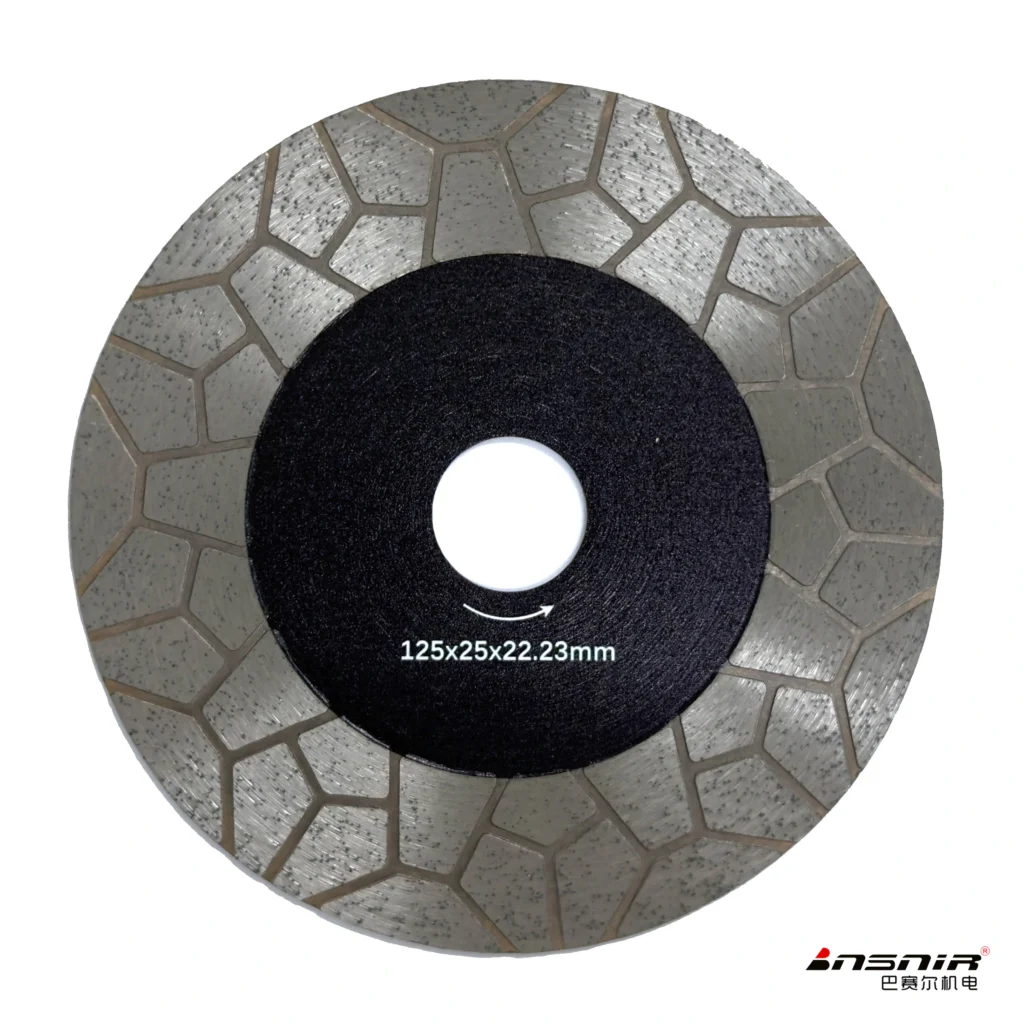
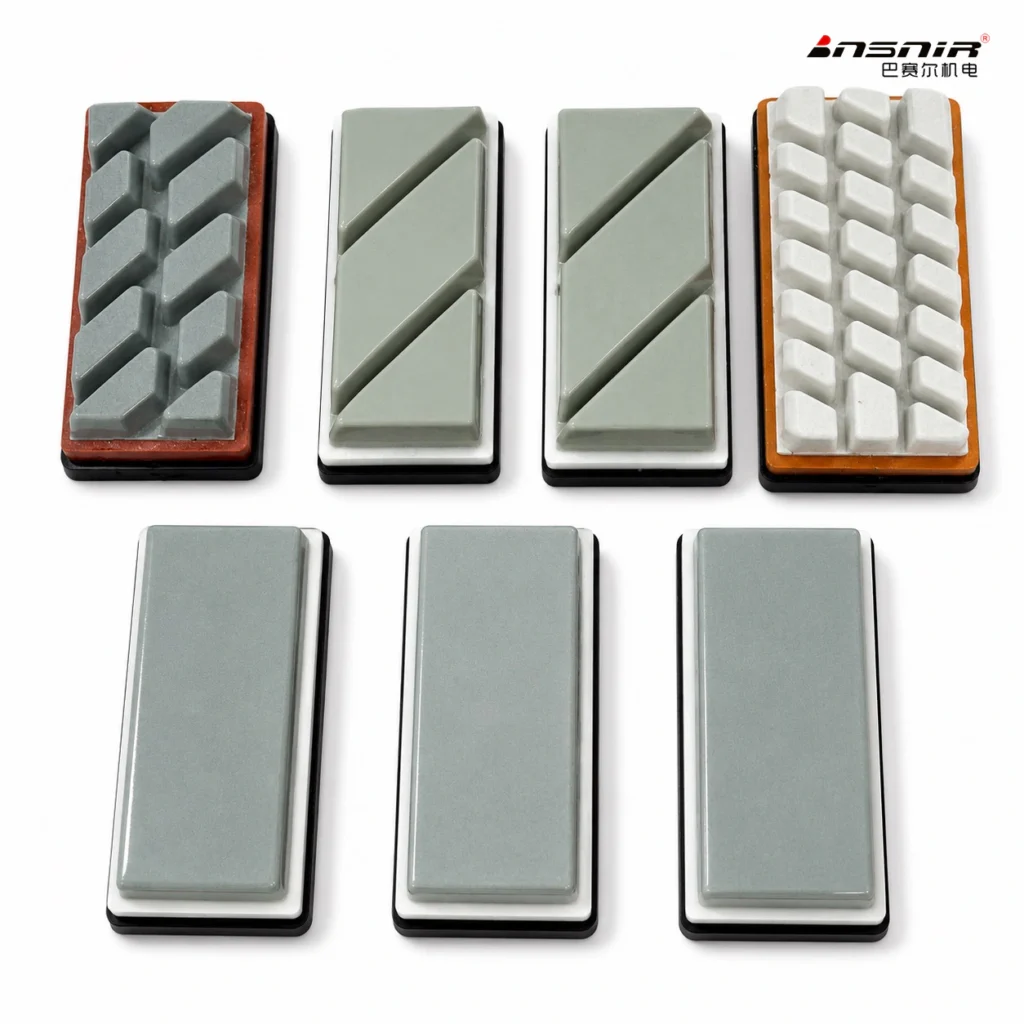
A diamond polishing pad and a buffing pad can look similar in a parts catalog, and both can appear in the final stages of a tile finishing line, but assigning the wrong one to a position in the sequence changes what the line actually produces. The practical question is not which pad is “better” in isolation — it is which surface condition each tool is meant to receive and which condition it is expected to hand off. Getting that boundary wrong either leaves correction work undone or asks a buffing stage to fix a problem it was never built to solve.
Surface condition that separates correction from final buffing
The dividing line between a correction duty and a final buffing duty is not the pad’s name or its listed grit range — it is the condition of the surface arriving at that position in the line. A surface that still carries the project-defined material-removal duty is not ready for buffing, regardless of how fine the pad mounted at that station happens to be. Conversely, a surface that has already been brought to the condition refinement is meant to deliver should not be routed back through a correction-oriented tool, because that tool’s action is calibrated for a rougher input than what it will actually receive.
This matters because the same physical pad construction can be asked to perform different duties depending on where it sits in the sequence and what surface it meets there. A pad manufacturer’s label describes a product family, not a fixed role. Where the incoming surface still shows the marks and texture associated with open material removal, any pad placed there is functioning as a correction tool in practice, whatever its catalog description says. Where the incoming surface has already closed that gap, the same pad construction may instead be performing a refinement or buffing duty. The boundary is defined by the surface state at the interface, not by a fixed position in a standard sequence.
This creates a direct consequence for how a line is configured. If the buyer treats “correction,” “refinement,” and “buffing” as interchangeable labels rather than as sequential duties with distinct input and output conditions, adjacent tools can end up with overlapping assignments — two stations each partially completing the same work — or with a gap, where no station in the line is actually responsible for closing a particular part of the transition. Either outcome shows up downstream as inconsistent gloss, uneven texture, or marks that persist further into the line than expected.
What the buyer needs to confirm before assigning pads to positions is the actual surface condition at each interface: what the tool upstream delivers, and what the tool downstream is designed to accept. This is a sequence question before it is a product selection question. A pad chosen correctly for its material and bond type still fails its purpose if it is placed at a point in the line where the incoming surface does not match what that pad’s action assumes.
Refinement duties between early removal and final appearance
| Sequence duty | Surface received | Surface delivered | Acceptance boundary |
|---|---|---|---|
| Material correction | Surface with the project-defined material-removal duty still open | Corrected surface ready for refinement | Correction ends before refinement and final buffing duties begin |
| Surface refinement | Surface leaving material correction | Surface condition ready for final buffing, assessed through visible marks, gloss response, texture, and stability across the tile | Refinement closes the gap between early removal and final appearance without taking over the final buffing duty |
| Final buffing | Surface leaving refinement | Final appearance assessed against the approved finish target | Buffing does not absorb unfinished correction or refinement duties |
Surface refinement occupies the zone between a surface that has finished material correction and a surface that is ready for final buffing — and this is where a diamond polishing pad most commonly earns its place, because its abrasive action is suited to closing that particular gap rather than performing either of the duties on either side of it.
The refinement duty is defined by what it receives and what it must deliver, not by a single visual check. A refining pad takes a surface that has already had its correction work completed and brings it to a condition where final buffing can proceed without having to compensate for unfinished refinement work. That handoff condition is assessed across several dimensions at once: the visible marks left on the surface, how the surface responds to light once some gloss begins to develop, the texture the pad leaves behind, and whether that result holds consistently across the full tile rather than only at a sample point.
Each of these dimensions can shift independently, which is why none of them alone confirms that refinement is complete. A pad can close visible marks acceptably while leaving texture inconsistent across the tile, particularly where tile surface variation or uneven pressure across the pad’s contact area is present. Where that happens, the final buffing stage inherits a surface that is not uniformly ready, and the buffing tool is then forced to either absorb that inconsistency — producing a visibly uneven final result — or fail to correct it, since absorbing an unfinished refinement duty is not what a buffing tool is configured to do.
The condition that most directly changes this judgment is the state of the incoming surface from the correction stage. If correction output varies from one production run to another, or across the width of the tile, the refinement pad is working against a moving input condition, and a pad selection that performed consistently under one correction output may not perform consistently under another. This is why refinement duty cannot be assigned purely by pad specification; it has to be assigned with reference to what the correction stage is actually delivering in practice, on the specific tile surface and line in question.
The practical implication for the buyer is that a refinement pad’s role should be evaluated by the transition it manages — early removal to final appearance — rather than by its position number in a sequence diagram. A pad correctly matched to this transition at one plant’s correction output is not automatically matched to the same transition where the preceding correction stage produces a different surface condition.
Buffing duties tied to the approved finish target
| Finish evidence | Comparison at buffing output | Decision boundary |
|---|---|---|
| Visible marks | Compare the delivered surface with the approved visible-mark condition | This check does not establish gloss, texture, or result stability |
| Gloss response | Compare the delivered gloss response with the approved finish target | A gloss match alone does not establish the other finish conditions |
| Texture | Compare the delivered texture with the approved finish target | A texture match alone does not establish gloss or stability across the tile |
| Stability across the tile | Compare the result across the tile rather than at one location | A local match does not establish a stable result across the tile |
Final buffing has a narrower and more specific duty than either correction or refinement: it exists to bring the surface to the approved finish target, not to establish a condition that should already exist by the time the surface reaches it. This distinction governs how a buffing pad should be evaluated and selected.
Because the buffing duty is tied to an approved target rather than to an open-ended improvement goal, its output is judged by comparison rather than by inspection alone. The delivered surface is checked against what was approved — for visible marks, for gloss response, for texture, and for whether that result holds across the tile rather than only where it was first observed. Each of these is a separate comparison, and a pass on one does not substitute for a pass on another. A surface can match the approved gloss response while differing from the approved texture, particularly where the preceding refinement stage left texture variation that gloss alone does not reveal. A match confirmed at a single point on the tile also does not confirm a match across the tile, since pad contact, pressure, and water distribution can vary across a tile’s surface in ways a single observation point will not show.
This is the condition that most changes how a buffing stage should be interpreted: the finish target is approved in advance, which means the buffing pad’s job is reproduction of a defined condition, not discovery of an acceptable one. Where the incoming surface from refinement already matches what final buffing is meant to work with, the buffing pad’s action stays within its intended scope. Where the incoming surface carries unresolved marks or texture inconsistency from an earlier stage, the buffing pad is effectively being asked to perform correction or refinement work it was not configured to perform, and the result will show that strain in reduced stability across the tile even where a single sample point appears acceptable.
For the buyer, this means a buffing pad cannot be qualified by its own performance in isolation. It has to be qualified against the specific approved finish target for the project, using the full set of comparisons — marks, gloss, texture, and stability — rather than any one of them standing in for the others. The published output of the equipment used in a ceramic tile line polishing machine for tile factories describes machine capability; it does not by itself confirm that a given buffing pad reaches the specific approved target for a specific tile surface and line configuration, which remains a project-level confirmation.
Sequence interactions that can shift load downstream
The duties assigned to correction, refinement, and buffing do not operate independently once a line is running. A change introduced at one position can shift the actual working load onto the position that follows it, even when no change was made to that downstream station itself.
This happens because each stage’s output becomes the next stage’s input condition. If the correction stage is adjusted — a different pad, a different machine setting, a different pass count — and that adjustment changes the surface condition delivered to refinement, the refinement pad is now working against an input it was not necessarily matched to. The refinement pad itself has not changed, but its effective duty has, because the surface it receives no longer matches the condition it was configured around. The same logic applies at the next interface: a shift in what refinement delivers changes what buffing is actually asked to do, independent of whether the buffing pad or machine setting changed at all.
Water condition and preceding tool action compound this. Where water delivery at one station changes, the surface condition leaving that station can change even if the pad itself is unchanged, and that altered surface then becomes the input the next station must work with. A downstream pad evaluated and selected under one water condition is not automatically matched to the same position once that condition shifts, because the input it receives is no longer the one it was selected against.
This is why a problem observed at final buffing does not necessarily originate at the buffing station. A buffing pad can appear to underperform when the actual cause is a change further upstream that altered the surface it receives. Diagnosing this requires tracing the surface condition backward through the sequence — checking what each preceding station is currently delivering — rather than assuming the station where the defect becomes visible is the station responsible for it.
For project planning, this means any change proposed at one position in the sequence needs to be evaluated for its effect on the positions after it, not only for its effect at the position where the change is made. A pad or setting change that improves output at one station can still degrade the line’s overall result if it shifts an unanticipated load onto a downstream station that was not reconfigured to absorb it.
Trial evidence that confirms each pad’s actual role
| Trial evidence | What to compare or record | Decision supported |
|---|---|---|
| Surface received by the pad | Visible marks, gloss response, texture, and stability across the tile before the pad position | Defines the pad’s actual input condition |
| Surface delivered by the pad | The same surface evidence after the pad position | Defines the pad’s actual output condition |
| Machine action | The machine action present during the observed input-to-output change | Limits the observed pad role to the machine action used in the trial |
| Preceding tools | The tools acting before the pad position | Shows whether the observed duty depends on work completed earlier in the sequence |
| Water | The water condition present during the trial | Limits the observed role to the water condition used in the trial |
| Tile surface | The tile surface used for the trial | Limits the observed role to the tested tile surface |
A pad’s actual role in a line can only be confirmed by observing what it does under the specific conditions of that line — not by reading its supplier label. The label describes a product family; the trial describes what that product does when it meets a particular surface, under a particular machine action, with particular preceding tools and water conditions.
Confirming a pad’s role requires recording the surface condition it receives and the surface condition it delivers, using the same evidence categories relevant throughout the sequence: visible marks, gloss response, texture, and stability across the tile. The input-to-output change observed at that position is what defines the pad’s actual function in that line, regardless of what the pad was marketed to do. A pad sold as a refining product that, in practice, closes correction-level marks on a particular tile surface is functioning as a correction tool in that context, and a pad expected to buff that instead leaves texture inconsistency unresolved is not completing the buffing duty, whatever its listed specification claims.
This observed role is bounded by the conditions under which it was observed. The machine action present during the trial limits what can be concluded — a pad’s behavior under one machine action does not confirm the same behavior under a different one. The tools preceding that pad position matter as well, since the duty a pad appears to perform may depend on work already completed earlier in the sequence rather than on the pad’s own action alone. Water condition and the specific tile surface used in the trial similarly bound the result; a role confirmed under one water condition or one tile surface is not confirmed for a different condition or surface without a separate trial.
This is the reasoning behind treating a supplier’s pad description as a starting point rather than a conclusion, consistent with how broader terminology from sources such as FEPA Abrasives describes diamond superabrasive use across grinding and polishing applications generally, without establishing a fixed division between correction, refinement, and buffing duties for a specific line. Distinct finishing operations are also recognized in ceramic-tile systems described by equipment references such as SACMI’s cutting, squaring, and lapping terminology, which supports that these are separate operations in principle without confirming how any particular pad performs within a specific line’s sequence.
For the buyer, the practical step is to treat the project’s own material, machine configuration, and line interfaces as the basis for a trial, and to bring that confirmed surface-condition evidence — rather than a catalog description — into any configuration or quotation discussion, including where a diamond polishing pad for ceramic and porcelain tiles is being evaluated for a specific position in an existing or planned line. Where that evidence shows a pad performing a duty consistent with its intended position, the selection is supported for that line’s conditions. Where it shows the pad performing a different duty than assumed, the sequence assignment — not just the pad choice — needs to be revisited before the line configuration is finalized.
Frequently Asked Questions
Q: Can a supplier label alone determine whether a pad belongs in correction, refinement, or final buffing?
A: No. Confirm the pad’s actual role with a line trial that compares the surface entering and leaving its position while recording the machine action, preceding tools, water condition, and tile surface.
Q: What project information should be defined before comparing diamond polishing pads with buffing pads?
A: Define the surface condition entering each position, the change that position must deliver, and the approved finish target. Include visible marks, gloss response, texture, and result stability across the tile so the comparison reflects distinct duties rather than product names alone.
Q: How can a buyer tell whether unfinished work is being pushed into final buffing?
A: Check whether the surface entering buffing has already completed the project-defined correction and refinement duties. If the buffing position must also absorb unfinished material removal or refinement, review the preceding sequence and its delivered surface before assigning buffing responsibility.
Q: Is meeting the gloss target enough to accept the buffed surface?
A: No. Compare the buffed output with the approved target for visible marks, gloss response, texture, and stability across the tile; a match in one dimension does not establish acceptance in the others.
Q: When should the same pad be trialed again for a different production setup?
A: Run a new comparison when the machine action, preceding tools, water condition, or tile surface differs from the setup used to establish its role. Record the new input and output surface evidence rather than assuming the earlier duty assignment still applies.