Selecting a lappato or polishing line without first characterizing the incoming tile is one of the more predictable sources of costly mid-production failure. Teams that define the machine configuration before confirming tile body hardness, glaze structure, incoming flatness tolerance, and accepted visual conditions often discover the mismatch only after full-scale output—at which point rework is expensive and tool re-sequencing disrupts an already-commissioned line. The decision that resolves most downstream disputes is deceptively simple: align surface target, tile body, abrasive family, and acceptance language before any line configuration is locked. Readers who work through this material will be better placed to question equipment and abrasive proposals before they become procurement commitments.
Surface Conditions That Define the Polishing Route
The first question is not which machine to buy—it is what the tile surface requires and what the tile body will tolerate. Lappato is a semi-gloss effect achieved by controlled, partial abrasion: the surface is worked enough to develop reflectivity but not to the point of full planarization, leaving roughly 40–60% of the original texture intact. Commercial guidance places the resulting coefficient of friction at approximately 0.5–0.7, compared to below 0.4 for a fully polished surface. These are design figures that help practitioners frame specification targets, not regulatory thresholds, and they should be verified against the specific tile body and surface treatment being used.
The tile body’s Mohs hardness determines which abrasive families are viable. Most porcelain tiles fall between Mohs 7 and 8, which means effective abrasion requires diamond tools rated at 9 or above. Attempting to run softer abrasives against a hard porcelain body produces inconsistent removal, accelerated and uneven tool wear, and a surface effect that drifts across a production run. This is a planning criterion, not a fixed rule with a single answer—but ignoring it at the route-selection stage typically forces abrasive changes after commissioning, which extends setup time and adds cost.
Incoming flatness matters as much as hardness. A tile entering a lappato line with significant bow or warpage will make consistent abrasive contact difficult to maintain. The instinct to compensate with higher removal is understandable but introduces its own risks: more material taken off means more heat, faster tool wear, and greater exposure of subsurface voids or body defects that would have remained hidden under lighter treatment. Dimensional and surface quality testing—as framed within ISO 10545-2—provides a testing reference for verifying incoming tile condition before a line is configured, though it does not define lappato-specific texture or slip targets. Establishing flatness acceptance criteria at entry is one of the checks most frequently skipped during project planning and most frequently regretted during commissioning.
Process Flow from Entry to Final Inspection
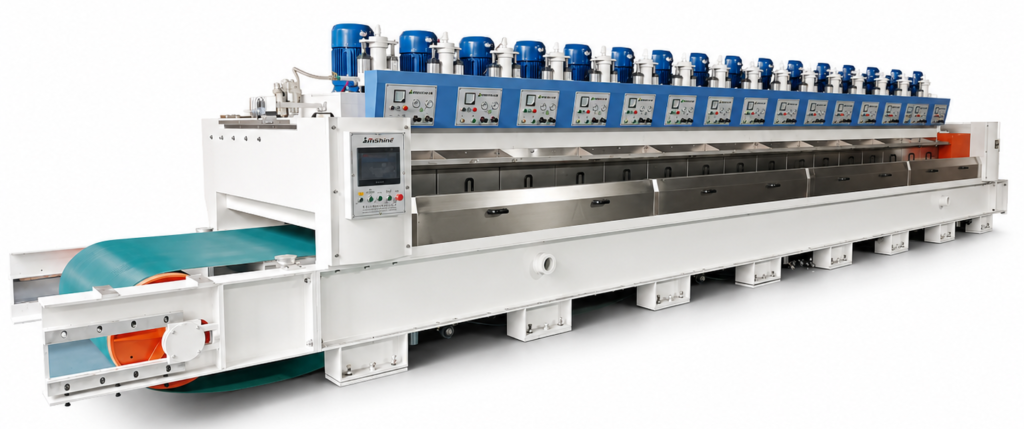
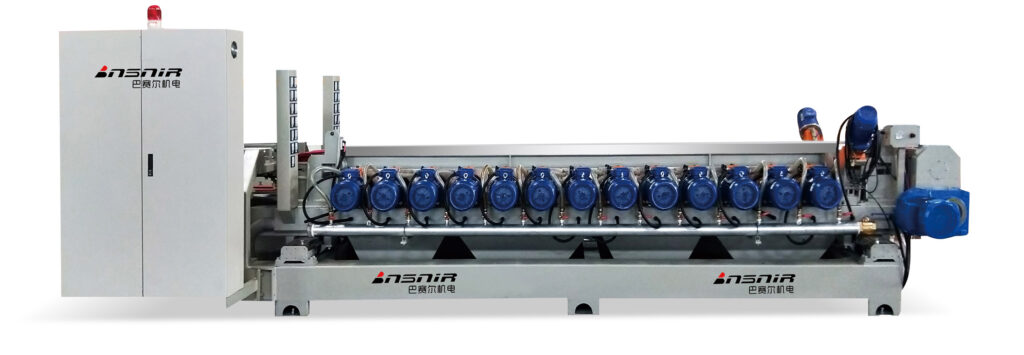
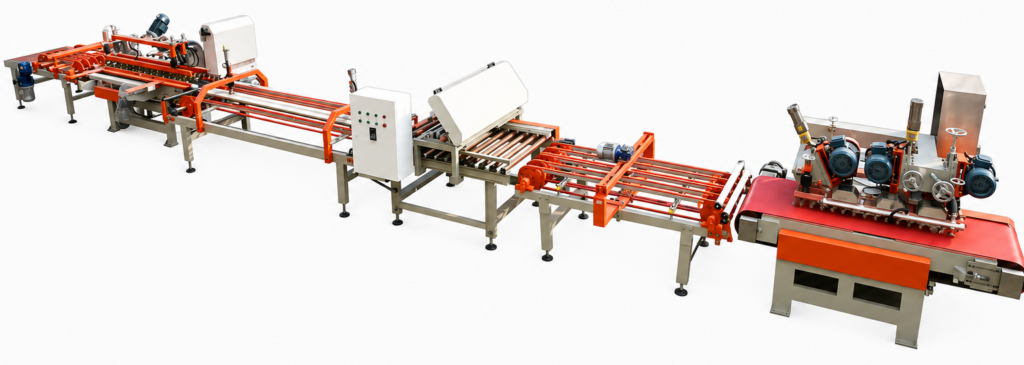
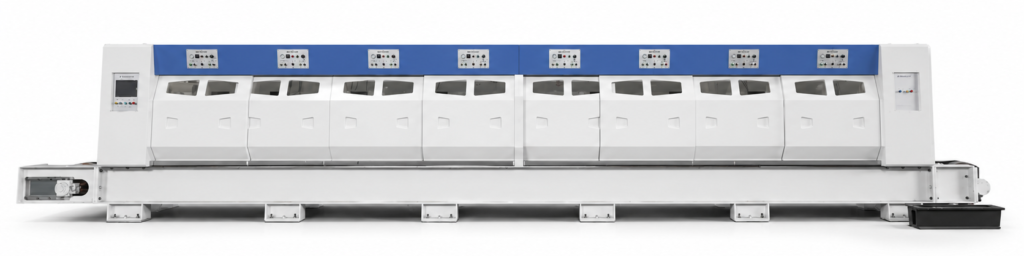
A lappato processing line is not a single abrasive pass. Material moves through progressive stages, each serving a distinct function in developing the final surface, and the grit sequence must be matched to the tile body hardness, the target finish depth, and the dwell time available at production speed.
| Stage | Grit Range (Mesh) | Purpose |
|---|---|---|
| Initial Calibration | 50–60 | Levels tile surface and removes major irregularities |
| Primary Development | 80–100 | Creates base lappato semi-polished effect |
| Refinement | 120–150 | Smooths surface and reduces visible scratch marks |
| Final Pass | (May include chemical treatment) | Enhances final sheen and surface uniformity |
The calibration stage does the structural work: it corrects residual surface variation and prepares a consistent base for the stages that follow. If this stage is undersized relative to the incoming variation, every downstream stage compensates imperfectly, and the final surface carries irregularities that no refinement pass can fully resolve. Primary development is where the lappato character is established—the degree of texture retention and the character of the semi-gloss effect are largely set here. Refinement reduces visible scratch marks from the primary pass, but it cannot create a uniform finish if the primary stage produced an inconsistent one.
The final pass, which may incorporate chemical treatment, determines surface sheen and uniformity but is sensitive to what has happened upstream. Chemical treatments protect and enhance, but they amplify whatever surface condition they are applied to—a patchy semi-gloss becomes a patchy enhanced semi-gloss. Teams planning a ceramic tile line polishing machine configuration should confirm that the treatment stage is scoped as part of the line, not as an afterthought added by a separate supplier. Fragmented supply of machine, abrasive, and treatment stages is one of the more common sources of integration delay and undefined accountability during commissioning.
Lappato Abrasives as a Separate Tool Family
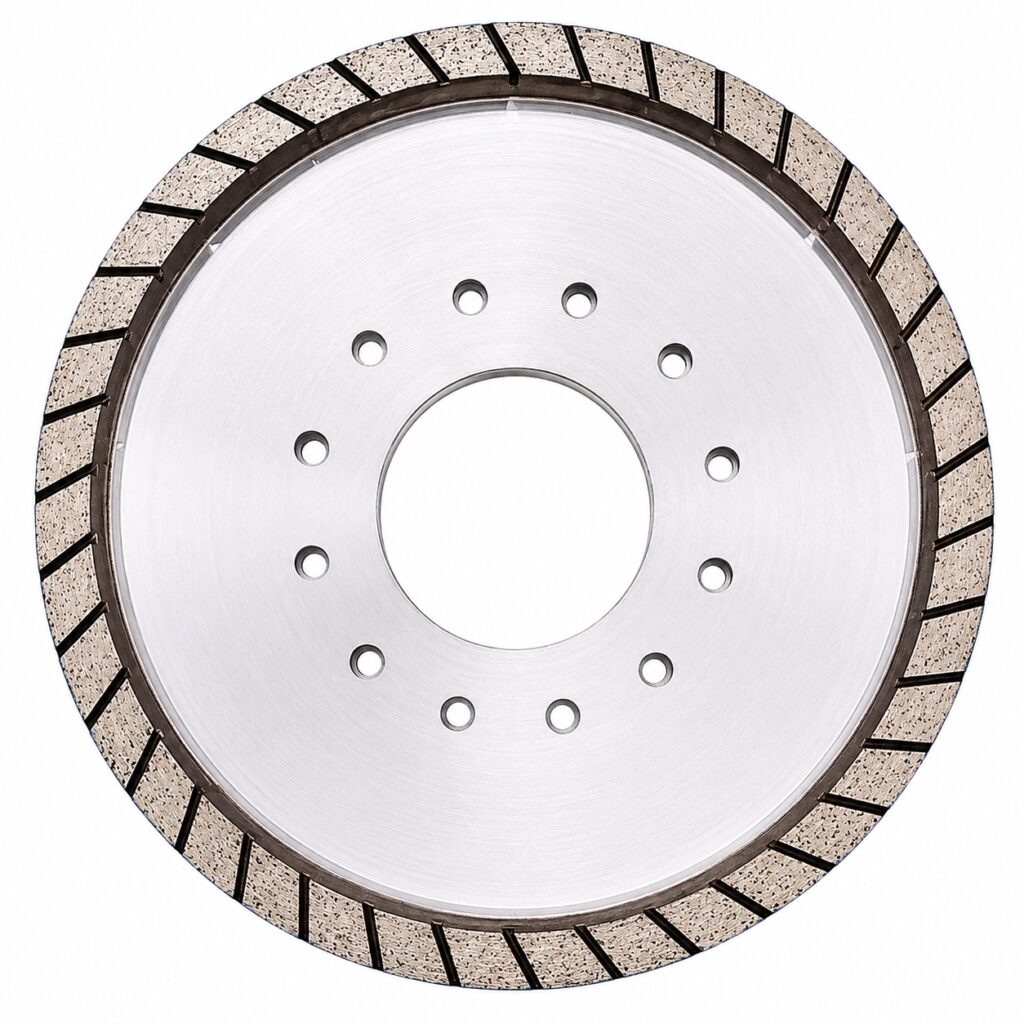
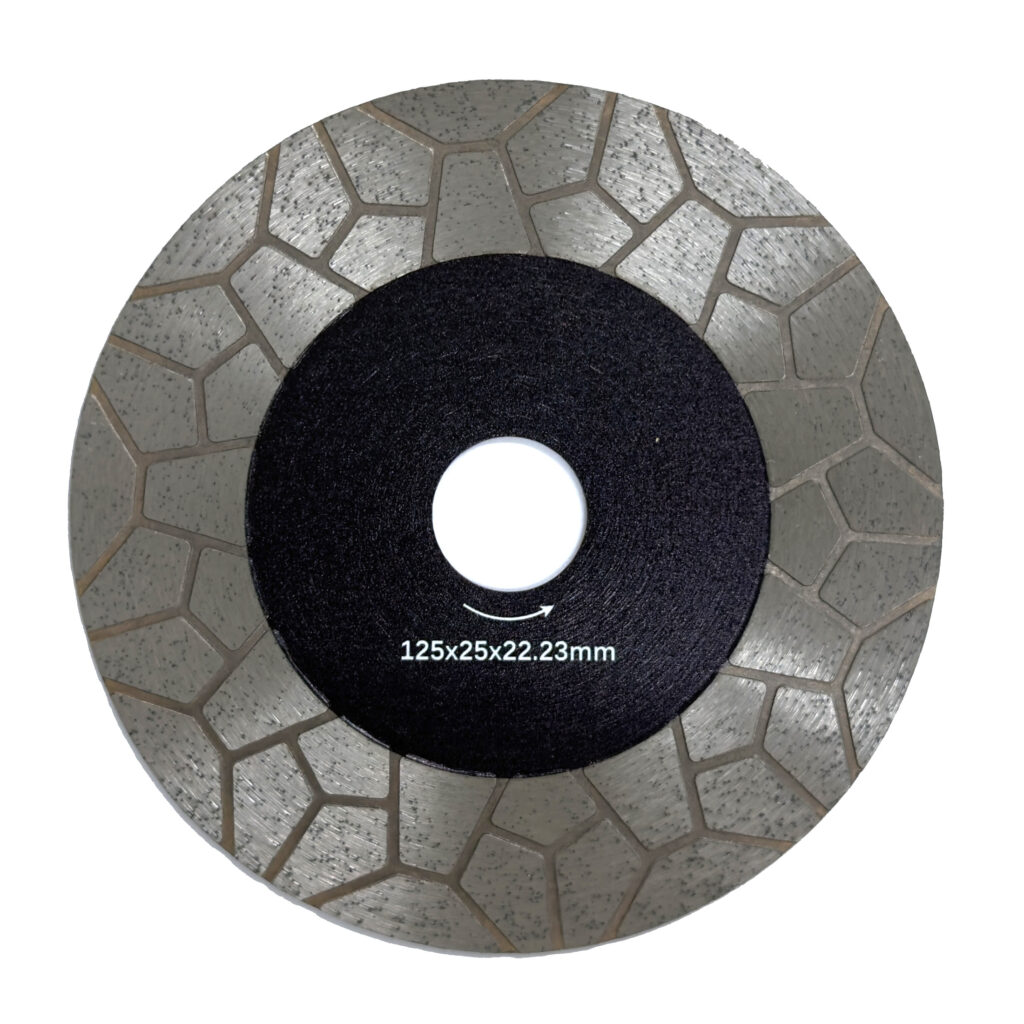
Lappato tools are not a lighter version of full-polishing abrasives. The architecture differs: lappato abrasives are designed for controlled, partial surface abrasion rather than uniform, progressive material removal across a full depth range. Using a full-polishing abrasive sequence for a lappato application produces over-removal in some areas, inconsistent texture retention, and a surface that fails to hold the semi-gloss character the specification requires. This distinction matters in procurement because the two tool types can appear interchangeable in a general abrasives catalog but perform fundamentally differently in use.
Bond type and particle size are the two variables that most directly shape the output. Bond type determines durability and surface character; particle size determines finish appearance.
| Bond Type | Characteristics | Typical Surface Effect |
|---|---|---|
| Metal-bonded | Durable, long tool life | Uniform, consistent semi-polish |
| Resin-bonded | Softer, more flexible | Distinctive variations, softer lappato appearance |
| Hybrid | Balance of longevity and flexibility | Controlled abrasion with moderate tool life |
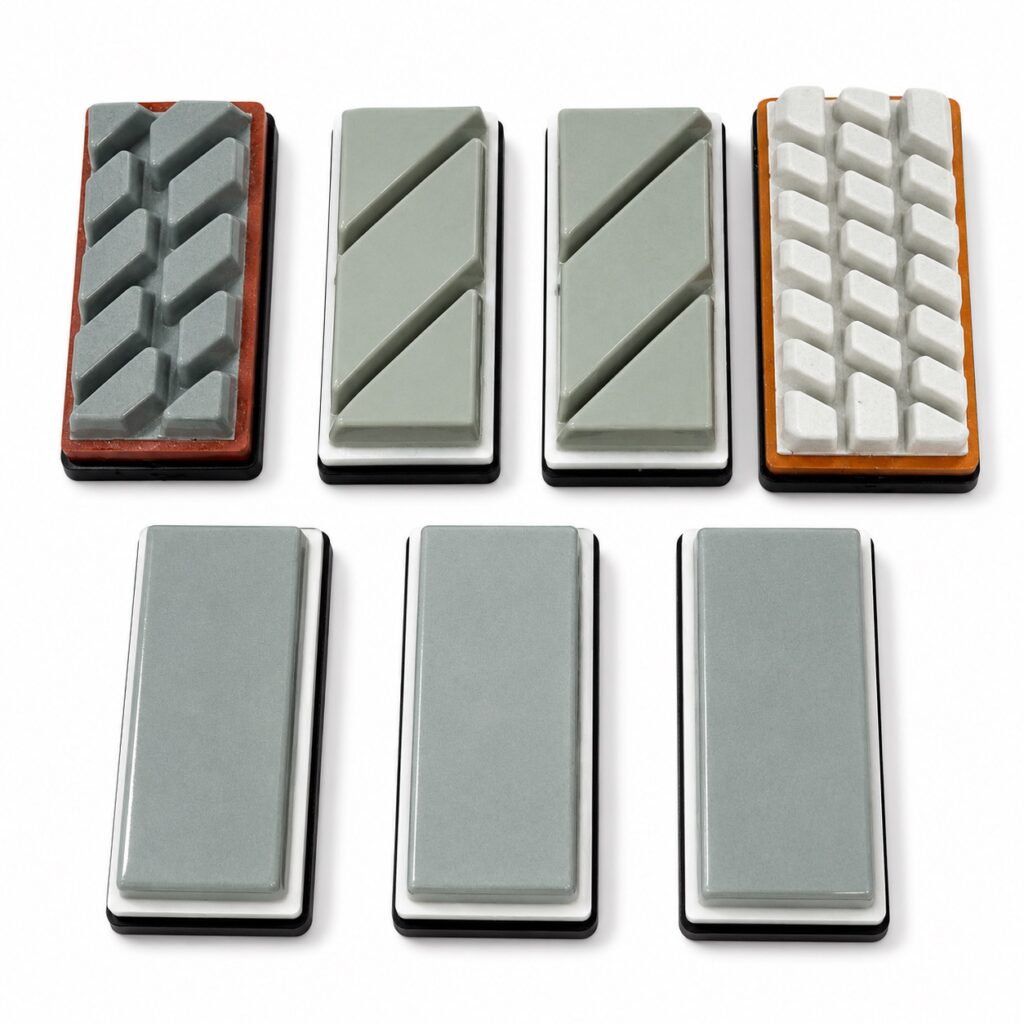
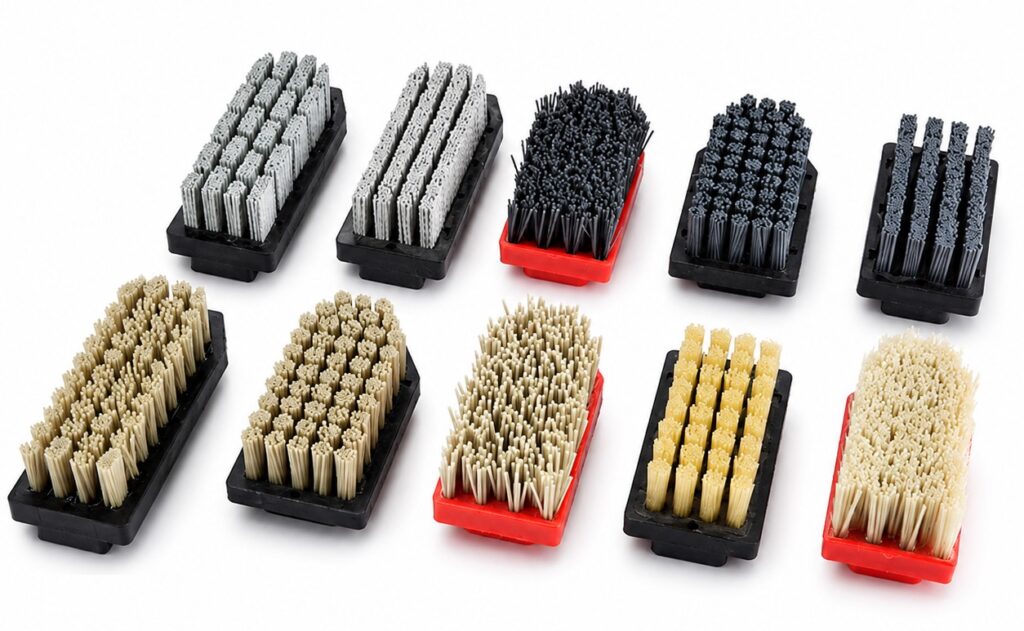
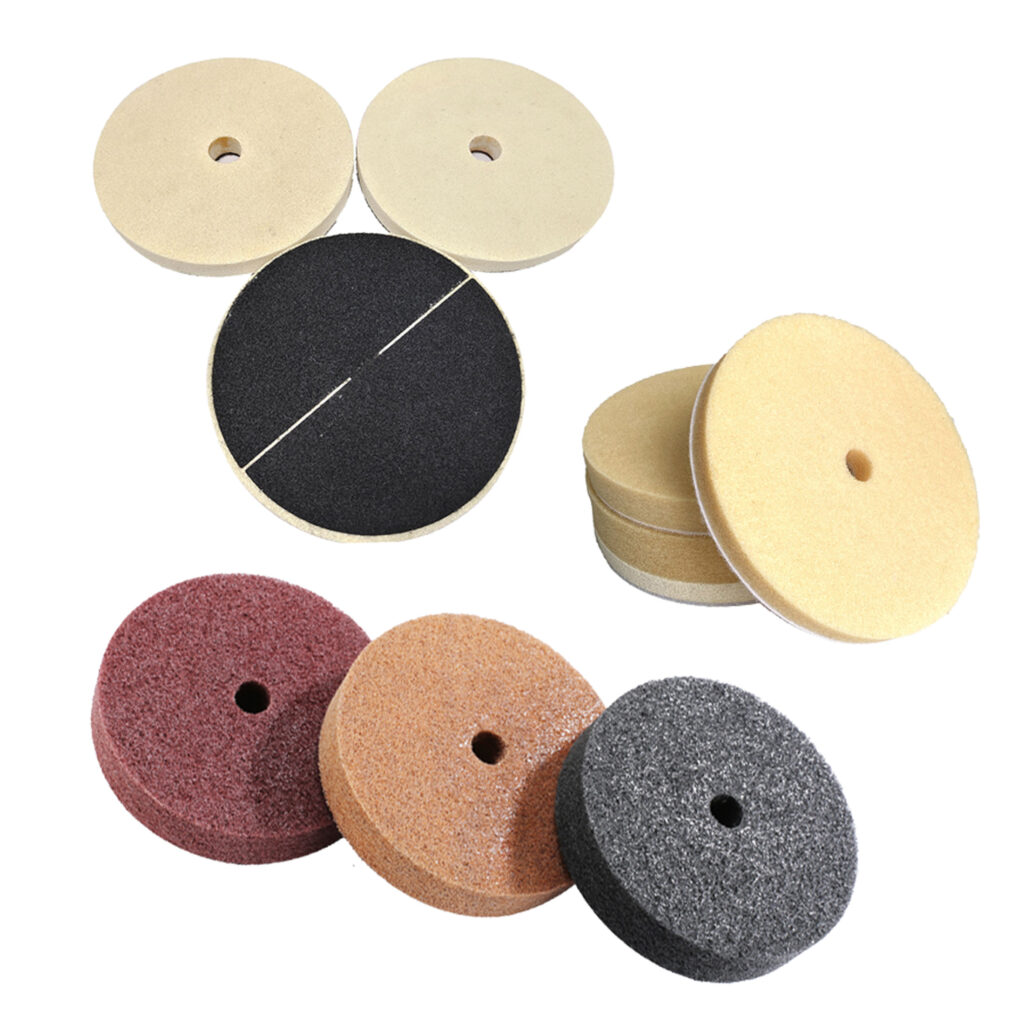
Specifying elastic lappato blocks, Fickert brushes, and polishing pads as though they serve equivalent functions is a recurring mistake. Each produces a different surface interaction, and assigning the wrong tool to a stage—even with the correct grit—can produce a surface that passes during trial tile assessment and fails in full production, where slight variation in tile support or water delivery amplifies the mismatch. The elastic lappato abrasives appropriate for a controlled semi-polish are not substitutable with general-purpose polishing consumables without confirmed trial evidence on the production tile body.
Quality Risks from Removal and Line Instability
Higher removal addresses more incoming variation but is not a neutral trade-off. Increasing the depth of abrasion generates more heat, accelerates tool wear, and exposes body defects—voids, inclusions, or subsurface porosity—that lighter treatment would leave undisturbed. The assumption that “more removal equals more correction” is partially true for flatness but can introduce defects that were not present in the incoming tile, particularly if cooling is inadequate.
The clearest thermal failure mode is micro-cracking. Inadequate heat dissipation during abrasion allows localized temperature buildup at the tile surface, which manifests as hairline cracks that are not visible during processing but become apparent after inspection or after surface treatment is applied. Cooling system design and water delivery consistency are not optional refinements—they are engineering requirements that should be defined and verified at line design, not adjusted after first production.
Equally important is distinguishing real defects from lappato’s inherent surface character. Pitting, crackled effects, and uneven shine are recognized as normal cosmetic variation for lappato surfaces and should not be treated as process failures. The practical consequence of misclassifying these as defects is unnecessary rejection of correctly produced tiles and pressure to modify the line in ways that may compromise the lappato effect itself.
| Surface Appearance / Condition | Normal for Lappato? | What to Clarify |
|---|---|---|
| Pitting, crackled effect, uneven shine | Yes, considered acceptable variation | Confirm acceptance criteria align with industry glossaries to prevent unnecessary rejection |
| Micro-cracks | No, indicates thermal damage from inadequate heat dissipation | Verify cooling system design and heat management provisions in the line |
Line stability is the underlying variable that controls whether normal lappato character stays within acceptable range or drifts into actual defect. Tile support consistency, abrasive seating, water flow uniformity, and conveyor speed stability all affect the surface-by-surface repeatability of removal. A line that works correctly on trial tiles but drifts in production is usually exhibiting instability in one of these variables rather than a fundamental problem with the abrasive sequence.
Procurement Scope Across Machine Tools and Treatment
The most common procurement mistake is splitting machine specification, abrasive selection, water handling, inspection, and protective treatment across separate suppliers without a defined integration lead. Each element functions in relation to the others—abrasive performance depends on machine stability and water delivery, treatment outcome depends on abrasive finish condition, and inspection criteria must be aligned with what the line is actually capable of producing. When these are sourced independently, no single party owns the interface, and commissioning delays accumulate at exactly those handover points.
Total cost of abrasives is rarely equivalent to purchase price. A single observed case comparison found that a premium diamond lappato abrasive priced 40% higher than the baseline delivered a 27% lower total processing cost per square meter when tool life, labor for changes, and consistency losses were included.
| Cost Factor | Standard Abrasive | Premium Abrasive |
|---|---|---|
| Initial Abrasive Cost | Base price | 40% higher than base |
| Total Processing Cost per m² | Base per m² | 27% lower total cost per m² |
This figure is from one documented case and should not be treated as a universal model. The trade-off depends on production volume, labor cost, replacement frequency in the specific line configuration, and consistency requirements. The relevant procurement check is not whether to buy a premium abrasive but whether the total cost comparison has been modeled against own operational data rather than unit price alone.
The treatment stage—waxing, protective coating, or surface sealing—is frequently scoped late and then sourced separately from the line machine. This creates an unresolved interface between the final abrasive condition and the treatment chemistry, and it can undermine both the surface effect and the durability of the finish. A tile waxing and surface treatment machine specified alongside the polishing line, with confirmed compatibility between the post-abrasive surface condition and the treatment process, removes this interface risk before it becomes a commissioning problem. Projects that have scoped treatment as an afterthought consistently take longer to stabilize than those where treatment is part of the original line design.
Project Release with Representative Tile Evidence
A project that reaches trial commissioning without a pre-agreed, measurable finish target is difficult to close. “Lappato appearance” is not a specification—it describes a category of surface effects with significant variation. Without a defined target, acceptance disputes arise between production teams and quality reviewers who are comparing results against different mental references, often using inconsistent or undefined defect language.
Measurable finish targets resolve this. One documented project case defined a 35–40% light reflectivity value target, used reflectometry testing during installation to verify consistency, and reduced the tile rejection rate from 7% to below 1%. These are project-specific figures tied to a specific tile body, finish specification, and production context. They should not be read as default industry standards, but they illustrate what a properly specified and measurement-supported release process can achieve relative to a subjectively assessed one.
The preconditions for a stable project release include more than the measurable target. Representative tiles must be confirmed as representative—meaning they come from the same body batch, fired under the same conditions, and held at the same flatness tolerance as production tiles. If trial tiles are selected because they are best-case examples rather than typical production samples, the line will be configured for a tile it will rarely see, and first full-production output will require re-adjustment. Shared defect language that explicitly classifies lappato’s normal pitting, crackled character, and uneven shine as acceptable variation—before production begins—removes the most common source of post-trial acceptance disputes.
Reflectometry is a useful project-release verification tool where measurable finish targets have been defined, but it is not a regulatory requirement. Its value is in providing a consistent measurement basis across different reviewers and different production batches. Where subjective visual inspection is the only acceptance method, batch-to-batch consistency is harder to defend and harder to document. Teams managing inspection readiness should confirm that the measurement method used during mock-up approval can be applied consistently in production inspection, or the specification will not transfer reliably from trial to manufacturing scale.
The most consequential decision in a lappato project is made before any equipment is specified: defining what the tile body is, what the target surface effect requires, and what acceptance looks like in measurable terms. Lines configured without that foundation tend to be re-adjusted during commissioning, overloaded with removal to compensate for incoming variation, and extended in timeline because acceptance disputes cannot be resolved without a shared reference.
Before committing to a line configuration or abrasive sequence, confirm that incoming tile flatness, body hardness, and accepted surface conditions have been documented; that lappato abrasive tools have been selected for their specific architectural function, not substituted from a general polishing sequence; that machine, abrasive, and treatment stages are scoped as an integrated system with defined interfaces; and that the project release criteria include a measurable finish target, representative tile evidence, and explicit defect language that accounts for lappato’s inherent surface character. Any gap in those four areas is more likely to determine project outcome than the specific equipment brand or abrasive price point.
Frequently Asked Questions
Q: Can I apply this same abrasive selection logic and process flow if I’m targeting a full high-gloss polish, not a lappato semi-gloss?
A: The process logic around progressive grit stages and cooling still matters, but the abrasive architecture and surface acceptance rules described here are specific to lappato. Full polishing requires tools built for continuous planarization, produces a uniform gloss with no retained texture, and changes the slip-resistance profile. Using lappato-focused tools on a full-polish line will over-retain texture and fail the gloss target, so you need a separate abrasive family and a different defect language.
Q: What should we do immediately after reading this guide to start a lappato line project on solid ground?
A: Document an incoming tile profile before contacting suppliers. Measure flatness against your internal tolerances (using the testing framework in ISO 10545-2), confirm the tile body’s Mohs hardness, and define the target lappato finish in measurable terms—such as an LRV range and the acceptable visual variation list. Sharing that data with an integrated line supplier shifts the conversation from generic capabilities to a configuration that matches your actual production tiles.
Q: At what production volume does the total-cost advantage of a premium lappato abrasive start to disappear?
A: The 27% total processing cost reduction cited in the article came from a single documented case and is not a universal promise. The advantage depends heavily on your labor cost for abrasive changes, your line’s scrap rate, and how often you currently replace tools. In low-volume operations—roughly under 50,000 m² per year—the higher purchase price of a premium abrasive may not be recovered through longer life and lower rejection alone. Run a total-cost model with your own tool change intervals and labor rates before deciding.
Q: Is it ever advisable to buy the waxing and surface treatment machine from a different supplier than the polishing line?
A: It’s technically possible but shifts integration risk to your team. The final abrasive surface condition directly determines how the treatment adheres and performs; without a single party accountable for that handover, commissioning delays at the interface are common. If you must split suppliers, appoint a dedicated internal integration lead and insist on a written interface specification that both sides validate with production trial tiles before full output begins.
Q: Do small-batch lappato producers really need to invest in a reflectometer and LRV testing?
A: A reflectometer is not mandatory, but visual-only acceptance creates consistency risk that grows with customer count and reviewer changes. For very small runs, a calibrated master panel and disciplined visual checks may be enough. However, the project case in the article showed that a defined 35–40% LRV target, verified with a reflectometer, reduced rejection from 7% to under 1%. If quality disputes are costly, that saving can justify a basic measurement tool even at modest volumes.