
This machine family is for wet polishing the top face of small stone strips and pieces—not for polishing a vertical edge. BASAIR can collect the application, define the line interfaces and coordinate the partner configuration. The final machine must be confirmed against the actual material, workpiece dimensions, hold-down condition, required face finish and production mix.
Request a small-stone polishing review
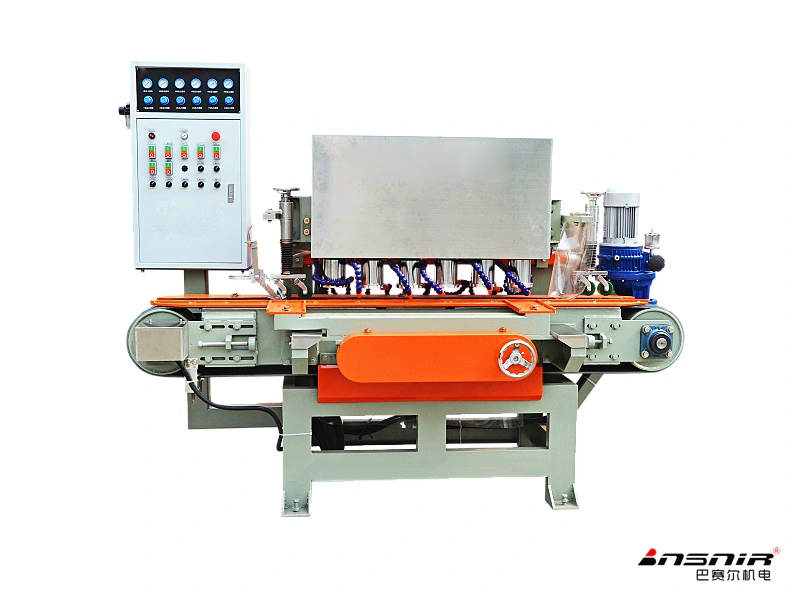
1. Confirm that the job is small-piece top-surface polishing
Start with the face that must be finished. E407 suits a flat upper working face on narrow strips or small pieces that can travel steadily beneath pressure rollers. It does not replace a straight-edge polisher, a shaped-profile machine or a four-face column machine. Thin, short, irregular or mixed-height pieces may need a carrier, grouping fixture or another feed route; a nominal width alone does not prove stable conveying.
The partner source identifies YSU-200-1 as a six-head machine for small stone pieces and states that strips within 120 mm width are a reference application. That limit is specific to the cited model. Submit the actual minimum and maximum length, width and thickness, including the smallest repeat order, so the hold-down span and guide position can be checked.
2. Select by hold-down, head sequence and real production mix
| Decision | YSU-200-1 source reference | What must be confirmed for the order |
|---|---|---|
| Top-polishing stations | 6 independent wet-polishing heads, 125 mm head diameter | Starting surface, target finish, material response and usable grit/pad sequence |
| Conveyor and workpiece | 200 mm belt; source describes strips within 120 mm width | Minimum bearing length, guide clearance, pressure-wheel contact and whether a carrier is needed |
| Thickness window | 10–50 mm | Actual tolerance, mixed-thickness changeover and allowable top-face variation |
| Alternative task | The comparison source YSPU-100 combines one calibrating position, eight surface-polishing heads and two light chamfering positions | Choose that route only if calibration and a light corner treatment are part of the same confirmed job; do not treat it as the same six-head surface-only layout |
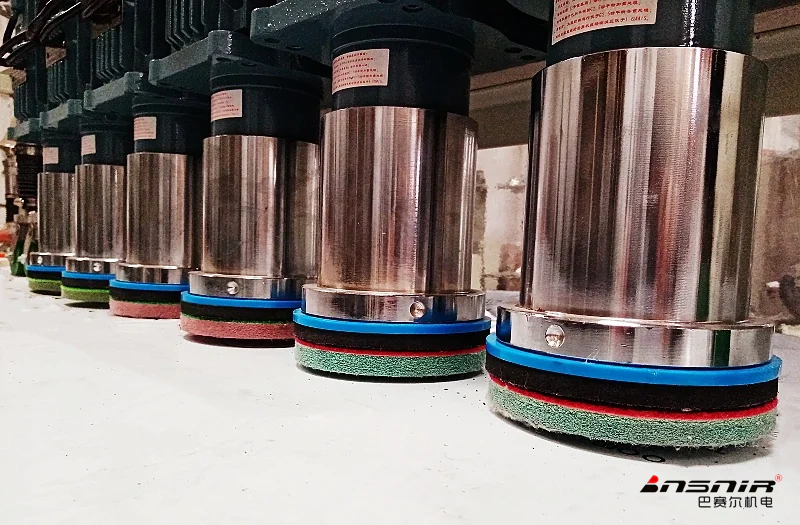
3. Define the upstream cut, clamping and abrasive sequence
The machine should receive pieces that are already cut to a conveyable shape. If stock thickness varies beyond what the polishing allowance can absorb, calibrate it before polishing. Entry guides align the strip while pressure rollers keep it seated on the belt; neither feature proves that every short or irregular piece will feed safely. Confirm the contact length before assuming automatic transport.
Each head needs an assigned stage rather than six copies of one pad. A workable proposal starts from the incoming saw or calibrated surface, then matches coarse correction, intermediate refinement and final polishing to the target sample. Water-polishing pads and snail-lock interfaces shown by the source are configuration references only. Pad bond, grit steps, head pressure and replacement interval must be tested on the buyer’s stone.
After the top face, specify whether the part goes to rinsing and drying, a separate edge/profile machine, inspection or packing. If both small top faces and sample edges are required, compare this route with the quartz and slab sample edge line instead of expecting one machine to complete both responsibilities.
Choose the pad sequence for the incoming surface, required finish and stone response. Confirm each pad grade and a trial sequence with the quotation; a set of coloured pads is not a fixed supply list.
4. Plan electricity, water, compressed air, slurry and safe access
The cited YSU-200-1 data lists 5.6 kW total power, about 100 L/min water and 30 L/min air, with a 2.38 × 1.10 × 1.96 m machine envelope and approximately 1,500 kg weight. These are source-model references, not universal BASAIR specifications. Voltage, frequency, installed load, air pressure and quality, water pressure, drainage elevation and foundation must be confirmed before quotation.
The source explicitly requires the buyer to provide a small air compressor for the pneumatic heads. Include a regulator, moisture control and an isolation point in the site plan. Wet polishing also produces stone fines: route the drain to a settling or treatment system, keep recirculated water quality compatible with the pads and nozzles, and provide non-slip access for pad changes and cleaning. Guards, emergency stops, electrical protection and local workplace rules must be reviewed for the actual installation; the source photos do not establish site compliance.
5. Submit the data needed to approve a configuration
| Submit | Why it changes the machine decision |
|---|---|
| Stone type and representative pieces | Confirms removal behavior, pad sequence and whether testing is required |
| Minimum/maximum L × W × T and tolerance | Sets guide, pressure-wheel, belt and carrier requirements |
| Incoming face and target sample | Separates light polishing from calibration or heavy stock removal |
| Pieces/hour, mix and shift pattern | Prevents a peak speed from being mistaken for sustainable mixed-order output |
| Upstream/downstream equipment | Defines transfer height, buffer, rinse/dry and separate edge work |
| Power, water, air, drainage and layout | Confirms utilities, compressor responsibility, sludge route and safe maintenance clearance |
Use the stone, sintered stone and countertop equipment guide for the wider process family, compare a meshed sheet on the stone mosaic polishing machine, or review the complete stone profile and small-piece processing route.