
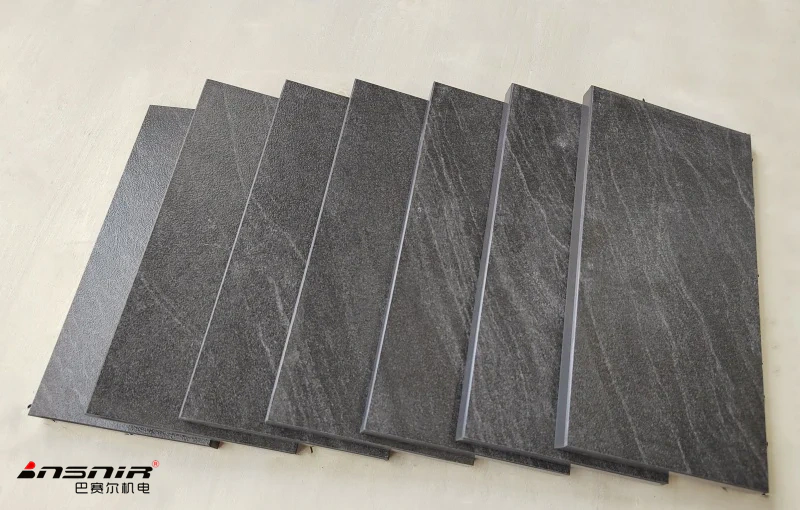
Quartz and sintered-stone sample blocks can be finished by a flexible single-edge route or by a two-stage double-edge line. The right choice depends on sample width, thickness, four-edge requirement, chamfer faces, product mix and daily demand—not simply on the number of polishing heads.
Compare the single-edge and two-stage double-edge routes using sample width, the edge section and support through each station.
Request a sample-edge route review
1. Define the sample family before choosing the line
Submit the actual sample sizes, material, thickness, incoming saw edge, required straight-face finish, upper/lower chamfer and the four-edge dimensional rule. Include how many sizes share one thickness and whether all four edges must be finished. Mixed widths do not automatically mean one setting: guides, bearing length, pressure contact and inspection must remain stable for every size.
Large or irregular small pieces may fit the flexible small-stone polishing route instead. Full countertop edges belong to the countertop edge polisher. E419 is specifically for repeatable sample-block straight edges and chamfers.
2. Choose one-edge flexibility or opposing-edge flow
| Decision | YSMDP-300 single-edge reference | YCMDR-250/400 double-edge route |
|---|---|---|
| Edge ownership | One straight face plus upper/lower chamfers per pass; index four times for four edges | Opposing edges in one pass; a turn/transfer stage presents the second pair to the next machine |
| Published head arrangement | 1 edging + 8 straight polishing + 2 upper chamfer + 2 lower chamfer | Each machine: 1 pair edging + 6 pairs straight polishing + 2 pairs upper + 2 pairs lower chamfer |
| Published work window | 100–300 mm width; 6–20 mm thickness | 100–250 mm or 200–400 mm width by model; 10–30 mm thickness |
| Production character | Lower layout complexity and manual indexing; useful for more varied sizes | Dedicated flow with transfer, centring and two edge stages; suited to a stable sample family |
| Main risk | Four-pass handling can introduce orientation or dimensional inconsistency | The line is only as stable as its turning, transfer, datum and width-change sequence |
These are separate partner configurations, not one universal machine with optional labels. The public YCMDR page describes a single-belt 250 mm route and a double-belt 400 mm route; the final line must be selected from actual sample sizes, changeover frequency and the transfer plan.
3. Use published figures only as model-specific screens
The YSMDP-300 source lists Ø200 mm edging, Ø125 mm wet-polishing/chamfer tools, 0–2 m/min, about 350 L/min water, 15.75 kW, 4560 × 2000 × 1450 mm and about 3000 kg. Its published sample examples include 100 × 200, 100 × 300, 150 × 300, 150 × 150 and 200 × 200 mm, but every actual size still needs a support and guide check.
The YCMDR source lists 1–1.7 m/min, 10–30 mm thickness and 23.75 kW for both the 250 and 400 configurations. It lists 4.6 × 1.9 × 1.45 m / about 3000 kg for YCMDR-250-1 and 4.76 × 1.9 × 1.4 m / about 3500 kg for YCMDR-400-2. Its combined-line reference is 12.5 × 2.53 m and 49.15 kW. These are source values for screening, not guaranteed production or acceptance results.
4. Design the wet process, handling and inspection together
Both routes use wet grinding/polishing. Confirm clean-water pressure and flow at each active head, splash containment, drainage and a settling/dewatering route for fine slurry. Published water flow for one model must not be multiplied into a plant requirement without the final head schedule, pump arrangement and recirculation-water quality.
Short sample blocks need continuous support, safe spacing and reliable detection. Confirm the minimum bearing length, centring method, anti-skew guides, turn-table sequence and what happens after a stop. Keep hands outside the feed, turning and opposing-head zones; use guards, interlocks, emergency stops and lockout. Final electrical load, any pneumatic demand, floor loading, access and local workplace compliance require engineering confirmation.
5. Submit one sample-and-flow package
| Submit | Required detail |
|---|---|
| Sample matrix | Each length × width × thickness, material, colour/finish and expected share of volume |
| Edge definition | Four-edge rule, straight face, upper/lower chamfer, allowance and approved finish sample |
| Incoming blanks | Cutting method, dimensional variation, saw marks, squareness and chipped-edge limit |
| Production basis | Pieces/shift by size, batches, changeovers, staffing, inspection and rework basis |
| Line interfaces | Loading, centring, turn direction, transfer height, buffers, outfeed and packing handoff |
| Site utilities/layout | Power, water, air if used, drainage/slurry, floor loading, maintenance space and safe access |
See the parent stone, sintered-stone and countertop equipment path and the complete countertop fabrication solution for upstream blank cutting and surrounding finishing tasks.