
Ceramic tile finishing equipment covers the post-firing stations that control a tile’s final size, edge geometry, surface finish, cleanliness, dryness and protective treatment before sorting or packaging. BASAIR plans these stations around the incoming tile, the required finished product and the interfaces with the existing line—not as a fixed package of machines.
This page is the process-selection entry point for ceramic and porcelain tile factories. For a complete project, the machine configuration, working range and final acceptance method depend on the tile body and surface, raw and finished dimensions, edge allowance, target finish, line rate, utilities and upstream and downstream equipment.
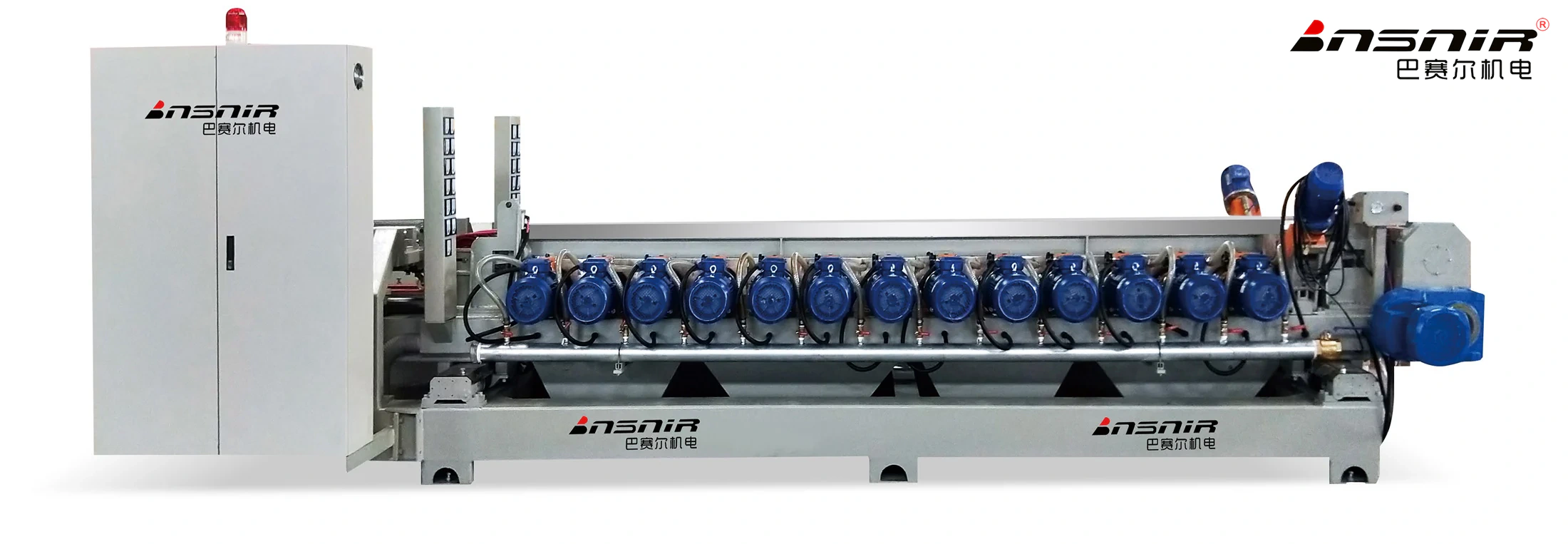
What equipment belongs in a ceramic tile finishing line?
A finishing line is a sequence of distinct process responsibilities. Not every product needs every stage, and the correct order must be confirmed against the factory’s tile route. The table below separates the main buying decisions instead of treating “finishing” as one machine.
| Stage | What it changes or controls | When to evaluate it | Equipment path |
|---|---|---|---|
| Edge sizing and small chamfer | Final width, length, straightness, squareness and a controlled small edge chamfer | For rectified tiles or when the fired edge must be corrected before sorting or packaging | Squaring & chamfering line |
| Surface calibrating | Surface level and removal before the polishing sequence | When the incoming surface or thickness variation requires a separate preparation stage | Tile surface calibrating machine (project-configured) |
| Continuous polishing or lappato | Surface texture and appearance through a staged abrasive sequence | For polished or lappato products whose surface route is defined before machine selection | Ceramic tile line polishing machine |
| Size conversion | Divides a tile into smaller formats, strips or mosaic blanks | Only when cutting is part of the finishing scope; scoring/splitting and multi-blade wet cutting are different routes | Ceramic tile cutting systems, including dry scoring & splitting or multi-blade wet cutting |
| Compact cutting and squaring | Combines size conversion and edge correction for a smaller processing footprint | For a workshop or line where output, format changes and space justify a coordinated compact route | Small cutting & squaring line |
| Surface cleaning | Removes process residue before inspection, drying or treatment | After a wet or residue-producing stage when the next operation needs a clean surface | Tile surface cleaning machine (project-configured) |
| Suction and air-knife drying | Removes carried water before inspection, treatment or packaging | When a wet process feeds a moisture-sensitive downstream operation | Tile suction & air-knife dryer (project-configured) |
| Waxing or surface treatment | Applies a confirmed treatment through the selected roller, pad or application arrangement | When the defined surface system requires an end treatment before protection or packaging | Waxing & surface treatment machine |
Important scope boundary: E108 calibrating, E109 cleaning and E110 drying are project-configured modules. Their supplier, structure, capacity and utility data must be confirmed for the specific line; this page does not present them as one fixed BASAIR standard model.
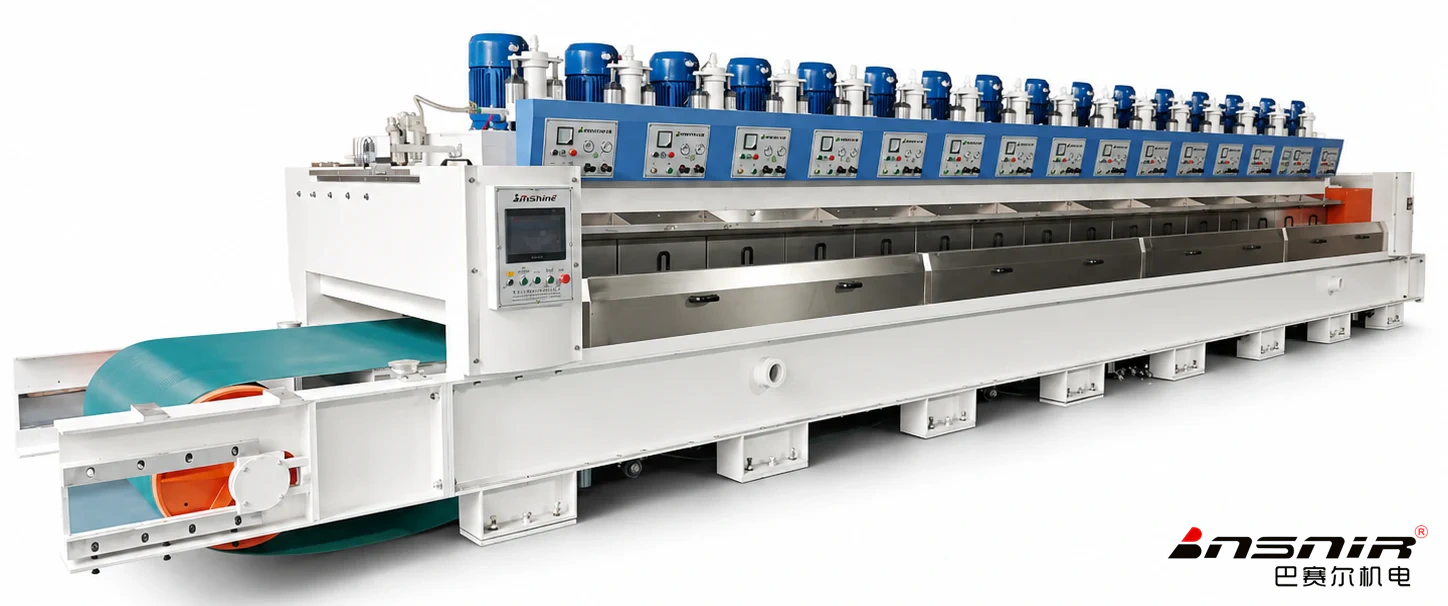
Start with the finished tile, then choose the process path
Machine count is not a useful starting specification. Define the finished tile and the incoming condition first, then determine which stations are necessary and in what order. Three planning paths illustrate the difference:
Rectified tile without a surface-polishing step
A typical scope may include alignment, continuous edge squaring, small chamfering and any cleaning or drying needed before inspection and packaging. A dry squaring route also needs dust-capture planning; a wet route needs water and downstream moisture management.
Polished or lappato tile
The project may require surface preparation, staged polishing, edge sizing, cleaning, drying and a confirmed surface-treatment step. The position of each station depends on the product route and quality-control method; the sequence should not be copied from another factory without checking the incoming surface and desired finish.
Smaller formats, strips or mosaic blanks
If the finished format is cut from a larger tile, first choose between scoring and splitting, multi-blade wet cutting or another approved cutting route. Edge correction, cleaning, drying and treatment are then selected for the cut product rather than assumed from the original tile size.

Dry and wet process planning
“Dry” and “wet” describe process conditions, not quality grades. Either route can be appropriate when the machine, tools, utilities and environmental controls are designed for the same condition.
| Decision area | Dry edge-processing route | Wet edge-processing route |
|---|---|---|
| Grinding condition | No process water at the wheel; heat, dust and tool selection must be considered together | Water is supplied at the grinding zone for cooling and material transport |
| Environmental interface | Capture points, ducts, collector selection, discharge and maintenance access | Water circulation, splash control, drainage, solids/slurry handling and cleaning |
| Downstream interface | Dust carryover and surface-cleanliness checks before inspection or packing | Cleaning and drying before a moisture-sensitive treatment, inspection or packing step |
| Tool matching | Dry-rated wheels selected by tile, removal, line position and mounting | Wet-rated wheels selected by tile, removal, water condition, line position and mounting |
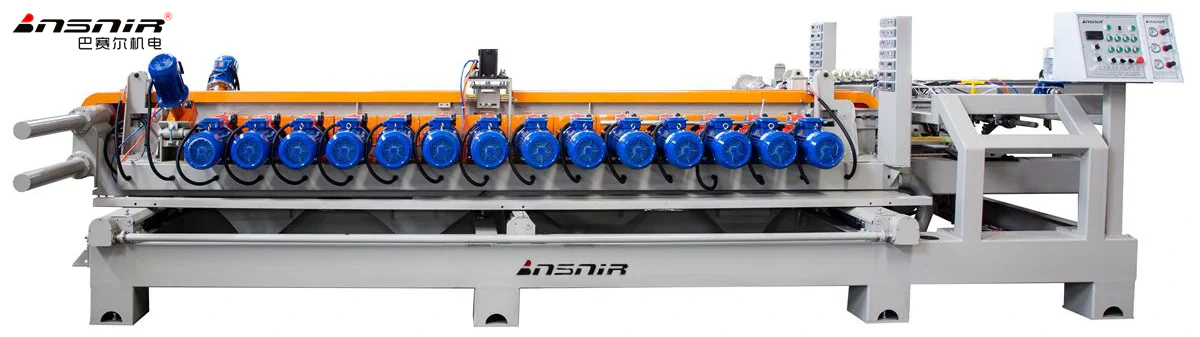
Interfaces that decide whether the line works as one system
Product and quality interface
- Tile body, water absorption, glaze or surface system, and incoming defects
- Raw and finished length, width and thickness, including the full format-change range
- Edge geometry, diagonal and dimensional checks, plus the agreed surface-result method
- Removal allowance at each stage and the accepted sample or drawing
Mechanical and automation interface
- Infeed and outfeed direction, working height, tile orientation and required turning
- Alignment, conveying, width change, gap control and protection of the finished surface
- Nominal and actual line rate, changeover frequency, shift pattern and buffer requirement
- Available footprint, service aisles, foundation and maintenance access
Utilities and environmental interface
- Electrical supply and connected load to be confirmed after the machine configuration is fixed
- Process water, drainage, recirculation and slurry route for wet operations
- Capture points, duct route and collector responsibility for dry dust-producing operations
- Compressed air and other utilities required by the selected automation and treatment equipment
For a broader coordinated route, combine only the approved product responsibilities required by the actual tile path. A line-level selection does not replace engineering confirmation for each station.
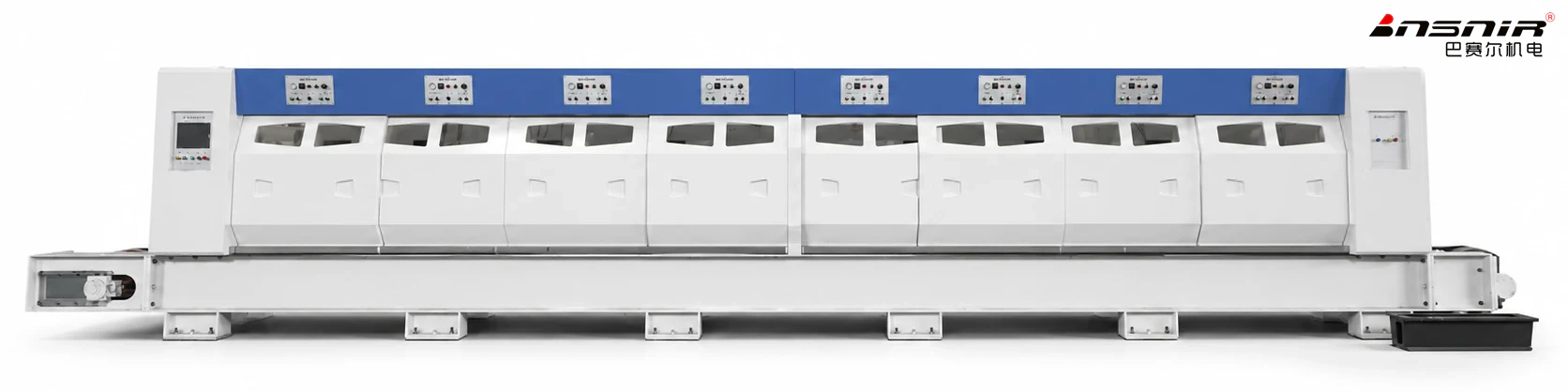
Information needed for a ceramic tile finishing-line proposal
Send the following information so BASAIR can define the process boundary before discussing a machine list:
- Tile material/body, water absorption if known, glaze or surface type, and clear product photos
- Incoming and finished length, width and thickness, including minimum and maximum formats
- Required stages: calibrating, polishing, squaring, small chamfering, cutting, cleaning, drying and/or treatment
- Target edge and surface result, inspection method, and available samples or drawings
- Required output, working shifts, typical changeover frequency and planned timeline
- Existing upstream and downstream machines, line direction, working height and layout drawing
- Available electrical power, water, compressed air, drainage, dust collection and slurry systems
- Required loading, unloading, conveying, buffering and other automation interfaces
Request a finishing-line configuration review
Published ranges and typical process descriptions are references for configuration discussion. Final working range, throughput, utilities, equipment scope and acceptance criteria depend on the customer’s material, process, selected configuration and engineering confirmation.