
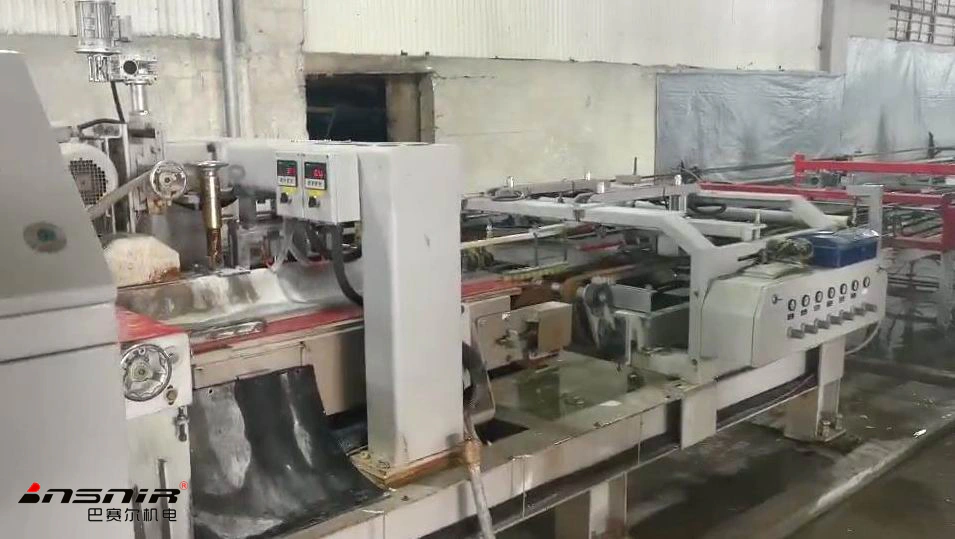
A thick-tile cutting and grinding line is selected around the tile body, required section and supported cutting route. The reference supply family includes upper-and-lower cutting with single-saw and single-side grinding arrangements, as well as multiple-saw and double-side grinding arrangements. BASAIR can coordinate a project review of those configurations; no universal thickness, capacity or edge result is assumed from the family name.
Define what “thick tile” means for this project
Send the actual material identity and samples, not only a trade description. Record thickness and variation, parent length and width, face texture, back pattern, flatness and any existing stress or edge defects. A line intended for thicker ceramic pieces cannot automatically process every outdoor paver, brick or stone body. The selected blade, support, feed and grinding route must be demonstrated with the intended workpiece.
Provide a section drawing showing the finished cut, the edge or edges that need grinding, any small chamfer and the final dimensional datum. Specify whether the purpose is size reduction, repeated strips, edge calibration or a combination. A drawing is especially important where the upper and lower cuts must meet within the same section.
Compare the cutting route and edge responsibility
- Upper/lower cutting: confirm which tools enter from each side, their order, overlap, alignment and how the piece stays supported between operations. The family description is not evidence of a universal split-cut method.
- Single-saw configuration: define the number of passes and required cut schedule; compare changeover and part handling rather than blade count alone.
- Multiple-saw configuration: show blade spacing, kerf, offcuts and the support and separation of each resulting piece.
- Single-side grinding: mark the processed edge and the reference surface used to set it. A second edge is a separate operation unless included.
- Double-side grinding: confirm whether the two edges are processed together or in sequential sections and how final width is established.
Station counts in a supplier title do not define the offered head allocation or abrasive sequence. The approved drawing and quotation should state the function of every saw and grinding position, tool access and the parts included in the supply.
Support, waste and downstream interfaces
The larger section changes handling and support requirements. Supply workpiece mass and centre-of-support information for the actual sizes. Confirm loading, pressure, transport and discharge without relying on a photograph of a thin-tile machine. Check how offcuts are removed, how cut pieces are separated and what happens if the next station stops.
Water, extraction, slurry, electrical demand and consumables must be defined for the proposed operating mode. Confirm collection points and cleaning access around the cutting and grinding sections. The quotation must identify whether conveyors, turning or transfer units, loading, drainage and waste treatment are included or supplied by the buyer.
Agree a sample and connected-line acceptance
Run the intended material at the agreed thickness extremes and finished sizes. Check cut meeting or alignment, residual steps, edge damage, finished dimensions, squareness and visible face marking. Include the narrowest part and an actual changeover. Assess grinding results on the same pieces that pass through the proposed cutting route, rather than combining unrelated samples.
Record usable output only with the material, tools, passes, feed conditions, handling and rejection criteria stated. No fixed removal rate, chip-free result, breakage rate or production capacity is promised here. Final configuration and acceptance depend on the material, process, site interfaces and engineering confirmation.
Send the information needed for configuration
Provide material samples, thickness distribution, parent and finished dimensions, a marked section drawing, cut map, required edge finish, production mix and existing line layout. Include available space, loading and discharge arrangements, utilities and maintenance access.
For conventional tile cutting with downstream chamfering, compare the tile cutting and chamfering line. For integration into a factory material flow, request an inline-line interface review alongside the thick-tile machine proposal.
Send your material, finished-part drawing and line-interface brief