
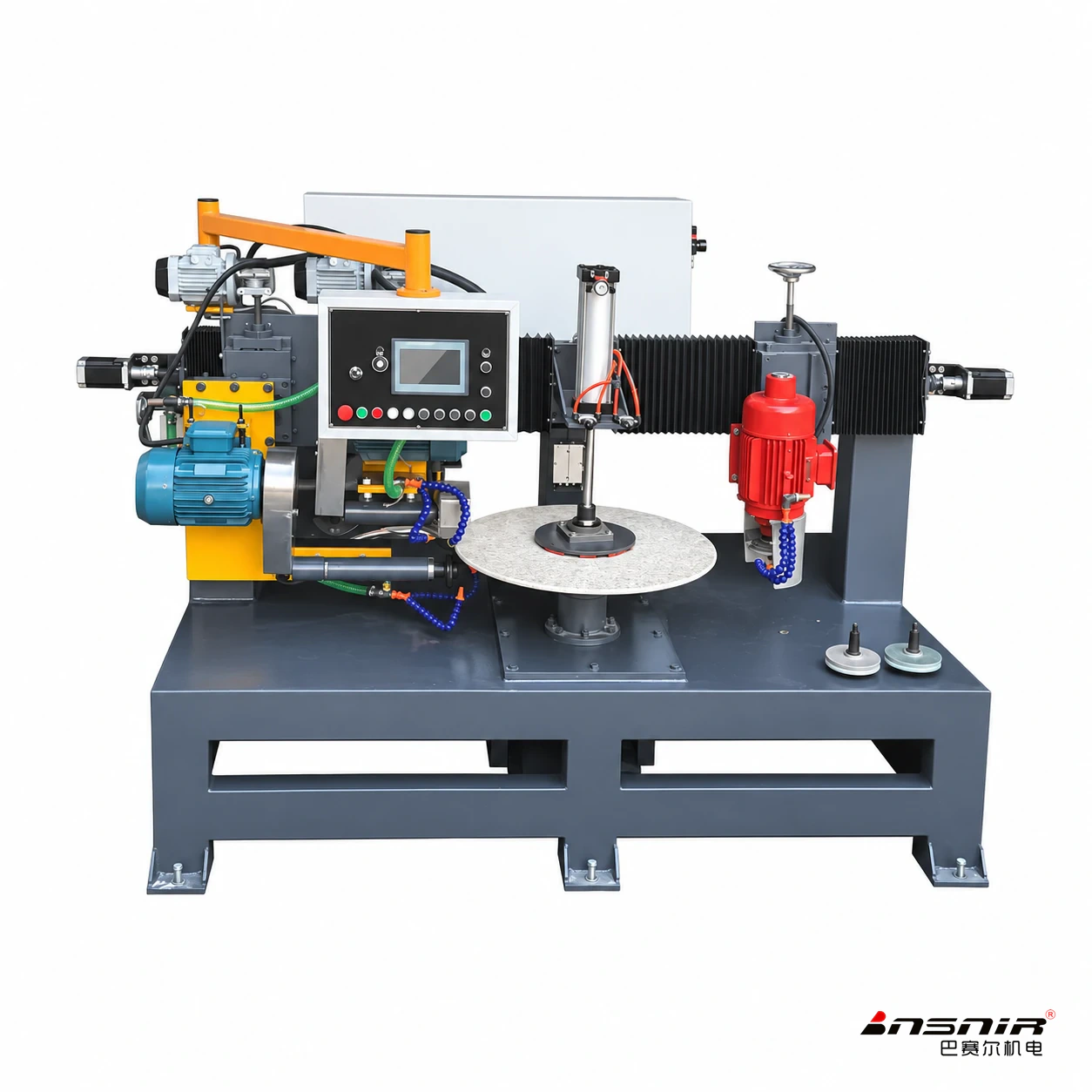
Round-table cutting, profiling and polishing. Round stone, porcelain and sintered-stone tabletops require both circular sizing and an edge that suits the furniture design. BASAIR can review rotating-table arrangements for this task. A cutting-and-milling machine and a combined cutting/profiling/polishing arrangement have different supply boundaries.
Define the finished tabletop before choosing the machine
Send the finished diameter, thickness and a dimensioned edge section. Show whether the top needs a simple eased edge, pencil round, bullnose, bevel or another profile. A shape name without its radius and section is insufficient to choose the wheel set.
Two routes for circular work
A cutting-and-milling arrangement rotates the supported workpiece past the cutting tool. Electric tool lift and fine diameter adjustment help establish the circular blank; downstream edge refinement may still be required. Choose this route when finishing will be done on separate equipment or when the circular forming task is the main bottleneck.
A combined arrangement sequences cutting with edge grinding and polishing. Referenced layouts use upper/lower cutting positions and interchangeable profiling or polishing wheels. The selected edge requires its own tooling and process sequence; the machine does not produce every advertised profile with one unchanged wheel.
Compare configuration-specific work windows
One combined reference lists 400–900 mm processing diameter and 6–30 mm thickness, with a stated processing feed of 0.5–1 m/min. A separate cutting-and-milling reference lists a 1500 mm maximum processing size and 10–20 mm thickness. These are separate configurations rather than one universal operating range.
Larger tables or alternative tooling require an engineering layout. Confirm the usable diameter after clamps, tool approach, center support and edge clearance are allowed for. A feed figure describes the process reference and should not be converted directly into finished tables per hour without loading, tool changes and inspection.
Workholding controls the circular result
Agree how the slab center is located, how the workpiece is retained and how offcuts are prevented from interfering with rotation. Thin porcelain, natural stone and engineered stone can require different support and cutting sequences.
Check water delivery at each active tool, slurry drainage and the accessibility of the center fixture. Show how operators load the blank, unload the finished top and change wheel profiles. Tool contact must reach the specified section without fouling the support or leaving an unintended unpolished band.
Request a tabletop configuration review
Send the material, diameter range, thickness, edge drawing, starting blank size, finish sample and required product mix. Include daily demand, batch sizes, local power, water and handling arrangements.
A trial should check roundness, finished diameter, profile consistency and surface appearance around the whole perimeter, including the start/finish transition. For non-circular cutouts or broader slab layouts, compare the CNC bridge-saw route; for straight external edges, see countertop edge polishing.
Send drawings and material details for a configuration review