
A large-slab packaging line is a project-configured route that protects a defined slab through support, lifting, wrapping or protective materials, packing, pallet/trestle/crate handoff and final logistics. The slab dimensions alone do not determine the line: mass, stiffness, face sensitivity, permitted grip zones and the destination packaging unit must be approved together.
1. Define the protected logistics unit first
Start from the condition in which the customer, warehouse or carrier must receive the product. A supported pack, tray, pallet, trestle or crate imposes different lift points, separators, edge protection, strap locations, stack orientation and forklift interfaces. Provide an approved pack drawing or sample and the complete slab matrix before choosing modules.
This page covers packaging and palletizing for large-format ceramic products and project-specific slabs. It does not replace upstream loading/unloading selection, the long/narrow tile route, or the separate surface-film decision.

2. Choose the route by product and destination, not by the word “large”
| Decision | Possible route | Use when | Confirm before quotation |
|---|---|---|---|
| Package form | Wrapped/board-protected pack, tray/pallet, trestle or crate | The logistics route and slab scale require different support and enclosure | Destination standard, handling method, stack orientation and approved sample/drawing |
| Lift method | Vacuum, supported mechanical grip or project-specific carrier | Surface condition, porosity, mass and safe contact zones permit the selected method | Surface/grip test, maximum slab mass, loss-of-energy behavior and backup support |
| Horizontal vs. vertical final unit | Horizontal pallet/pack or vertical A-frame/trestle/crate | Warehouse and transport use one orientation consistently | Tilt/turn scope, restraints, base support, forklift/crane access and transport loads |
| Manual assistance vs. robot palletizing | Assisted handling or guarded robot cell | Pack mass, rate, pattern, reach and staffing justify the automation level | Cycle, end effector, pallet/trestle position, access and recovery procedure |
| Inline vs. separated modules | Balanced continuous route or individually buffered stations | The factory prioritizes compact flow or maintenance/bypass flexibility | Available footprint, transfer risk, stop cases and line ownership |
3. Separate the partner instance from the wider project envelope
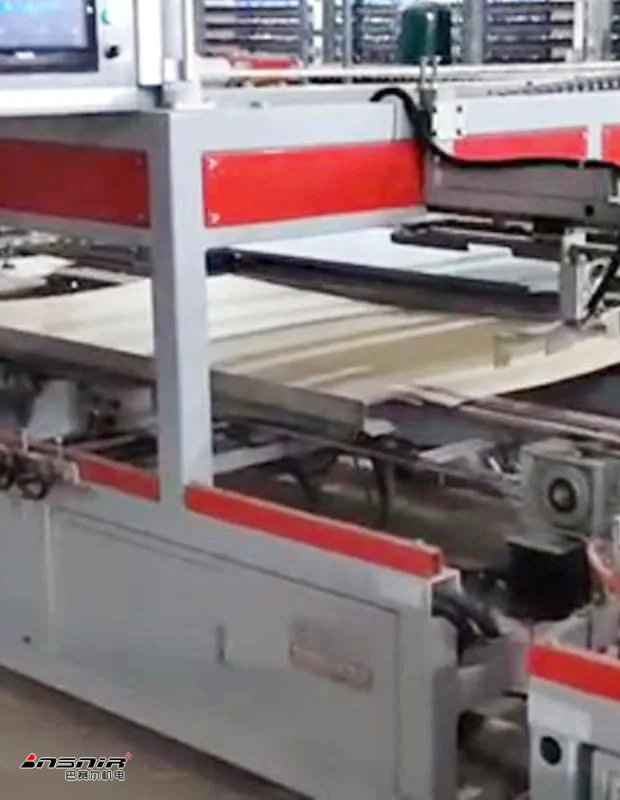
The cited large-plate packaging source lists one configuration for 600–1800 mm length, 600–900 mm width and 6–20 mm thickness. It describes open-bottom partial paper wrapping, six-core corner binding, robot palletizing and short-side transverse entry, with format-dependent published rates. Those values describe that exact partner arrangement only; they are not a universal BASAIR slab range or throughput guarantee.
Independent industry sources confirm that larger ceramic slabs may require different palletizing and packaging routes. System Ceramics publishes a slab palletizer example for 800×1200 to 1800×3600 mm, while SACMI distinguishes cardboard packs for medium/small formats, trays for larger sizes and crates or trestles for large slabs. These are market-reference boundaries only. A project beyond the cited partner envelope requires explicit engineering confirmation of product support, gripping, package, guarding and logistics.
4. Engineer handling, protection, controls and safety together

- Product: all slab dimensions/thicknesses, mass, stiffness, surface finish/porosity, edge condition, permitted contact and grip zones, maximum overhang and breakage history.
- Package: orientation, count per pack/unit, separators, face/edge/corner protection, paper/board/film, straps, pallet/tray/trestle/crate drawing, restraints and accepted appearance.
- Handling: infeed datum, lift/tilt/turn sequence, suction or mechanical grip test, support during energy loss, robot/end-effector scope, forklift or crane handoff and reject route.
- Line and controls: upstream rate/orientation, inspection, recipes, tracking, ready/busy/fault signals, packaging-material alarms, pallet/trestle availability, downstream release and safe restart.
- Utilities/site: power, compressed air/vacuum, floor loading, anchors, cell footprint, clear height, access, material storage and packaging-waste route.
- Safety: project risk assessment, vacuum-loss or load-retention response, fixed/interlocked guarding, robot safety cell, exclusion zones, emergency stops, lockout and local compliance responsibility.
- Acceptance: named minimum/maximum products, approved package, handling and grip trial, surface/edge inspection, cycle conditions, changeover, pallet/trestle stability and fault recovery.
5. Submit the slab and logistics brief
| Submission item | Minimum detail | Decision enabled |
|---|---|---|
| Slab matrix | Material, finish, all sizes/thicknesses, mass, porosity, drawings, photos and samples if available | Support, grip, guide and machine envelope |
| Approved logistics unit | Pack/tray/pallet/trestle/crate drawing, orientation, count, separators, protection, straps and restraints | Packaging modules and consumables |
| Handling route | Infeed, lift/tilt/turn, inspection, reject, final handoff and forklift/crane interfaces | Transfer and palletizing concept |
| Production case | Required units/hour, shifts, format mix, changeovers, staffing and planned time | Automation level and cycle balance |
| Factory and safety | Layout/CAD, elevations, footprint, clear height, power, air/vacuum, floor, signals and local requirements | Cell, utilities and supply boundary |
Connect the line with the automation and handling range, upstream loading/unloading systems, and the project-configured sintered-stone slab route or tile automation and packaging route.
Submit your slab matrix, package drawing and factory layout for configuration review
Define the final logistics unit before the robot cell
A flat package, supported tray, upright trestle and crate require different loading motions and restraint. Decide which unit leaves the line and which part of final securing remains manual. Submit the forklift or crane pickup geometry and permitted slab contact points with the package drawing; this avoids selecting a packing station that produces a unit the warehouse cannot handle.