
This page is for a wet, two-head machine that machines an L-shaped step on the back edge of tile, then smooths that step. It is not a general surface-slotting page: a photo of an ordinary straight groove does not prove the rear L-step operation described here. BASAIR collects the workpiece and line requirements; the cooperation manufacturer confirms the exact machine, wheels, utilities and supply boundary before quotation.
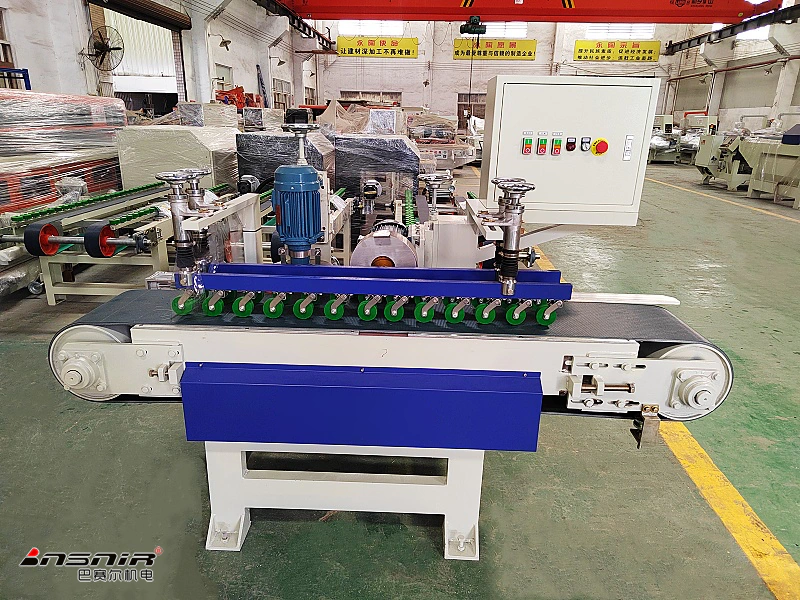
1. Use this machine only for a rear L-shaped step
The intended task is a step at the rear edge of ceramic tile: the first operation removes material to create the L-shaped back step and the second operation smooths the flat step surface. Start with the required cross-section, not with a generic request for a “groove machine.”
| Buyer task | Fit for this page? | Próxima decisión |
|---|---|---|
| Wet rear-edge L-shaped step | Yes | Confirm step width, depth, orientation, material and finish |
| Front-face decorative groove | No | Use the decorative forming-and-polishing route |
| General cutting or an unspecified straight slot | Not enough information | Return to tile secondary-processing selection with a section drawing |
2. Define the back step before choosing wheels
Send a dimensioned cross-section and identify the face that must remain visible. The machine and wheel set cannot be selected safely from overall tile size alone.
| Datos que hay que facilitar | Why it changes the configuration | Pruebas útiles |
|---|---|---|
| Tile material, backing and fired-body condition | Changes removal behavior, wheel specification and water management | Representative samples and close photos of the back |
| Overall length, width and thickness | Determines support, pressure and infeed/outfeed handling | Dimensioned drawing and size range |
| L-step width, depth, edge offset and orientation | Defines the removal and smoothing geometry | Cross-section with tolerances and a marked reference face |
| Required surface condition and visible-edge protection | Sets the acceptance sample and handling precautions | Approved sample or defect limits for chipping and scratches |
The wheel interface should be checked together with the diamond grooving-disc and rueda de rectificado y pulido de ranuras requirements; names alone do not establish diameter, bore, profile or bond.
3. Keep coarse shaping and smoothing as two distinct duties
The two-head rear-step configuration source describes a first, sintered wheel that machines the rear L-shaped step and a second, resin wheel that smooths the L-shaped flat. Both heads are manually adjustable vertically and laterally in that documented configuration. Treat these as model-specific reference facts, not as a promise that every quoted machine uses an identical head, motor or wheel.


4. Confirm wet-process, line and acceptance interfaces
The documented model is wet-process equipment with water covers around the grinding heads. The factory must still confirm water quality, supply pressure and flow, drainage, slurry capture, electrical standard, direction of travel and safe access for the actual project.
| Referencia o interfaz | Documented reference | Confirmación del proyecto |
|---|---|---|
| Processing speed | 1–4 m/min for the two-head rear-step configuration reference model | Validate with material, removal depth, wheel set and sample result |
| Processing thickness | 10–30 mm for the two-head rear-step configuration reference model | Confirm actual tile range and pressure/support setting |
| Agua y lodos | Wet heads with water covers; no fixed project flow claimed here | Supply, return, filtration or settling, drain point and cleaning access |
| Line connection | Conveyor-fed reference machine | Infeed/outfeed height, tile reference edge, available footprint and upstream/downstream control |
| Aceptación | No unconditional result promised | Approve a sample against step dimensions, consistency, chipping and required surface condition |
For a workshop-level layout, place this duty within the taller de procesamiento secundario de baldosas flow and identify where wet slurry is collected.
5. Send a complete back-step brief
Include material, size and thickness range, a dimensioned L-step drawing, target finish, representative samples, daily or hourly demand, current upstream and downstream equipment, available footprint, electrical supply, water and slurry arrangements, required feed direction and project location. BASAIR will use that package to confirm the cooperation-supplied machine, wheel interfaces and quotation boundary.
Dry-hang slots are a separate configuration decision
The rear L-step machine described above must not be assumed to make every dry-hang fixing slot. The wider supply family also includes manual and automatic dry-hang grooving arrangements, including multi-blade machines intended for edge slots, partial-edge slots or local bracket clearances. Each requires its own tool path, workpiece support and approved slot drawing; a generic groove photograph cannot prove compatibility with a facade fixing.
For a dry-hang inquiry, submit the panel material, thickness, edge distance, slot width, depth, length and end geometry, with the fixing interface drawing and required datum. State whether slots run along the edge or stop at defined positions. Confirm blade access, clamping, breakout control and inspection of residual material. Machine selection does not certify the facade or anchorage system: structural suitability and acceptance of the fixing remain with the responsible project design and agreed tests. Retain the wet rear-L-step route only when that is the specified geometry.