
Polishing and buffing pads are selected by what must happen at one defined station: mechanical grinding/refinement, controlled surface conditioning, treatment application or final buffing. Diamond, PVC, fibre/nylon, wool and sponge pads are different working materials and cannot be substituted from diameter or color alone.
Water-grinding discs belong to a defined finishing stage
A water-grinding disc is a selection family rather than a complete specification. The name indicates a wet-process enquiry; it does not establish diamond content, resin type, grit, backing or compatibility with the current holder.
For slab and stone-edge work, identify whether the disc removes saw marks, refines an already shaped face or delivers the final surface. Send the current sequence with each disc position marked. Skipping a stage or mixing unrelated discs can leave scratches that later fine stages cannot remove efficiently.
Match the disc diameter, attachment, approved speed, water delivery and actual material to the proposed grade sequence. The additional source provides no confirmed formulation or size table, so the supplied selection should be confirmed from the labelled tool and material trial.
Place the pad within the wider surface-finishing tool route. A máquina pulidora de líneas defines the mechanical head and upstream abrasive sequence; a waxing or surface-treatment machine defines the application/buffing duties. Exact treatment chemistry remains the responsibility of the surface-treatment consumable, not of the pad name.
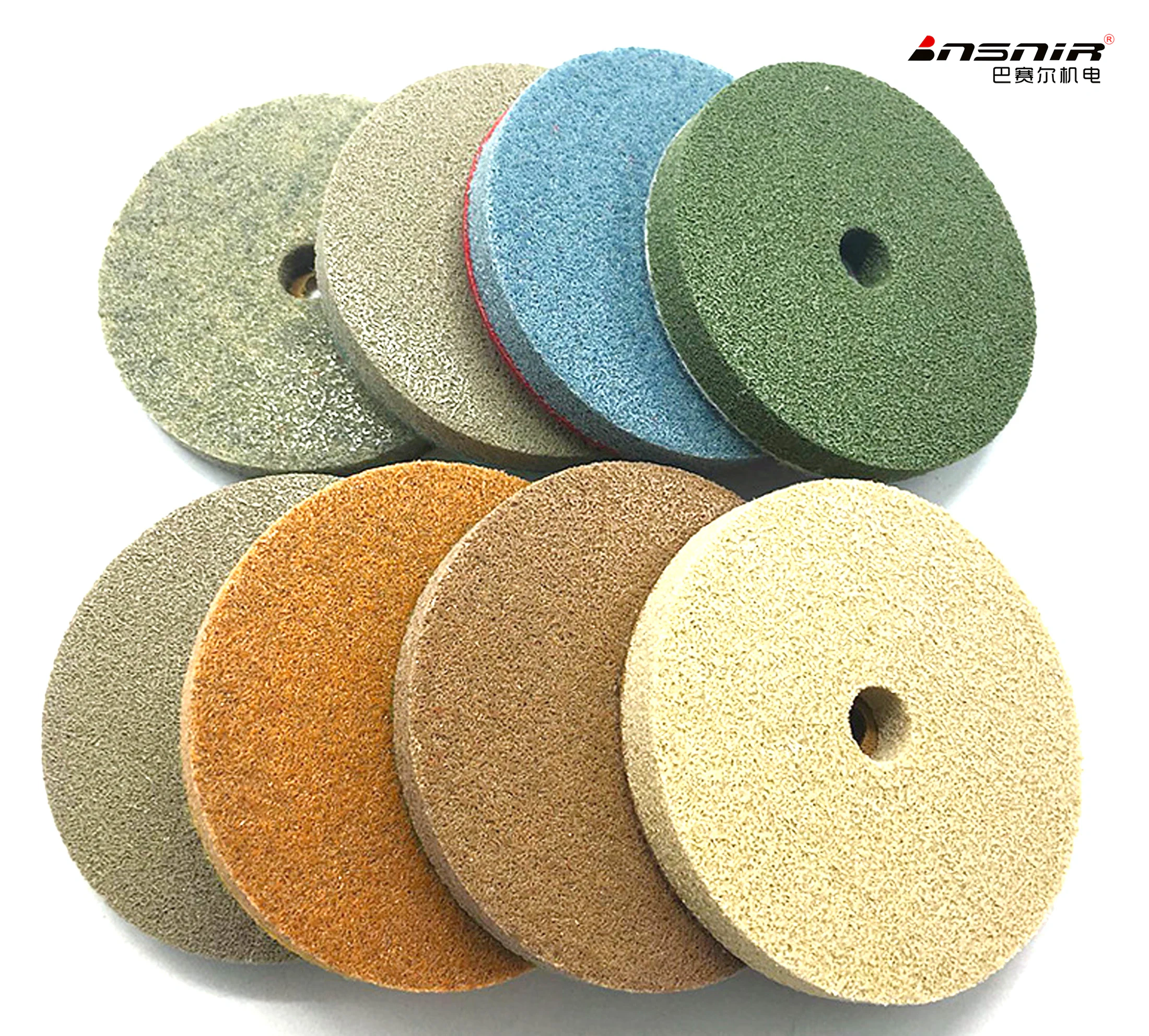
Select the pad family from the station duty
| Pad family | Starting process role | What must be specified | No saques conclusiones |
|---|---|---|---|
| Diamond | Mechanical grinding or surface refinement at a defined polishing stage | Abrasive/bond, grade, working pattern, backing, stage, removal/finish target and wet/dry approval | That every colored or textured round pad contains diamond or belongs at the same stage |
| PVC | Candidate end-line contact pad for a product-specific application or buffing duty | PVC formulation/type, face pattern, thickness, backing, compatible treatment, approved speed and cleaning method | Mechanical cutting ability, chemical compatibility or a fixed finish from material name alone |
| Fibre/nylon | Distributed-contact conditioning or buffing where the specified fibre construction suits the stage | Fibre construction, density/grade, backing, stage, dry/wet instruction and treatment compatibility | That printed numbers, colors or an open texture equal a transferable grit system |
| Wool | Final buffing with a separately approved dry or compound-assisted process | Wool/felt construction, density, thickness, backing, compound, speed, contact and cleaning/replacement rule | That wool alone creates a gloss target or is compatible with every treatment liquid |
| Sponge | Gentle distribution, application or final contact where the exact product instructions require foam | Foam type, pore/density, thickness, backing, liquid compatibility, absorption/release and cleanout | That visual softness proves chemical resistance, dosing control or finish performance |
Diamond pads belong to a defined grinding or refinement step
Start with the incoming surface, required material change and the preceding/following abrasives. Confirm whether the proposed pad cuts, refines or only conditions the surface. Diameter and grade are not enough: the bond, working-face geometry, backing, attachment, approved speed, coolant condition and head motion must all match the machine.
A diamond-pad stage does not replace the separate elastic-Lappato sequence, abrasive-brush texture route or chemical end treatment. Accept the result through a controlled trial on representative tiles, with the surface state recorded before and after the pad stage.
Keep four end-stage materials distinct

PVC pads are evaluated against the actual application or buffing duty. The offer should state whether the pad spreads material, works it into the surface, removes residue or performs a dry finishing contact. Each duty has different compatibility, cleaning and replacement questions.
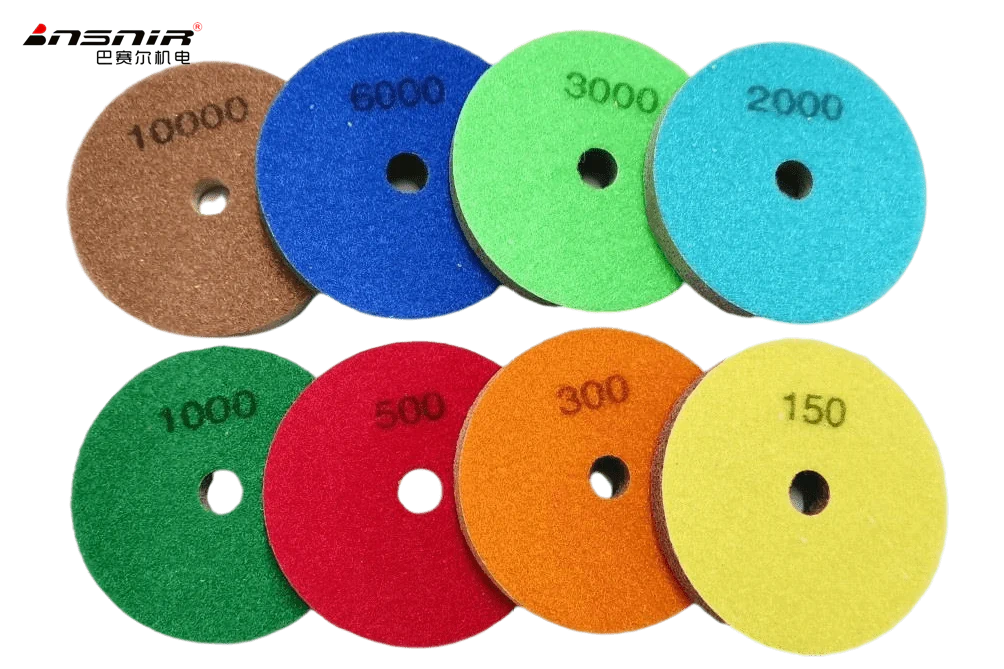
Fibre/nylon pads use a fibrous working face for distributed contact. Their stage can only be assigned after confirming the exact fibre product, backing, dry/wet instruction, current surface and target. Do not transfer the grade printed on one supplied family to another manufacturer or material.
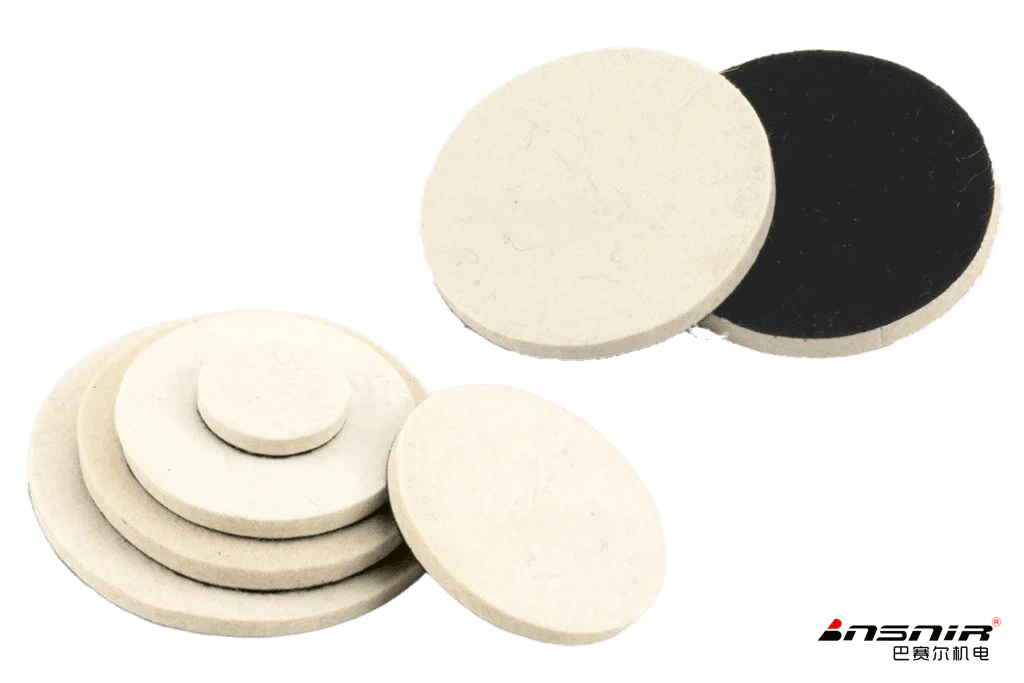
Wool pads are a final-buffing candidate when the machine, compound or dry process and surface allow it. Confirm heat, residue, loading and cleanout during the trial. A visual gloss change does not by itself establish chemical cure, stain resistance or packaging compatibility.

Sponge pads may be evaluated for gentle distribution or application where the exact consumable instructions call for that contact body. Absorption, release, swelling, residue and cleaning must be tested with the actual treatment product; a generic “nano” label cannot approve the combination.
Match the tray, holes, backing and clearance
| Elemento de interfaz | Record from the current installation | Why it changes selection |
|---|---|---|
| Pad size | Outside diameter, working thickness, total thickness and permitted wear/change point | Controls contact area, clearance and holder coverage |
| Hole pattern | Center bore plus any bolt, pin, vacuum or liquid-distribution holes; measure diameter and pitch circle where applicable | A visible center hole does not establish mounting or fluid flow |
| Backing/attachment | Photograph and identify hook-and-loop, adhesive, clamped, keyed, bolted or other attachment; confirm tray material and face condition | Prevents detachment, eccentric mounting and unsupported substitution |
| Head and motion | Machine/head model, pad count, rotation/orbit, direction, approved speed and contact setting | Binds the pad to its actual machine position rather than to appearance |
Confirm dry/wet use and treatment-liquid compatibility
For a mechanical pad, obtain the manufacturer’s dry/wet restriction, speed limit and coolant/cleaning instructions. For an application or buffing pad, obtain compatibility confirmation for the exact treatment product, including carrier solvent or water phase, temperature, dwell, residue and cleaning method. Do not trial an unknown chemistry on a pad selected only by visual similarity.
If liquid is fed through the tray or head, document the hole path, flow distribution, seals and cleanout. If the process is dry, document dust/residue control and heat observation. A pad approved for water-assisted mechanical polishing is not automatically approved for a wax or coating, and a pad used with one treatment batch is not automatically approved for another.
Define the preceding and following stages
State what surface enters the pad, what the pad must change and what stage follows. Mechanical grinding/refinement may hand off to inspection or a finer mechanical tool. End-line pads may distribute an approved consumable, work it in, remove excess or buff after the required dwell. These duties must be listed separately even if one machine carries several heads.
Run representative tiles through the complete proposed sequence. Record pad identity and wear, dry/wet or chemical condition, speed, contact setting, line speed, surface state and inspection time. Approve only the tested combination; do not turn color, material name or one gloss observation into a general performance promise.
Information needed to match polishing and buffing pads
- Machine manufacturer/model, head/tray type, pad position, quantity, motion, direction and approved speed range.
- Photographs of the working face, backing, empty tray and installed pad.
- Outside diameter, total/working thickness, center bore, all holes/pins and attachment method.
- Requested family: diamond, PVC, fibre/nylon, wool or sponge; current label and grade if known.
- Tile/stone material, processed surface, size/thickness, incoming condition and target sample.
- Whether the stage grinds, refines, conditions, applies treatment, removes residue or buffs.
- Dry/wet condition, water or coolant delivery, treatment-product identity and compatibility documents where applicable.
- Preceding/following tools, line speed, contact setting, defects to avoid, trial quantity and order quantity.
Request a pad, tray and process-stage review
Pad material, grade, attachment, speed, dry/wet condition, treatment compatibility and result remain conditional on the exact product, machine, surface and controlled trial.