
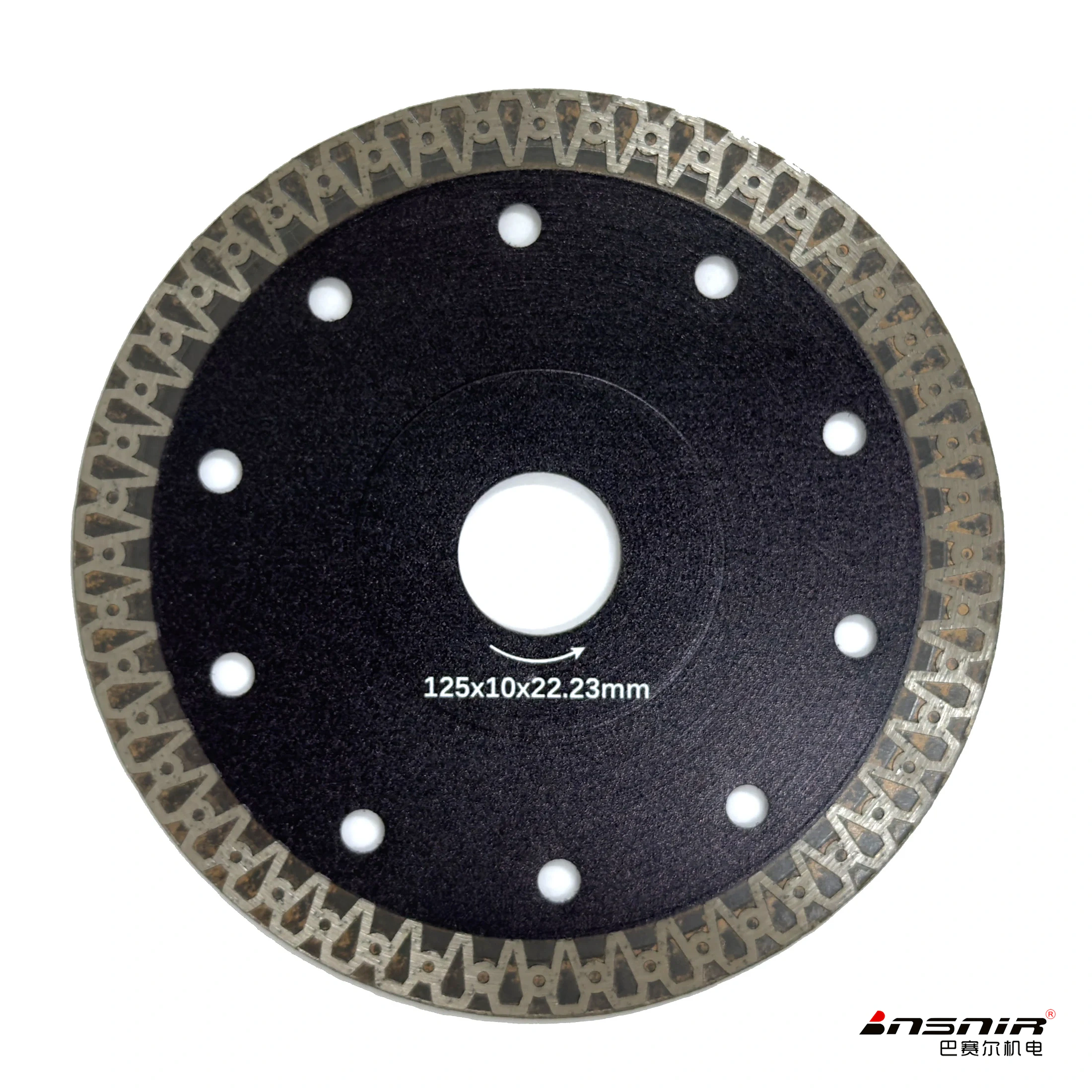
Patterned working rim
Uninterrupted working rim
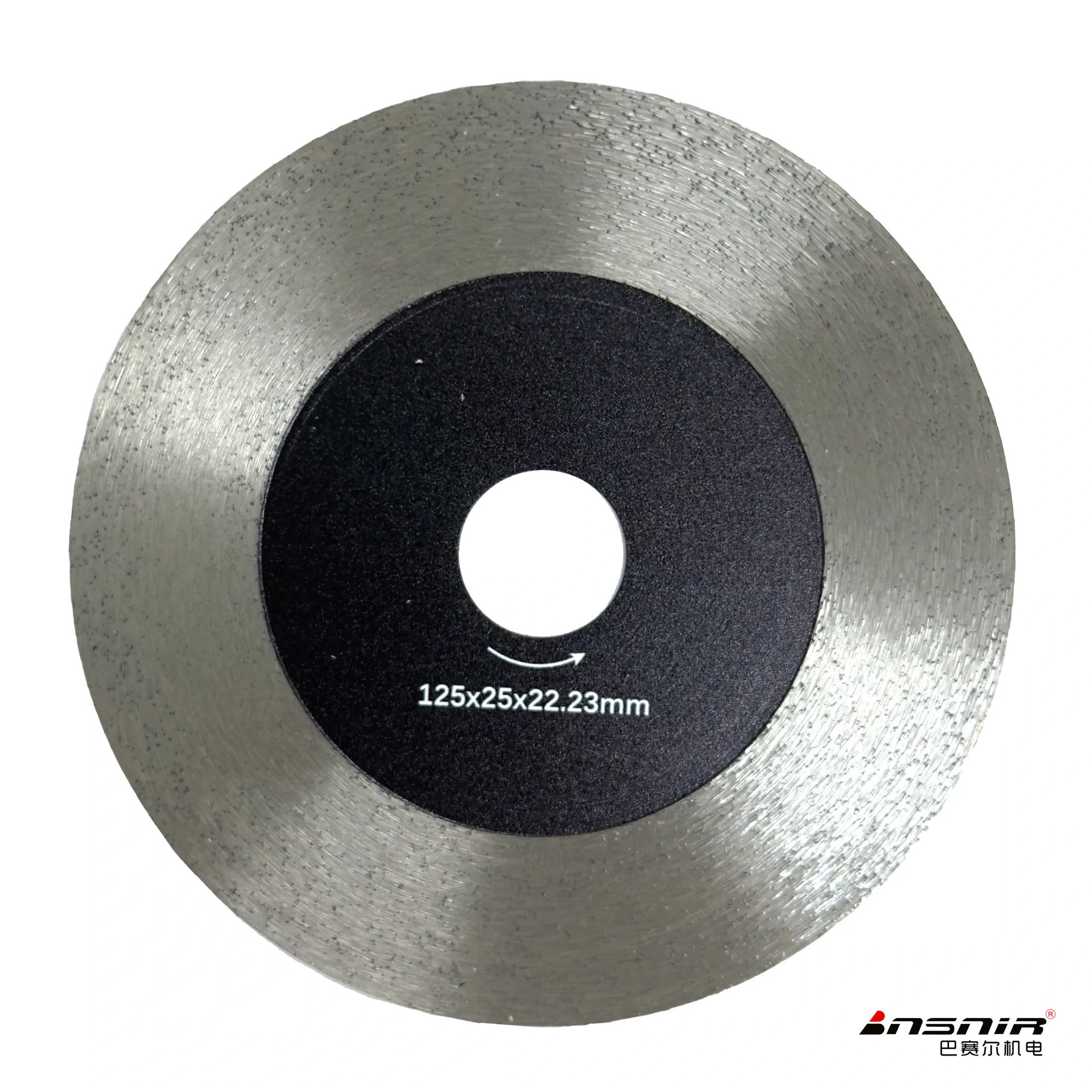
Send both blade faces and marking, outside diameter and bore, material and thickness, wet/dry duty, and single- or multi-blade arrangement.
Hojas de sierra de diamante are selected as a dimensioned, speed-rated cutting component for one machine, material and cut schedule. Outside diameter, bore, core and working-edge geometry must be checked together with kerf, material thickness, cooling, spindle/flange and single- or multi-blade assembly.
Keep three records separate: the photographs show visible blade features and markings; the 130 mm nominal reference below describes one size option; the later published SKU table includes 125 mm and other item-bound dimensions. They are not one interchangeable specification. Confirm the exact marked product and drawing.
Small-diameter blades and machine-specific cutting sets
The additional ceramic-tile blade family includes a 130 mm nominal-diameter reference. Treat this as one size option to match to the spindle and cutting duty; it does not redefine the full blade range or approve a wet or dry operating condition.
For a multi-blade station, send the stack arrangement as well as one blade sample. Record blade diameter, bore, thickness, flange contact, spacers, cutting direction and coolant delivery. A blade that fits a single-spindle guard may still be unsuitable in a closely spaced cutting stack.
Generic cutting-blade catalogue entries do not supply a verified speed rating, bond, segment geometry or material approval. The marked blade and written proposal must establish these items before a replacement is fitted. Keep the SKU-bound references below attached to their original material and station conditions.
Start from the cutting and grooving tool route y el ceramic tile cutting-system choice. This page covers straight saw-blade selection; it does not absorb grooving discs, chamfer-cutting discs, blade spacers or the cutting machine itself.
Build one blade record from machine, material and finished cut
| Campo de selección | Buyer/machine evidence | Confirmación del proveedor | Selection limit |
|---|---|---|---|
| Outside diameter | Current blade measurement, guard and machine drawing | Exact SKU diameter and tolerance | Must clear guards, coolant hardware and adjacent blades through full wear/use condition |
| Bore and mounting | Spindle/arbor diameter, flange faces, pins/holes, rotation and photographs | Bore, bush if any, secondary-hole pattern and flange requirement | Never modify a blade or force a mismatch onto the spindle |
| Core/body thickness | Measured current core plus machine clearance and stack drawing | SKU-bound core thickness and any reinforcing plate | Core thickness is not the same as segment width or actual kerf |
| Working rim/segment | Photographs, current SKU, working-edge width/height and wear condition | Construction, segment/rim geometry, bond and approved duty | Rim appearance alone cannot prove speed, chip result or life |
| Kerf/cut allowance | Parent and finished-part drawing, trim and measured current cut | Expected trial cut width under the proposed blade, alignment and material | Do not equate nominal segment thickness with finished kerf without trial evidence |
| Allowed speed | Machine spindle-speed range and control method | Current product marking/data sheet with maximum operating speed and maximum rpm for the exact SKU | Use only within both blade and machine limits; never infer from diameter or rim pattern |
| Material and thickness | Body/material, glaze/surface, thickness range, size and batch variation | Approved material/thickness range and trial condition for the exact blade | “Ceramic” or “porcelain” alone is not enough |
| Dry/wet and coolant | Machine process, nozzle position, water quality/flow, slurry or dust route | Exact dry/wet restriction and coolant instruction | Do not run a wet-only blade dry or assume water delivery from the word “wet” |
| Single/multi-blade | Blade count, spindle length, flanges, spacers, output schedule and narrow-piece support | Approved stack, blade consistency, clamping and drive/load condition | A blade sold for single use is not automatically approved for a gang stack |
Use rim geometry as an identification field, not a performance promise
Continuous, slotted, patterned or segmented appearances can help identify the offered construction, but the manufacturer must bind that construction to the exact SKU, machine duty and operating data. A rim shape must not be turned into an unconditional “faster,” “chip-free,” “long-life” or heat-control claim.
Photograph both blade faces and the working edge. Record segment/rim width, core thickness, bore, secondary holes, rotation marking, product code and maximum-speed marking. If any field is missing or illegible, obtain the current manufacturer data before the blade is approved for installation.
Current BASAIR published dimensions are SKU-bound examples
The current BASAIR saw-blade page publishes the following table. These values stay attached to the listed item number and are not generalized to a rim family. The source labels one field “Qty” without defining its engineering meaning; it must be clarified on the quotation/drawing. The page does not publish allowed rpm, material-thickness range or dry/wet restriction for each row, so those fields remain mandatory before use.
| Artículo | Blade OD (mm) | Qty (source label) | Core thickness (mm) | Reinforcing plate OD (mm) | Segment thickness (mm) | Segment height (mm) | Bore (mm) |
|---|---|---|---|---|---|---|---|
| SB-01 | 125 | 1 | 1.2 | — | 1.7 | 25 | 22.23 |
| SB-02 | 125 | 1 | 1.2 | — | 1.7 | 25 | 22.23 |
| SB-03 | 125 | 1 | 1.2 | — | 1.6 | 25 | 22.23 |
| SB-04 | 125 | 1 | 1.2 | — | 1.7 | 25 | 22.23 |
| SB-05 | 115 | 1 | 0.9 | 60 | 1.2 | 8.0 | 22.23 |
| SB-06 | 125 | 1 | 0.9 | 70 | 1.2 | 8.0 | 22.23 |
| SB-07 | 115 | 1 | Núcleo delgado mecanizado | 65 | 0.8 | 7.0 | 22.23 |
| SB-08 | 125 | 1 | Núcleo delgado mecanizado | 80 | 0.8 | 7.0 | 22.23 |
| SB-09 | 116 | 1 | 1.4 | — | 1.8 | 8.0 | 22.23 |
| SB-10 | 250 | 1 | 1.6 | — | 2.0 | 8.0 | 25.4 |
| SB-11 | 300 | 1 | 1.6 | — | 2.0 | 10.0 | 25.4 |
| SB-12 | 350 | 1 | 1.8 | — | 2.2 | 10.0 | 25.4 |
| SB-13 | 55 | 2 | 0.4 | — | 0.6 | 8.0 | 6.0 |
| SB-14 | 45 | 2 | — | — | 0.6 | Tamaño completo | 6.0 |
Allowed speed, material thickness and coolant are release conditions
The exact blade data sheet or permanent marking must state the permitted operating speed/rpm and restrictions for the proposed SKU. Confirm that the machine’s full speed range cannot exceed the blade limit. The current published SKU table above does not provide this release data, so none of its rows is approved for installation from the table alone.
Bind material and thickness to the same SKU record. Then state dry or wet operation, coolant flow and nozzle location, slurry or dust path, feed/support condition and inspection method. A wet process needs effective water delivery at the cut; simply having a pump elsewhere on the line is not proof of cooling at the blade.
Single-blade and multi-blade cutting use different assemblies
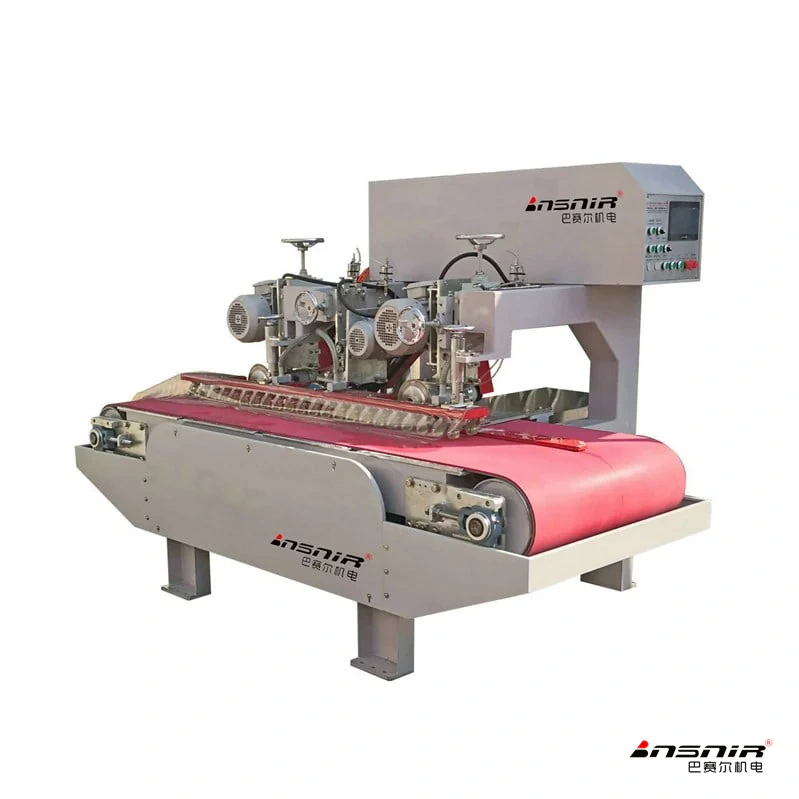
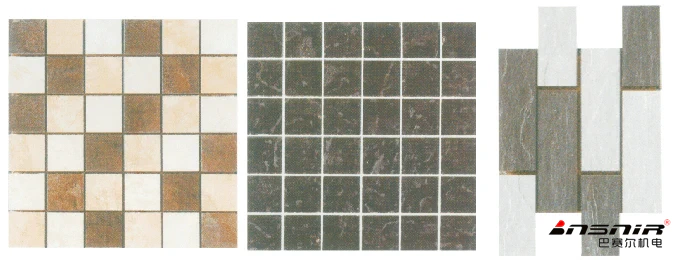
A single blade can be matched for one cut only after spindle, support, coolant and finished-edge requirements are known. For repeated strips or mosaic blanks, use the multi-blade cutter route and treat blades, flanges and spacers/mounting parts as one dimensioned stack.
The purchase drawing should list each blade and spacer from a fixed spindle reference, usable spindle length, clamping/end restraint, rotation, clearances and every target piece width. Finished width depends on the complete stack and actual kerf; it is not equal to a spacer label by itself. See the planned mosaic and strip production route for the full cutting, handling and downstream edge-processing responsibility.
The planned dry scoring-and-splitting route at Dry Scoring & Splitting Machine is currently stopped for missing identity-clear equipment evidence and is not presented here as published, available or validated. Scoring/splitting also uses a different separation principle and must not be used as proof for a saw blade.
Approve the blade through a controlled cut trial
Use representative material across the requested thickness and surface range. Record blade SKU/lot, mounting stack, spindle speed, feed, coolant/dust condition, cut direction and wear state. Measure actual kerf, finished dimensions, cut-edge condition and repeatability using an agreed method. Separate startup, changeover, breakage and rejected pieces from accepted output.
Inspect the blade and mounting components before use and after abnormal sound, impact or cut behavior. Guards, interlocks, support and site safety requirements remain machine responsibilities. No rim pattern, catalog photograph or one successful sample proves universal no-chipping performance, life or safe operating speed.
Information needed to match diamond saw blades
- Machine manufacturer/model, spindle/arbor drawing, flange/pin arrangement, rotation, speed range, guard and usable clearance.
- Current blade photographs of both faces, rim and marking; product code/lot and manufacturer data if available.
- Outside diameter, bore, secondary holes, core thickness, reinforcing plate and working-rim/segment dimensions.
- Tile/stone material, body/surface, dimensions, thickness range, batch variation and representative samples.
- Parent and finished-part drawing, cut direction, required kerf/allowance, edge inspection method and downstream process.
- Dry/wet condition, coolant position/flow and water quality, or dust-control route for an approved dry blade.
- Para trabajos con varias hojas: número de hojas, cada espaciador/brida, orden de apilamiento, longitud del husillo, anchuras deseadas y soporte para piezas estrechas.
- Cantidad necesaria, plan de pruebas, defectos observados y criterios de aceptación.
Solicitar una revisión de la hoja, el husillo y el programa de corte
Las dimensiones, la velocidad permitida, el material y el grosor, el refrigerante, el ancho de corte, el resultado del borde y la vida útil dependen de la referencia (SKU) o lote exactos, la máquina, el apilado, el material y la prueba controlada.