
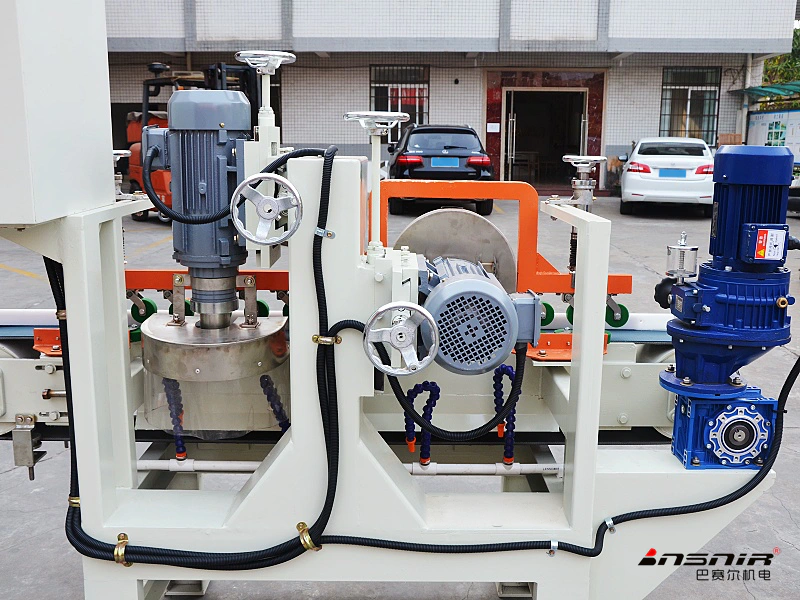
This machine prepares a repeatable L-shaped stone blank with one horizontal and one vertical saw station. It is a dedicated blank-making step for corner or line work. It is not a general promise to cut an L-shaped countertop outline, and it does not replace the downstream machine that creates and polishes the final profile.

Plan the blank around the horizontal and vertical cuts. Send the stone section, two leg dimensions and support requirements for a configuration review.
The purchasing task in five parts
- Entrada
- Pre-cut small square or rectangular engineered-stone/stone blanks with a known length, width, thickness, datum edge and an approved L-section drawing.
- Acción
- Guide and press the blank on a conveyor while one horizontal and one vertical wet saw remove the specified corner material. Each saw position is adjusted to the required blank geometry.
- Resultado
- An L-shaped corner or line blank with sawn faces, ready for a template-guided shaping and polishing operation.
- Comprador
- Engineered-stone and decorative-line processors making repeated L-section blanks or external-corner components from pre-cut stock.
- Exclusión
- Not a bridge saw for an L-shaped countertop plan, not a sink cut-out machine, and not a profile shaper or polisher. For target contour formation, continue to the stone profile shaping machine; for countertop geometry, use the countertop cutting route.
Selection decisions
| Decisión | What to define | ¿Por qué cambia la máquina? | Límite |
|---|---|---|---|
| L-section geometry | Outside dimensions, leg widths, removed block, sawn-face allowance and orientation | Sets both blade positions and the guide datum | A plan-view L countertop is a different task |
| Material and thickness | Engineered stone, agglomerate or other proposed material; thickness range; reinforcement or resin-rich zones | Changes blade, cooling, feed and support | The exact source identifies artificial/engineered stone; other materials require partner confirmation |
| Holding method | Guide edge, pressure-wheel contact, underside support and downstream template | Prevents movement and protects a fragile blank | A shaping template belongs to the next operation, not the cut itself |
| Batch pattern | Pieces per size, changes per shift and required buffer | Determines whether manual handwheel adjustment and a compact conveyor are suitable | Mixed one-off geometries may fit a CNC cutting route better |
| Next operation | Target profile, faces to polish, template/nest and acceptable sawn allowance | Prevents over-cutting material needed for shaping | This cutter does not deliver the final visible profile |
YSQZ-200 model reference
The exact partner page identifies YSQZ-200 as a two-blade L-shape cutter with one horizontal and one vertical head. Its reference table lists a 5.5 kW motor and a 200–250 mm saw range for each head, a 200 mm main belt, 0.75 kW transmission motor, 2400 × 1100 × 1650 mm machine envelope, 380 V and approximately 600 kg. These values belong only to the shown model and must be reconfirmed for the proposed material, market voltage, guarding and supply scope.
From slab to finished corner: the full process boundary
- Pre-cut: a bridge saw or straight cutter divides the large slab into manageable blanks with a usable datum edge.
- L blank cutting: this machine makes the horizontal and vertical cuts that remove the corner block.
- Inspección: verify leg dimensions, remaining material, cracks, chipping and whether enough allowance remains for the target profile.
- Template support: if multiple L blanks enter a shaping process together, the fixture or template must locate each piece without rocking or point loading.
- Profile shaping and polishing: a separate profile machine removes the sharp corner and develops the approved visible section. The complete small-piece route is covered under stone profile and small-piece processing.
Mechanical, utility and site interfaces
Guides, pressing and blank support
Confirm which face may contact the side guide and pressure wheel. Polished or fragile surfaces can require protective contact materials. The pressure system must restrain the blank without opening an existing fissure. Specify the smallest piece, because a pressure wheel that works on a long strip may lose contact before a short blank reaches the second station.
Saws and cooling
Submit the material and cut direction so the cooperating source can choose the blade diameter, bond, segment and spindle arrangement. Each blade needs directed water at the cut, a drain path that does not flood bearings or the floor, and access for safe replacement. The source photographs show local water shields, but they do not prove the final project’s water containment.
Electricity, water and slurry
Provide site voltage, frequency, phase and earthing. Confirm clean-water pressure/flow, the sump and settling route, and whether water will be recirculated. Fine sludge must not accumulate under the belt or around adjustment mechanisms. Any compressed-air demand must be confirmed from the selected build rather than assumed.
Space and safety
Reserve straight access at both ends, room to adjust and replace both saws, drainage falls, non-slip walkways and a handling route for input blanks and removed blocks. Required safeguards include saw enclosures, emergency stops, electrical isolation, lockout points and a documented jam-clearing method. Destination-site risk assessment and regulations control the final guarding package.
Information to submit
| Enviar | Datos obligatorios | Used to confirm |
|---|---|---|
| Material | Name, composition/type, thickness range, surface and representative samples | Blade, feed, cooling and contact materials |
| Dimensioned drawings | Input blank and desired L blank; identify datum and all allowances | Two saw positions and adjustability |
| Next-process drawing | Final profile, polished faces, fixture or template concept | Material left for E410 shaping |
| Cartera de productos | Pieces/shift, batch size, size changes and labour arrangement | Feed method and economic fit |
| Interfaces | Upstream blank supply, downstream rack/line, transfer height and direction | Infeed/outfeed and handling scope |
| Utilities and floor plan | Electricity, water, drainage/slurry, available space and maintenance clearances | Site fit and complete project boundary |
Browse the wider stone and countertop equipment path if the geometry is not yet fixed.