
This machine family shapes one continuous stone profile from a straight blank; it does not complete the polishing stage. The wheel set defines the geometry, so one installed profile set produces one approved contour at a time. BASAIR can translate the buyer’s drawing and blank into a partner configuration, then define the handoff to manual or automatic polishing.
Start with the finished section and blank allowance. Match the forming wheel to the required contour, then define the separate polishing stage.
Request a stone profile shaping review
1. Convert the finished profile into a shaping task
Provide a dimensioned cross-section, not only a product name such as cornice, door frame or skirting. Mark datum surfaces, overall width and thickness, maximum drop, concave/convex radii, sharp transitions and the faces that must remain uncut. The straight blank must contain enough allowance for the deepest feature while still presenting stable bearing surfaces to the conveyor and pressure system.
E410 is for a repeated contour along the workpiece length. It does not polish the shaped face, finish the two side edges automatically or process a four-sided square column by indexed passes. Those are adjacent but separate responsibilities.
2. Match four shaping heads to one approved contour
| Punto de selección | YSX-250 source reference | What must be approved |
|---|---|---|
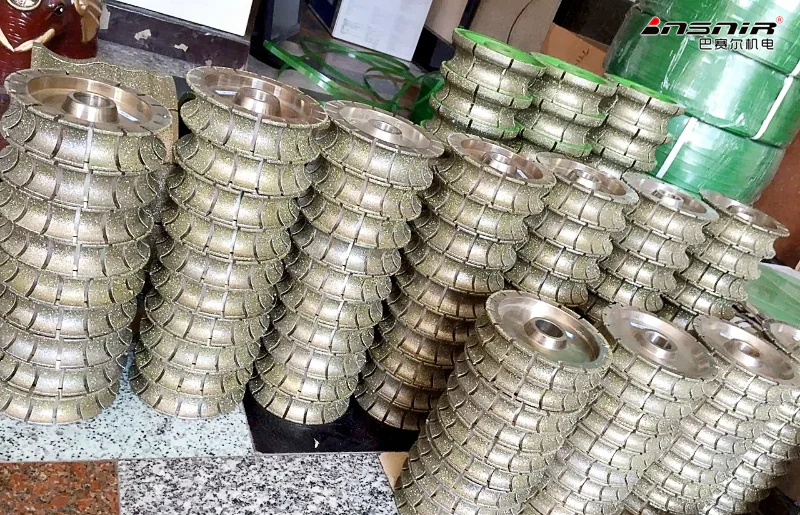
| Shaping positions | 4 shaping heads; Ø200 × 60 mm electroplated wheels; manual head lift | Removal split, wheel stack, spindle interface and adjustment plan |
| One-profile rule | One installed wheel shape produces one contour; change the wheel set for another contour | Profile families, changeover frequency, wheel storage and setup verification |
| Reference work window | 30–400 mm working width; 10–70 mm thickness; up to 70 mm drop | Actual blank, finished section, bearing face and clearance around the deepest relief |
| Referencia de la fuente | 0.3–3 m/min | Sustainable speed by material, total removal, profile complexity, wheel condition and inspection plan |
All dimensions and speed values above belong to the cited YSX-250 reference and require partner confirmation for the ordered machine.
3. Control blank support, wheel stages and downstream polishing
Upstream cutting and, where needed, thickness preparation should produce a straight blank with repeatable datum faces. Entry/exit roller stands must support the full length without lifting the blank off the belt. Guides and pressure wheels should hold the blank against the datum while avoiding a finished face. Very short, narrow or heavily relieved parts need a dedicated stability check.
Split the total removal across the four shaping heads rather than forcing the finished contour in one aggressive contact. The source configuration uses electroplated profile wheels; actual wheel bond, geometry, overlap and dressing/replacement plan depend on the stone and section. The machine ends after shaping. If the shaped face must be polished automatically, hand it to the stone profile polishing machine. If the two straight side edges remain unfinished, treat them on the profile side-edge polisher.

4. Confirm electrical, wet-process and site responsibilities
The YSX-250 source table lists 36.6 kW total power, a 3.8 × 1.8 × 2.0 m four-head machine envelope and approximately 2 t weight. It does not provide a dependable water-consumption or compressed-air figure. Confirm voltage/frequency, motor starting method, installed load, cooling-water flow/pressure, drainage, return-water quality and whether the ordered controls or accessories need compressed air. Do not reserve an air system from an unsupported assumption.
Wet shaping creates coarse fines and sludge. Provide splash containment, screening, settling/dewatering and cleaning access; recycled water must remain suitable for the wheel and surface. Allow space for long blanks, front/rear roller stands, wheel handling and guarded maintenance. Emergency stops, interlocks, lockout, electrical protection, lifting aids and local machine-safety requirements must be reviewed for the actual installation.
5. Submit the drawing, blank and line interface
| Enviar | Datos obligatorios |
|---|---|
| Finished profile drawing | Dimensioned section, datums, radii, depth/drop, tolerances and protected faces |
| Blank and material | Stone type, L × W × T, allowance, straightness and photos/samples |
| Tooling plan | Existing wheel/spindle data, profile families and expected changeover frequency |
| Producción | Metres/shift by profile, batch sizes, inspection and rework method |
| Upstream/downstream | Blank preparation, transfer height, automatic/manual polishing and side-edge requirement |
| Site | Power, water, possible air demand, drainage/sludge route, foundation and long-piece access |
Utiliza el stone, sintered stone and countertop equipment guide for the parent path, or review the full Solución para el perfilado de piedra y el procesamiento de piezas pequeñas.