
A multi-blade tile cutting machine divides one tile into repeated strips or mosaic blanks by mounting several saw blades on one or more spindles. It is a wet saw-cutting route, not a dry scoring-and-splitting machine. The blade stack, spacers, material support and downstream handling must be designed together around the finished-piece schedule.
Utiliza el ceramic tile cutting systems page first if you still need to compare scoring/splitting, multi-blade wet cutting and CNC cutting.
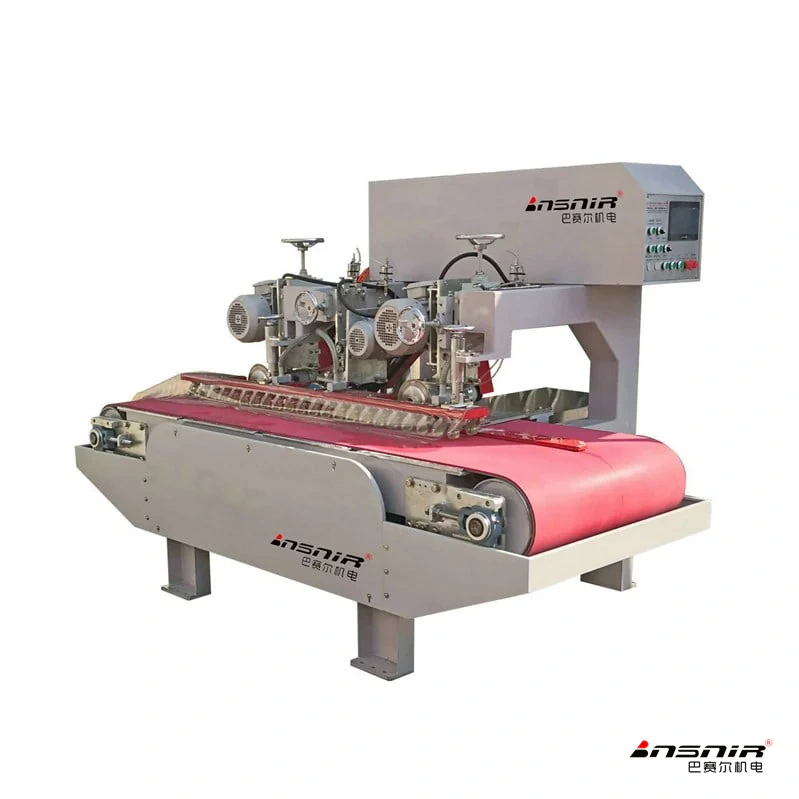
Choose the spindle arrangement from the cutting plan
| Arrangement | Best starting question | What must be checked | Typical project risk |
|---|---|---|---|
| Single spindle with multiple blades | Can the required strip schedule be cut in one pass? | Usable spindle length, blade quantity, spacer stack, drive load and minimum supported piece | Requesting too many cuts without checking spindle, support or motor limits |
| Two spindles or two cutting stages | Is the second stage needed for another direction, another cut group or load distribution? | Tile orientation between stages, cut-piece spacing, synchronization and collection | Calling every two-head machine “dual-spindle” without confirming the actual material path |
Treat the blade and spacer stack as a dimensioned assembly
The finished strip width is not selected from a machine name. It comes from the mounted blade positions, blade body and segment geometry, spacer and flange stack, usable spindle length, end restraint, alignment and the material removed by each cut. The purchase drawing should identify every blade, spacer, flange and free position in order from a fixed spindle reference.
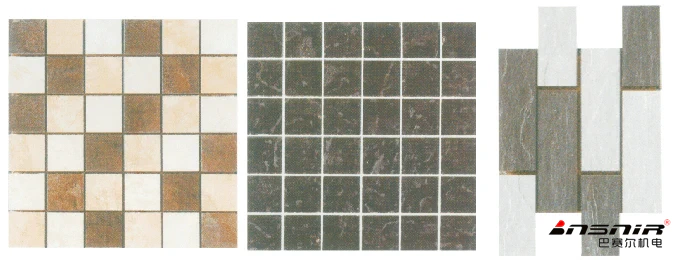
For several output widths in one run, provide a cut map showing the parent tile, trim allowances and each required finished piece. BASAIR can then review the matching hojas de sierra de diamante and saw-blade spacers and mounting parts. Do not assume a spacer marked with one thickness automatically produces that exact finished width; blade kerf, runout and layout also matter.
Support the parent tile and every smaller output
Small pieces become less stable as cutting progresses. The review should cover belt or roller gaps, pressure devices, water flow, tile flatness, broken-piece escape, transfer between stages and finished-piece collection. A cut schedule that fits mathematically can still fail if the narrowest strip is not supported through the blade and transfer zones.
If the output goes to edge finishing, state whether pieces remain in lane order, are turned, or are accumulated before the next machine. The planned mosaic and strip production page connects cutting, edge processing and collection as one line decision.
Confirm utilities, cooling and line boundaries
- Electrical supply and the separate loads of spindle, conveyor, pump and auxiliary modules.
- Process-water quality, flow and nozzle arrangement for the selected blades and material.
- Slurry collection, drainage and the factory treatment or recirculation boundary.
- Infeed tile orientation, locating reference and acceptable incoming variation.
- Outfeed piece size, spacing, edge-finishing handoff and scrap route.
- Blade-change access, lifting method, guards and the site’s applicable safety requirements.
Run the trial with the final blade-stack logic
A useful factory test uses representative tiles and a documented blade/spacer assembly. Measure the parent tile before cutting; then record each finished width, edge condition, chipping method, breakage, blade runout where applicable, line setting and accepted output. Keep startup, changeover, planned stops and rejected pieces separate from accepted production.
Final tolerances, output and blade life are project-specific. They depend on tile body, thickness, glaze, blade specification, stack alignment, cooling, feed setting and the agreed inspection method.
Information to send with the cut schedule
- Tile material, glaze or surface, dimensions, thickness range and photos.
- Parent-tile drawing and every required strip or mosaic blank size.
- Required cut directions and whether one or two cutting stages are expected.
- Edge-quality and dimensional inspection method, with approved samples if available.
- Required usable output, shift pattern, product mix and changeover frequency.
- Current spindle drawing, blade bore/diameter and spacer details for a retrofit.
- Available power, water, drainage, floor area and downstream handling plan.
Solicitar un análisis de corte con múltiples cuchillas
Recorridos de un, dos y tres husillos
La familia de referencia incluye configuraciones de un, dos y tres husillos para tiras estrechas repetidas, piezas en bruto para zócalos y trabajos en mosaico. En un recorrido por etapas, un husillo puede realizar el precorte y otro la separación completa; la presencia de un husillo adicional no garantiza una secuencia de operación universal. Solicite el esquema de cuchillas ofrecido, las posiciones de los husillos, la profundidad de corte por pasada y el apoyo entre pasadas.
Para las virutas de mosaico, pueden ser necesarias placas de presión o un dispositivo de sujeción específico cuando los rodillos no puedan sujetar las piezas más pequeñas de forma segura y uniforme. Para las tiras largas de zócalo, dé prioridad al apoyo recto y a la descarga controlada. Una pila de cuchillas que produzca el ancho requerido sobre el papel sigue necesitando una prueba para comprobar el astillado, la deflexión de las cuchillas, la variación del corte y si las piezas se pueden separar y contar. Indique el tamaño mínimo de las piezas y todos los patrones de anchos mixtos antes de seleccionar el número de cuchillas.