
Move tile batches between process lines and hold planned work-in-process without treating every pause as the same buffer problem. BASAIR receives the line duty, layout and production constraints; the partner confirms the transfer mechanism, storage arrangement, controls and final supply boundary for the project.
1. Separate transfer duty from storage duty
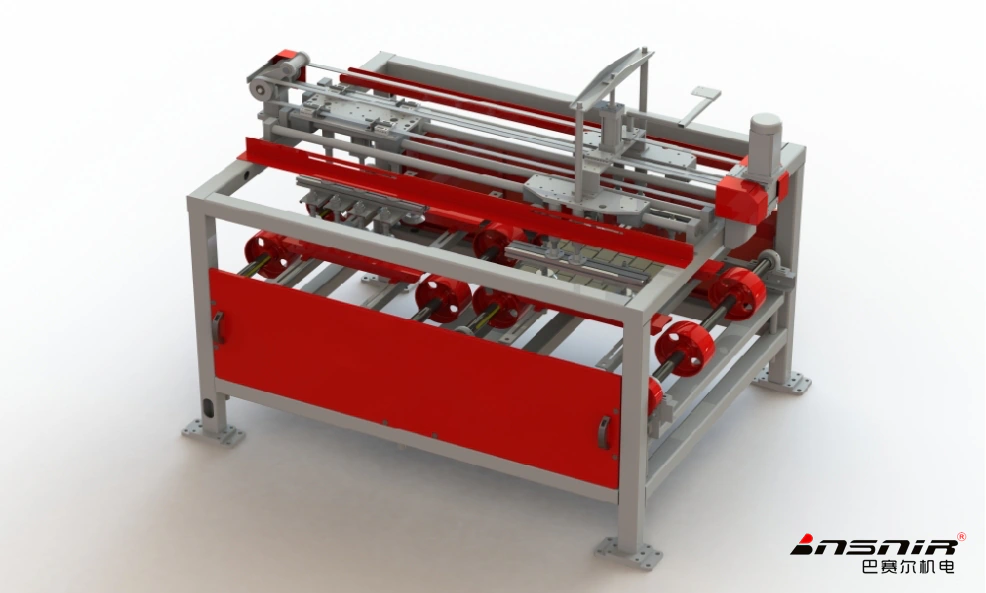
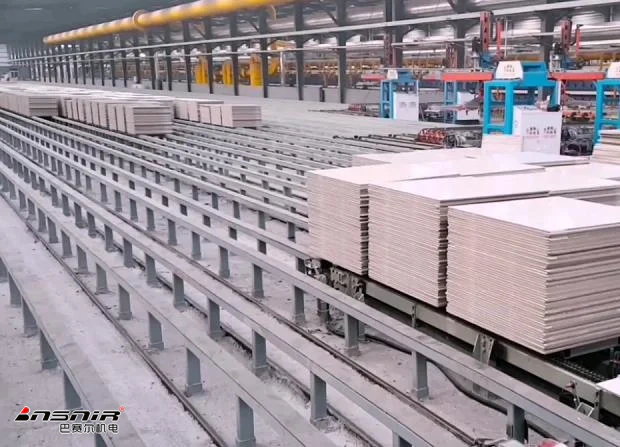
A transfer unit changes the location of a tile stack or batch between defined infeed and outfeed points. A storage line holds multiple batches so production can continue across a planned sequence, a format change or a downstream interruption. Define both duties before choosing equipment: the same project may need a compact transfer station, a multi-lane storage area, or the two connected as one controlled system.
This page covers line-to-line transfer and temporary batch storage. It does not replace tile loading and unloading selection, general conveyor and positioning design, or a short-duration line buffer and accumulator.
2. Make the main selection trade-offs explicit
| Decisión | Choose the first direction when | Choose the second direction when | Confirmar antes de realizar el presupuesto |
|---|---|---|---|
| Transfer only vs. transfer plus storage | The next process is continuously available and only the route changes | Batches must wait, be sequenced or be isolated during a downstream stop | Stop scenarios, required hold time and restart sequence |
| First-in/first-out vs. flexible retrieval | Product sequence must remain unchanged | Orders or formats may need controlled resequencing | Batch identity, recipe logic and permitted reordering |
| Surface-mounted vs. pit-integrated conveying | Civil work must be minimized and floor crossings are manageable | A flush interface or lower transfer elevation justifies civil work | Floor loading, pit dimensions, drainage and maintenance access |
| Compact lanes vs. higher batch capacity | Available footprint is the binding constraint | Longer hold time and format separation have priority | Usable area, clear height, aisle access and batch count |
3. Use source numbers as configuration references, not promises
On the cited transfer-system reference configuration, the partner page lists 1.5 kW and 2.3 kW figures for robot motions, a two-belt infeed driven by a 1.1 kW motor with variable-frequency speed control, and an approximately 7 m plate-chain conveyor with 1.5 kW installed power. It also describes servo and worm-reducer drives, electronic and mechanical travel limits, and a large-stroke pneumatic cylinder for pushing an empty tile frame into position.
Those values describe that cited arrangement only. The selected motor power, travel, conveyor length, transfer height, storage capacity and cycle time depend on stack mass, tile dimensions, direction of travel, batch logic, safety layout and the upstream/downstream equipment confirmed for the project.
4. Freeze every mechanical, control and safety interface
- Producto: tile material and finish, length, width, thickness, unit and batch mass, stack height, separator or frame, edge condition and permissible contact areas.
- Line geometry: infeed and outfeed directions, datum side, conveyor elevation, lane spacing, transfer stroke, turning restrictions, floor area and clear height.
- Mechanical and civil: support points, frame or pallet dimensions, floor loading, anchor plan, any pit, drainage, guarding footprint and maintenance-removal route.
- Electrical and pneumatic: site voltage and frequency, available connected load, compressed-air pressure and quality, cable/air entry and isolation points.
- Controles: upstream/downstream ready, run, blocked, full, empty and fault signals; batch identification; recipe ownership; recovery after power loss; manual and maintenance modes.
- Seguridad: risk assessment, fixed and interlocked guarding, safe access, emergency-stop zoning, travel limits, presence detection, stored-energy isolation and responsibility for site compliance.
- Aceptación: agreed tile and batch set, transfer sequence, storage/retrieval logic, fault-recovery trials and measurable handover conditions.
BASAIR coordinates the buyer’s duty and line interfaces. The partner confirms the final mechanism, engineering values, guarding, controls and deliverables before an offer is frozen.
5. Submit the data needed to size the system
| Elemento de envío | Detalle mínimo | Por qué es importante |
|---|---|---|
| Tiles and batches | Material, surface, size range, thickness, unit mass, tiles per batch, stack/frame photos | Sets support, contact, load and travel requirements |
| Tarea de producción | Current and target rate, shifts, format mix, batch sequence and planned time | Establece los requisitos del ciclo y de la receta |
| Caja de almacenamiento | Escenario de parada, tiempo de retención requerido, número máximo de lotes, regla FIFO/de recuperación | Determina la capacidad y la lógica de los carriles |
| Línea existente | Disposición, elevaciones, direcciones, planos de las máquinas, señales y espacio disponible | Define el traspaso físico y de control |
| Servicios y seguridad | Suministro eléctrico, aire comprimido, restricciones del suelo o foso, requisitos de seguridad locales y partes responsables | Evita que el perímetro de suministro quede incompleto |
Para un trazado de línea más amplio, revisa automatización, manipulación y envasado y el solución de automatización y embalaje de baldosas.
Envía tu ruta de transferencia, los datos de los lotes y el plano para su revisión de configuración
Elige entre empuje, transferencia móvil y un traspaso fijo
Una estación de empuje desplaza un lote soportado desde una posición definida; una unidad de transferencia móvil cambia la posición del carro de manipulación; una disposición de doble capa introduce referencias de transferencia separadas para la parte superior e inferior. Estas rutas resuelven diferentes problemas de trazado. Indique ambas alturas de traspaso, las rutas de retorno con carga y sin carga, la restricción de apilamiento, la masa máxima del lote y el espacio necesario para recuperar un lote detenido. Una máquina de transferencia no proporciona automáticamente almacenamiento de lotes ni resecuenciación controlada.