
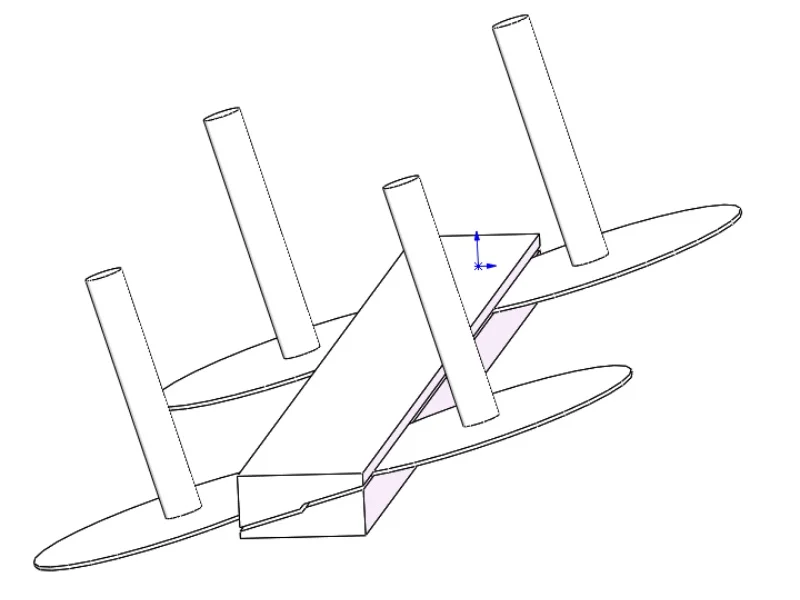
A thickness splitter divides a narrow thick strip into thinner blanks through its thickness. The YSQZ-150 reference uses four saw heads—two from each side—to create the split. The resulting faces can retain a small step or saw allowance, so the next operation is normally calibrating rather than immediate final finishing.
Send the incoming strip, target split and remaining stock. Define holding and blade clearance before deciding how much downstream calibration the part needs.
Input, action and output
- Entrada
- Narrow artificial-stone, engineered-stone or quartz strips with a confirmed width, original thickness, length, flat support face and detectable fissures or reinforcement.
- Acción
- Guide and press the strip on a narrow conveyor while opposed left/right saw groups cut through the thickness. Head height, lateral position and inclination are set for the intended split and remaining allowance.
- Resultado
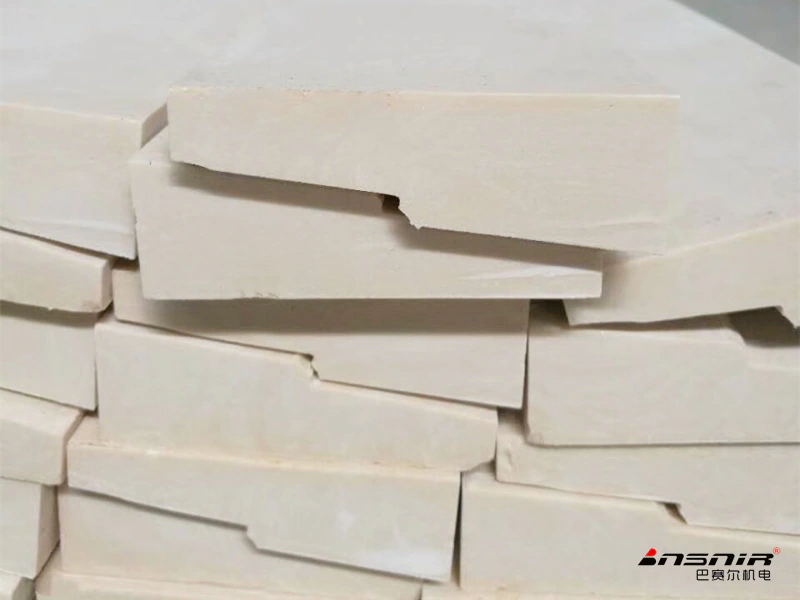
- Two thinner strip blanks, normally with sawn faces and a small meeting-line step or allowance that is removed in a following calibrating operation.
- Comprador
- Stone-line and engineered-stone processors seeking to recover two thinner blanks from a narrow thicker strip before profile shaping or polishing.
- Exclusión
- This machine does not set final face flatness, produce a polished face, shape a decorative profile or divide a full slab into plan sizes. Use the stone and quartz calibrating machine for the next thickness/flatness step.
The wider routing choices are under Equipos para piedra, piedra sinterizada y encimeras. For a combined strip workflow, see stone profile and small-piece processing.
Selection table
| Datos de selección | What must be measured | Machine consequence | Acceptance focus |
|---|---|---|---|
| Original and target thickness | Actual thickness variation; desired two blanks; saw kerfs; calibrating allowance | Blade height, inclination and meeting line | Minimum remaining thickness and step after splitting |
| Strip width and length | Smallest/largest width, length and straightness | Guide, 100 mm belt fit, pressure-wheel contact and infeed support | No loss of restraint before all blades clear |
| Material structure | Engineered stone/quartz type, resin content, inclusions, cracks and reinforcement | Blade bond, feed, water and whether the route is feasible | Cracking, breakout and blade deflection |
| Downstream process | Calibrator input range, final thickness, profile and polished faces | Required stock allowance and handling orientation | Blank must remain suitable for E405, not appear finished |
| Production pattern | Pieces/shift, batches, size changes and rework policy | Adjustment method, buffer and labour plan | Stable split across representative material |
YSQZ-150 model-bound reference
The exact partner page describes YSQZ-150 with four cutting heads, 200–250 mm saw blades, four 7.5 kW cutting motors, a 100 mm belt and a listed processing width of 30–150 mm. Its body text states a reference board thickness of 12–30 mm, and the table lists a reference processing speed of 0.5–3 m/min. These values apply only to the shown model and source configuration. Material strength, fissures, blade choice, meeting-line allowance and required downstream stock can narrow the usable range; the partner must confirm the offered values.
Clamp the strip without bending it
A narrow strip can twist or bow more easily than a slab. The datum guide must keep the strip straight while pressure wheels maintain contact before, between and after the blade groups. Submit the shortest strip and any edge waviness. A long part that remains supported is not evidence that a short part can cross every station safely.
Contact materials must suit the finished face. If the strip has a polished face, protective rollers or a defined sacrificial side may be needed. Existing fissures, porous areas and reinforcement should be marked because opposed cuts can release internal stress.
Blades, water and the downstream calibrator
The cooperating source must confirm blade diameter, segment/bond, spindle direction, inclination and cut depth for the submitted material. The meeting zone should leave enough stock to avoid an uncontrolled breakout while minimizing what the calibrator must remove. A visibly smooth split is not the same as a calibrated face.
Water has three jobs: cool each blade, carry swarf from the kerf and keep sludge from compacting around the belt and adjustment components. State whether the site uses fresh or recycled process water, and provide pressure, flow, filtration and settling information. Separate water delivery from the final polishing-water circuit if solids or chemistry make cross-use unsuitable.
Power, sludge, layout and safety
- Electricidad: confirm voltage, frequency, phase, earthing, available load, local isolator and protection method. The source’s 380 V reference is not a universal supply value.
- Wet-cut water: confirm clean-water pressure and flow at all four blades, nozzle access and whether the circuit uses fresh or filtered return water. The final filtration grade must be compatible with the blade/spindle supplier’s limits.
- Aire comprimido: the public YSQZ-150 source does not establish a compressed-air requirement for the reference structure. If the final configuration adds pneumatic clamping or actuators, confirm required pressure, flow and air quality; otherwise record compressed air as not applicable for the offered structure.
- Filtration, return water and slurry removal: capture and settle quartz/stone fines; define filters, return-water tank/pump, sump and the manual or mechanical sludge clean-out route for the actual shift load. Do not allow settled solids to lift or track the belt.
- Manipulación: support both thin outputs at discharge. A split piece can be more flexible and fragile than its input strip.
- Cleaning and maintenance: reserve safe access to nozzles, guards, belt underside, sumps and blade-change points; define isolation before cleaning, inspection or clearing a jam.
- Footprint and approach: include infeed/outfeed stands, blade-change clearance, drains, operator positions, maintenance approach and safe movement of strip bundles.
- Safety responsibility: the confirmed machine scope must state blade guards, splash containment, emergency-stop positions, approach/access protection, electrical isolation and lockout provisions. The buyer must confirm site-side aisles, drainage, utility isolation and destination rules; unresolved guarding or emergency-stop responsibility blocks final acceptance.
Information to submit for a partner configuration
| Enviar | Minimum content | Por qué es importante |
|---|---|---|
| Input strips | Material, length, width, actual thickness distribution, surface and photographs | Confirms the feasible holding and cutting envelope |
| Target split | Number of outputs, target blank thicknesses, kerf and calibrating allowance | Defines blade depth and meeting line |
| Material risk | Fissures, inclusions, reinforcement, rejected defects and sample pieces | Determines trial requirement and feasible yield boundary |
| Throughput | Pieces/shift, batches, changeovers and shifts | Feed and operating plan |
| Next machine | Calibrator range, transfer height/direction and final product drawing | Preserves stock and handling orientation |
| Paquete del sitio web | Power and isolation; wet-cut water pressure/flow; filtration, return-water and sludge clean-out route; compressed air marked not applicable or pressure/flow/quality if pneumatic; floor/maintenance access; guarding, emergency stops and approach responsibility | Defines utilities, cleaning and the machine-versus-site safety boundary |