
A portable dust collector is a local dust-capture arrangement for one workstation, or a small number of changing pickup points, whose hood, hose, airflow, pressure duty, filtration and collected-dust handling are selected together. Portability here means adapting the local pickup to the task; it does not mean that a small collector can replace a factory-wide extraction system.
BASAIR reviews the dust-producing operation and the proposed connection before selecting a unit. Send the material, source-point photos, hood position, hose route, operating pattern and available utilities. A collector’s free-air figure or motor power alone does not establish the airflow available at the working hood.

Choose a local pickup duty before choosing a collector
A useful starting point is a task with an identifiable release point and a pickup that can remain close to that point. Record whether the task changes location, whether several pickups operate together, and whether the process is intermittent or runs through the shift. These differences change the hood arrangement, hose resistance, filter loading, cleaning method and operator workload.
| Deber | Qué hay que confirmar | Selection consequence |
|---|---|---|
| One task at one pickup point | Release direction, pickup shape and gap, hose route, dust characteristics and operating hours. | Match the working hood and collector at the required airflow and system resistance. |
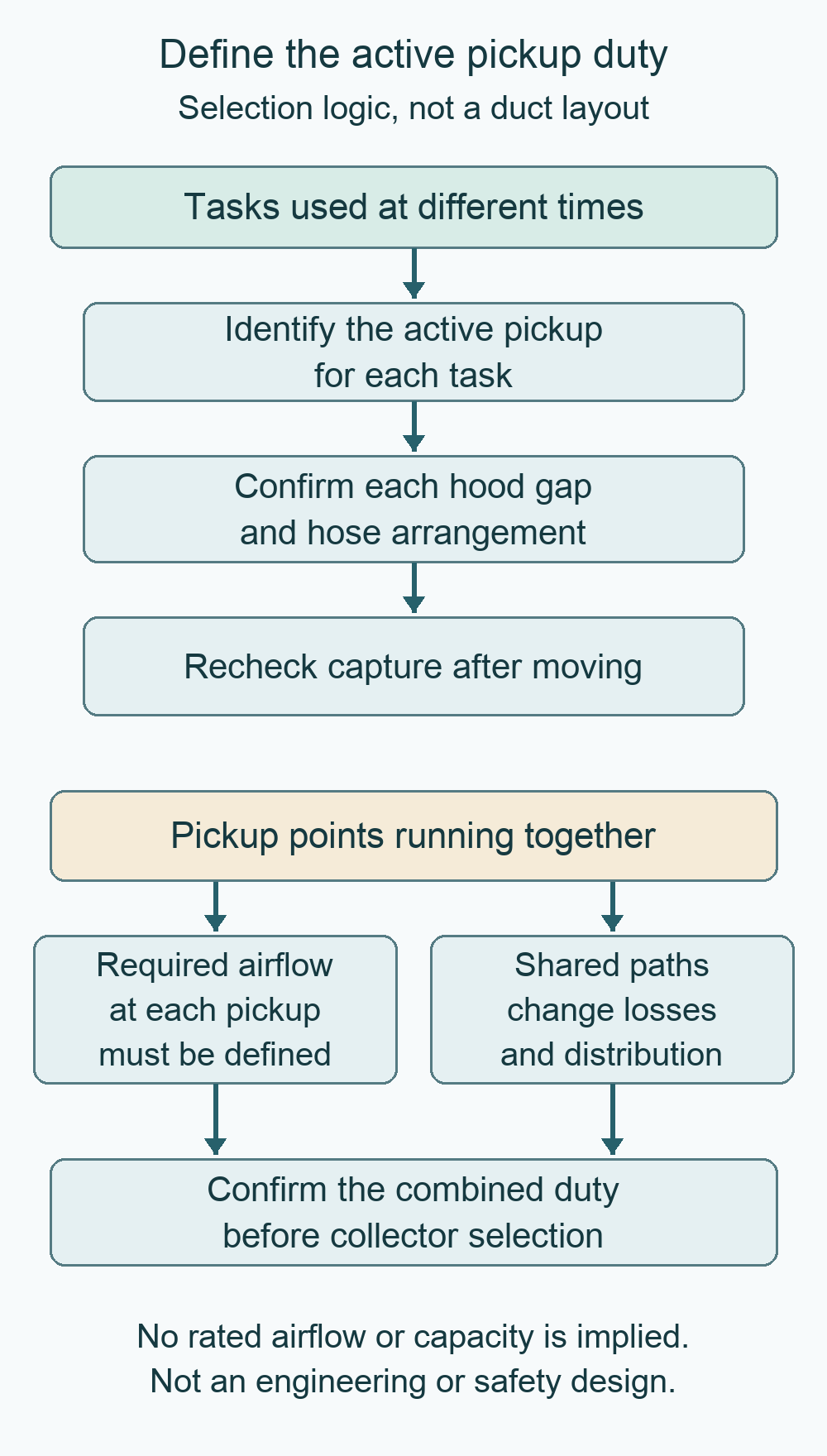
| Workstations used at different times | Each task’s connection, hose length and bends, changeover method, route and available utility points. | Check every intended arrangement; a setting suitable at one position may not suit the next. |
| A few pickup points operating together | Which points run simultaneously, required flow at each, branch arrangement and control of unused connections. | Confirm combined duty and flow distribution before deciding that one local collector is appropriate. |
| Many fixed sources across a plant | Whole-plant source schedule, main ducts, fan duty, discharge and maintenance access. | Review a central baghouse system instead of extending a local unit beyond its confirmed scope. |
A cyclone pre-separator is a different selection task; it is not interchangeable with the final filtration function. Combustible, reactive, hot or spark-bearing material also needs a separate engineering and safety review. No explosion-protection, certification, emission or exposure-control result is established by this page or the reference photograph.
The hood and hose decide what reaches the collector
Show the actual source point and the operator’s normal working position. Confirm whether a movable hood, receiving pickup or a more enclosed connection suits the task. Keep the proposed pickup close enough to the release point for the intended capture duty, while preserving working access and checking cross-drafts. The correct gap and shape must be established for the operation; a long-reach hose does not mean the hood can capture effectively from a long distance.
Record the hose’s diameter, total route, bends, connection changes, support and likely crushing or damage points. Extra length, bends and restrictive fittings add resistance. A collector selected for a short direct hose should not be assumed suitable after the hose is extended or split.

Specify airflow at the required pressure duty
Airflow and static pressure belong in the same selection discussion. The hood, hose, fittings, filter condition and outlet path all contribute resistance. Provide any measured airflow and pressure data, identifying where and under what condition they were measured. If these values are unknown, provide the layout and source details so the required duty can be evaluated; do not substitute motor power for a working airflow specification.
| Entrada | Qué enviar | Por qué es importante |
|---|---|---|
| Dust and source | Material, particle information, moisture, source process, loading pattern and relevant safety data. | Defines the filtration, cleaning, handling and suitability review. |
| Hood and hose | Pickup photos, distance from source, opening, hose diameter/length, bends and outlet path. | Defines capture conditions and pressure losses rather than free-air capacity alone. |
| Airflow and static pressure | Required or measured flow/pressure, measurement point, active pickups and filter condition. | Allows the working duty to be matched to the proposed collector. |
| Power and compressed air | Voltage, phase, frequency, connection location and compressed-air availability where a selected cleaning system needs it. | Prevents assuming that every unit or cleaning method uses the same utilities. |
| Outlet and dust removal | Air discharge/return boundary, collection bag/bin arrangement, removal frequency and disposal route. | Defines containment and handling responsibilities; room-air return is not automatic. |
Confirm filtration, cleaning and the dust-container boundary
Select the filter medium and cleaning method for the actual dust and duty. Ask how filter condition will be monitored, how cleaning is initiated, whether cleaning interrupts pickup, what utilities it needs, and how replacement elements are identified. A visible fabric bag does not establish a filter classification or prove suitability for fine ceramic dust.
Define how collected dust is contained and removed: the bag or bin type, access, isolation method, change frequency, lifting/handling and destination. Confirm the offered unit’s actual arrangement from current drawings or photographs. The reference image does not show a cabinet interior or sealed dust bin, so neither is inferred from it.
Match changing workstations to the working cycle
Describe the required movement range, floor surface, thresholds, route width, storage position and available connections. If a wheeled arrangement is requested, confirm its actual wheel type, restraint, handling and access from the offered unit; the reference image is not used to prove those details. Include the time spent moving, connecting, cleaning and emptying as well as the time spent collecting dust.
For the wider relationship between source-point capture, central collection and environmental systems, see the dry tile processing and dust-control solution. A local unit remains a bounded workstation decision within that wider factory review.
Information for a portable dust-capture configuration review
- Dust-producing operation, material and each source point marked on photos or a layout
- Proposed hood or pickup shape, gap from the source, operator position and cross-drafts
- Hose diameter, route, total length, bends, connections and intended movement range
- Required or measured airflow and static pressure, including measurement conditions if available
- Particle/moisture information, expected dust loading and relevant safety data
- Voltage, phase, frequency and compressed-air conditions where required
- Filter medium, cleaning method, monitoring and element-replacement requirements
- Collection bag/bin arrangement, isolation, emptying frequency and disposal route
- Active pickup count, simultaneous use, operating hours, shift pattern and cleaning/changeover periods
- Project location, air outlet/return boundary, site constraints and responsible engineering/safety parties
Discuss a local dust-capture setup
Final pickup arrangement, airflow/pressure duty, filter and cleaning system, utilities, movement provision, containment and acceptance depend on the customer’s material, task, selected configuration and engineering confirmation.