
Compare the two belt-contact sections, support through the grinding heads and the handoff to the next station. Send the tile width, thickness and required edge to define the machine layout.
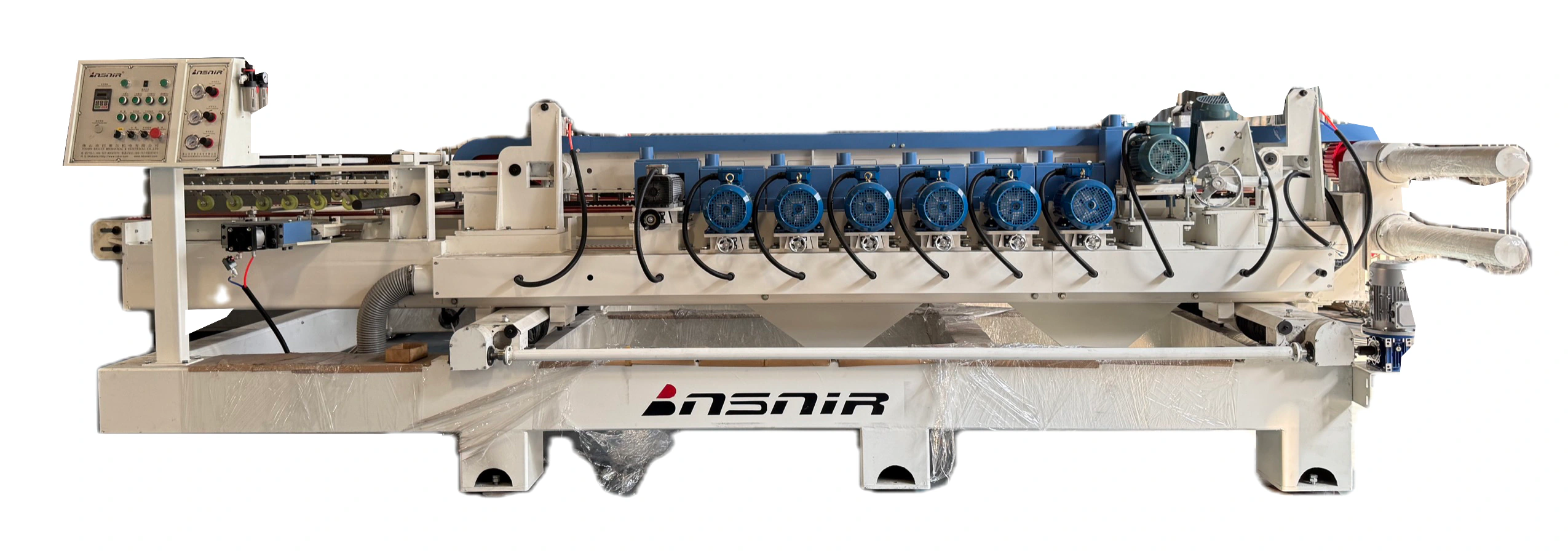
Define the edge task before choosing a double-belt grinder
- Entrada
- Pre-cut ceramic or porcelain workpieces with a declared width, thickness, minimum piece size, face orientation, supportable belt-contact area, feed direction, and wet-processing suitability.
- Acción de la máquina
- Two belts grip and transport the workpiece while selected heads grind a straight side edge, form a small safety chamfer, and, where the wheel sequence supports it, refine the edge surface. The two belts describe the holding and conveying method; they do not by themselves prove that both opposing edges are processed at the same time.
- Output geometry
- A specified straight edge on one side or a confirmed two-side arrangement, with the required small chamfer and edge finish. The drawing must state which face is protected and which edge or edges are worked.
- Comprador
- Tile secondary-processing workshops comparing a stable belt-held edge-finishing station for manual loading, standalone use, or connection to a cutting and conveying line.
- Exclusión
- This is not a bilateral offset machine for separated strips after multi-blade cutting, not a full-through decorative 45-degree miter, and not proof that every double-belt configuration processes two sides simultaneously.
Select by holding condition, edge count, and line role
The first decision is whether the narrowest workpiece has enough stable contact area under the pressure and transport belts. The second is which side is presented to the heads. A request for two finished sides must identify whether the intended result comes from opposed head banks, a second station, or a second pass; the name “double-belt” does not answer that question.
| Pregunta de selección | Suitable direction | Se requiere confirmación |
|---|---|---|
| One straight side with a small chamfer | Configure the presented side, pressure zone, and grinding/chamfer sequence around the drawing. | Face orientation, removal allowance, chamfer position, edge-finish sample, and minimum stable piece. |
| Both opposing sides | Confirm an actual two-side arrangement or define two passes/stations. | Finished width, side-to-side relationship, independent adjustment, and how the part is referenced between sides. |
| Polished or refined edge | Add the wheel stages required by the material and target appearance. | Material, glaze or surface sensitivity, acceptable wheel marks, wet conditions, and approved sample. |
| Standalone workshop cell | Manual loading can suit mixed orders when safe support and discharge handling are provided. | Piece weight, operator access, infeed/outfeed support, water collection, and changeover frequency. |
| Connected production line | Match transport height, feed direction, speed window, spacing, and control handshakes to adjacent equipment. | Upstream/downstream drawings, datum, line speed, gap between pieces, reject handling, and wet-area boundary. |
Market-reference configuration: W450/20+2
This card records one current partner model for comparison; it is not a BASAIR-tested specification and is not a combined BASAIR product range. The partner page lists a 150–450 mm working width, a 14–42 m/min conveyor-belt speed, 20 grinding heads plus 2 chamfer heads, water cooling, and manual loading with an optional conveying device for line connection.
Those values apply only to the referenced W450/20+2 configuration. Usable speed, minimum stable piece, edge removal, finish, yield, and output depend on the tile material, dimensions, flatness, belt contact, wheel sequence, cooling, feed stability, and an approved sample. Final supply values require engineering confirmation.
When another route is the better fit
- Start with tile secondary processing equipment selection if the blank size and cutting route are not yet fixed.
- Utiliza el bilateral offset tile edge machine when multiple strips must be pushed, spaced, and transferred through first-side and second-side stages after multi-blade cutting.
- Review a línea de corte y biselado when cutting, edge finishing, and chamfering must be engineered as one continuous process.
- Plan the wider workshop through the taller de procesamiento secundario de baldosas route when conveyors, water handling, controls, and multiple machines share one system boundary.
Information required for configuration review
| Enviar | Por qué es importante |
|---|---|
| Material and surface type | Determines wheel sequence, water compatibility, marking risk, and sample requirements. |
| Width, length, thickness, and narrowest workpiece | Defines support, belt contact, head access, and whether the piece can be held steadily. |
| One side or two sides | Prevents a dual-belt conveyor from being mistaken for simultaneous bilateral processing. |
| Straight edge, small chamfer, and polishing requirement | Defines head duties, wheel stages, removal allowance, and the inspection sample. |
| Good-face orientation | Identifies the protected surface and the upper/lower chamfer position. |
| Available pressure and belt-contact zone | Confirms that clamps and belts do not interfere with the finished geometry. |
| Standalone or line-connected use | Sets loading method, transfer height, spacing, controls, and safety responsibility. |
| Infeed and outfeed direction | Fixes layout, operator side, datum, and adjacent-machine interfaces. |
| Wet-processing conditions | Defines water supply, filtration, drainage, splash containment, and corrosion considerations. |
| Electrical supply | Confirm site voltage, phase count, frequency, control-power supply, and the motor-starting and adjacent-control interfaces for the selected configuration. |
| Compressed air | Confirm whether the selected head and control configuration requires compressed air; if it does, specify connection, pressure, flow, filtration, dryness, and other air-quality requirements. |
| Grinding debris and slurry removal | Define where edge debris and slurry are captured, settled or filtered, removed, and prevented from accumulating around belts, heads, sensors, and drains. |
| Machine, service, and cleaning access | Provide the machine area, loading and discharge clearance, inspection and maintenance aisles, and access needed to clean heads, belts, guards, tanks, and drains. |
| Target output and approved edge sample | Provides a project-specific basis for speed, finish, and acceptance instead of an unconditional performance claim. |