
Define the post-cut bilateral process
- Entrada
- Multiple tile strips leaving an upstream multi-blade cutter, with known parent-tile width and length, finished strip width, both target edges, strip spacing, pushing direction, front/back datum, and wet-processing conditions.
- Acción de la máquina
- A pushing and spacing stage presents separated strips to the first edge section; an offset transfer then re-references the pieces for the second edge section. Grinding and optional small chamfer heads work the two sides in staged sections with matched but independently adjustable drives and controls.
- Output geometry
- Two processed straight side edges on each strip, with the specified finished width and optional small safety chamfers. The edge-to-edge result depends on stable spacing, datums, transfer alignment, and adjustment of both sections.
- Comprador
- Tile processors building a continuous strip or mosaic route after multi-blade cutting, especially where manual turning and repeated edge handling must be replaced by a defined two-stage transfer.
- Exclusión
- This is not a double-belt pressure grinder, not proof that two edges are cut in one common head bank, and not a substitute for specifying the upstream cutter, pushing assembly, strip pitch, and downstream collection.

Why the offset transfer matters
- Multi-blade cutting: the parent tile is divided into several strips whose spacing and exit order must be known.
- Pushing and separation: a pushing assembly advances and spaces the strips so they do not collide or enter the first section without a stable datum.
- First-side processing: the first section grinds and, where specified, chamfers one edge while its fence and head position establish the first reference.
- Offset transfer: the workpieces move to a laterally offset path that presents the opposite edge without treating the unit as a double-belt machine.
- Second-side processing: the second section works the opposite edge; its drive, control, fence, and overall left/right position must be synchronized to the first section and the desired finished width.

Selection table
| Decisión | What to select | What can go wrong if omitted |
|---|---|---|
| Upstream blank and strip plan | Parent width/length, number of strips, cut width, kerf plan, and exit spacing. | The pusher and fences may receive strips at the wrong pitch or datum. |
| Two finished edges | Finished width, removal allowance on each side, straight-edge requirement, and chamfer location. | One side may be overworked while the second section cannot recover the width. |
| Pushing direction and timing | Stroke, push face, cycle sequence, gap between groups, and sensor logic. | Pieces can overlap, skew, or arrive before the first section is ready. |
| Front/back datum | Identify good face, leading edge, fixed fence, and transfer reference. | The second section may process the wrong face or create inconsistent edge-to-edge geometry. |
| Grinding and chamfer heads | Choose head count and wheel duties from material, removal allowance, finish, and chamfer drawing. | A head-count label alone cannot predict finish, speed, or tool life. |
| Section synchronization | Match conveying speeds while retaining independent drive and control adjustment. | Spacing can compress or stretch between sections and destabilize the transfer. |
| Width adjustment | Confirm independent fence adjustment and the second section’s overall left/right travel. | The line may not align the opposite edge or maintain finished strip width. |
| Water and debris | Specify flow, filtration, drainage, splash boundary, and chip/slurry removal. | Wheel condition, sensors, belts, and transfer surfaces can become unstable. |
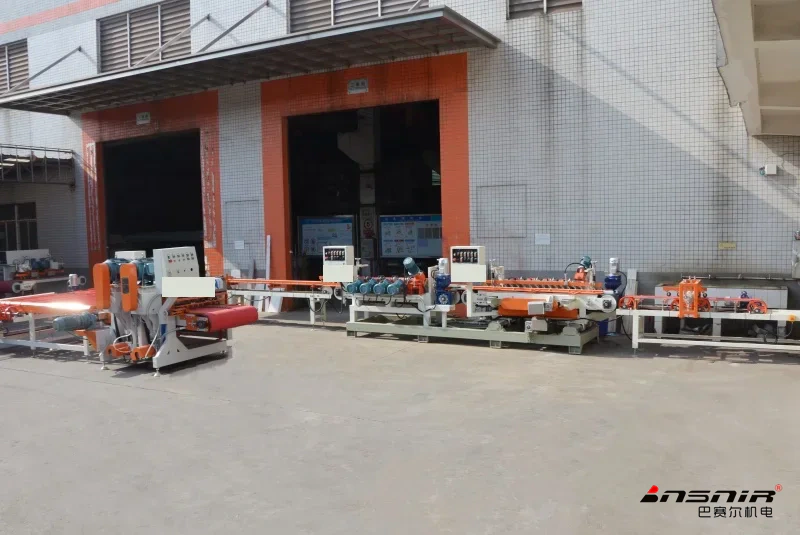
Market-reference configuration: bilateral reference configuration
The exact partner page describes a 4+1-pair bilateral offset machine: four pairs of edge-grinding motors (eight heads) and one pair of pneumatic chamfer motors (two heads). It also shows two offset processing sections, independently adjustable front and rear fences, overall left/right adjustment of the rear section, separate section drives, separate control boxes, and water outlets at the processing heads.
For this one partner model, the published table lists a 250 mm belt width, a 50–300 mm processing-width range, a 5300 × 1300 × 1640 mm machine envelope, and 30.64 kW total edge-machine power. These are configuration references for bilateral reference configuration only—not a BASAIR-tested family range or a guaranteed buyer result. Usable throughput, dimensional result, finish, and tool life depend on material, strip geometry, cut quality, pusher timing, section alignment, wheels, water, debris control, and an approved sample.
Place the machine in the correct process route
- Uso tile secondary processing equipment selection to define the parent blank and cutting route.
- Match the exit geometry of the multi-blade tile cutting machine to strip spacing, pushing, and first-section entry.
- Review the broader tile cutting and chamfering line if cutting, straight-edge finishing, and chamfering share one acceptance boundary.
- Specify the stroke and interfaces of tile pushing assemblies rather than treating the pusher as an anonymous conveyor.
- For a complete strip or mosaic route, use the mosaic and strip production route to coordinate material flow and utilities.
Submission table for engineering review
| Enviar | Detalle mínimo |
|---|---|
| Upstream tile dimensions | Parent width, length, thickness, material, surface, flatness condition, and multi-blade cut plan. |
| Finished strip geometry | Strip width, both processed edges, per-side allowance, chamfer size/location, and approved sample. |
| Strip spacing | Exit pitch, minimum gap, group size, and whether spacing varies by recipe. |
| Pushing direction | Plan view showing feed direction, pusher face, stroke, group timing, and return path. |
| Front/back datum | Good face, leading edge, fixed reference side, and how the opposite side is re-referenced. |
| Grinding/chamfer head duties | Material removal, target finish, chamfer drawing, wheel proposal, and sample acceptance. |
| Synchronization | Cutter exit speed, pusher cycle, first/second section speeds, buffers, and control handshakes. |
| Independent width adjustment | Required recipe range, fence travel, rear-section left/right travel, and changeover method. |
| Electrical supply | Site voltage, phase count, frequency, control-power supply, motor-starting arrangement, and control handshakes for both processing sections and the pusher. |
| Compressed-air supply | The pneumatic chamfer heads require the accurate project connection, pressure, flow, filtration, dryness, and other air-quality requirements to be confirmed for the selected configuration. |
| Water, debris, and slurry plan | Water quality/flow, filtration, drainage, splash boundary, chip/slurry collection and removal, and the safe method for cleaning belts, heads, sensors, transfer surfaces, tanks, and drains. |
| Site, service access, and output | Available footprint, infeed/outfeed area, inspection, maintenance and cleaning aisles, shifts, target pieces or linear metres, and downstream handling. |
Confirm what moves between the two edge sections
A double-set or offset edge-grinding line needs a process drawing that follows each separated piece from the cutter through the first edge section, offset transfer and second section. The offset is a handling and datum decision. It must not be interpreted as simultaneous two-sided grinding or a guaranteed finished width without proving the actual reference change.
Supply the number and spacing of strips from each parent tile, minimum strip width, feed direction and both required edge sections. Check pressure and support during the transfer, how thin strips are kept apart and how slurry is prevented from disturbing the guides. Agree the restart and reject path so one missed or skewed strip does not enter the next section unidentified. Source naming supports the equipment family; the offered station arrangement, tool duty and operating envelope still require engineering confirmation.