
Cutting and grooving tools include saw blades for separating material, grooving discs for forming a specified slot, wheels that grind or polish the slot after cutting, and chamfer-cutting discs used in a defined multi-stage edge route. The finished cut or groove determines the tool family.
This page separates the buying responsibilities before a tool is matched. Diamond saw blades have a current supply path; grooving, slot-finishing and chamfer-cutting families remain project-confirmed until the actual machine interface and proposed product are verified.

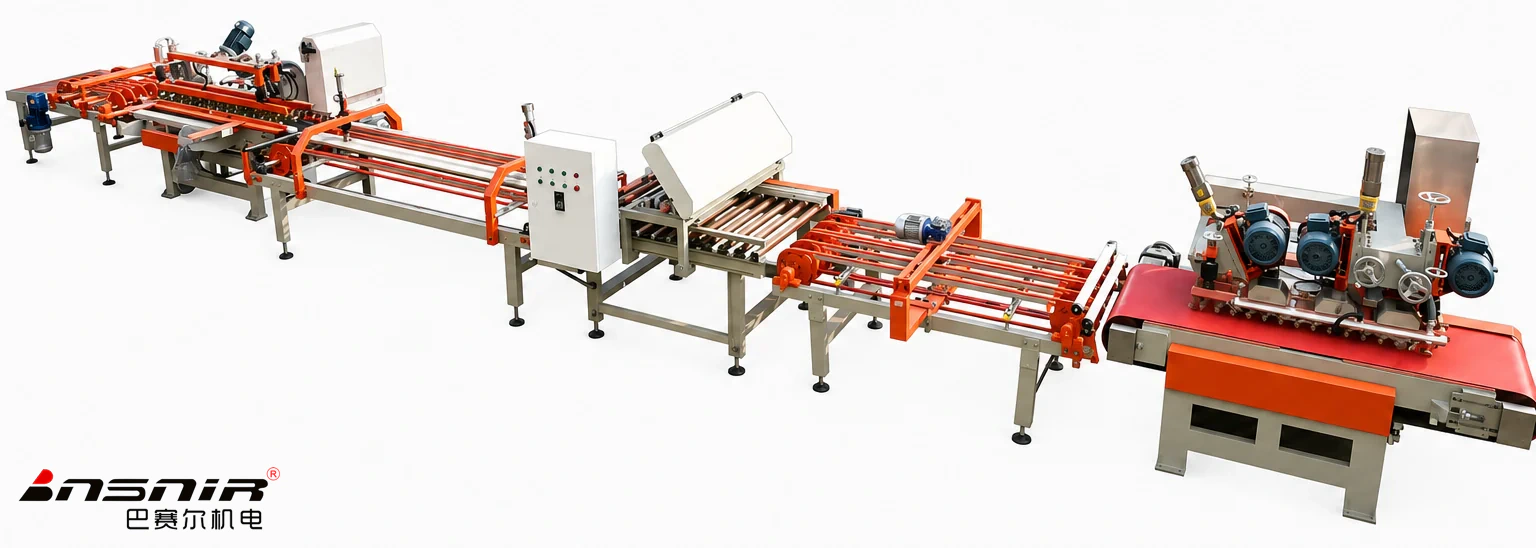
Select by what the tool must create
| Tool family | Primary task | Required definition |
|---|---|---|
| Lâminas de serra diamantadas | Single-blade cut or a spaced multi-blade cut in tile/stone approved for the machine | Material, wet/dry use, diameter, bore, body/segment thickness, spindle, speed, depth and edge target |
| Diamond grooving discs | Form a specified back, edge or decorative groove | Groove section, width/depth, material, dry/wet condition, machine and disc mounting; supply is project-confirmed |
| Slot grinding/polishing wheels | Refine a formed groove or visible slot to the required shape and finish | Preceding disc, residual allowance, groove accessibility, profile, grit sequence and target finish; supply is project-confirmed |
| Chamfering cutting discs | Pre-cut, bevel or full-cut duty in a confirmed cutting/chamfering sequence | Station order, remaining head, cut geometry, blade structure and downstream finishing; supply is project-confirmed |
Saw blades are defined by machine, material and cut
For a sistema de corte de azulejos de cerâmica, specify whether one blade makes an individual cut or multiple blades and spacers establish repeated strips. Record spindle diameter, flange, usable blade diameter, blade count, spacing, rotation, speed and coolant delivery.
Outer diameter and bore do not fully identify a blade. Body thickness, segment/working-edge geometry, segment width, exposure, material and required cut quality influence the choice. The blade must also clear guards and adjacent blades in the actual assembly.
A groove has forming and finishing stages
A back groove may be judged mainly by position, section and fixing function. A visible groove made by a decorative groove forming and polishing machine may need a second or multi-step tool sequence to refine the sidewalls and bottom. Send the cross-section and identify which surfaces are visible.
Do not select a grooving disc only by nominal width. The actual groove depends on disc runout, working-edge width, feed, material, wear and whether one or several passes are used. Slot-finishing wheels must fit the groove without changing the intended geometry.
Chamfer-cutting tools belong to an ordered process
Some cutting-and-chamfering routes use a pre-cut, bevel-forming and final separation sequence. State the duty of each station and the material left for the next tool. A tool chosen for full separation should not be assumed to perform the same way as a bevel tool that retains a controlled head for later assembly.
For a linha de corte e chanfradura ou 45-degree tile chamfering machine, provide the finished joint drawing and the current blade stack in installation order.
Information needed to match cutting or grooving tools
- Material, surface, thickness and the required cut/groove/chamfer drawing
- Machine manufacturer/model, spindle, flange, rotation, speed and available clearance
- Dry/wet operation, coolant position and dust or slurry arrangement
- Current tool outside diameter, bore, body/working-edge thickness, segment/profile and label
- For a blade stack: blade count, each spacer thickness, target finished widths and stack drawing
- For grooves: cross-section, tolerance, visible surfaces, preceding and following tools
- Photos of both tool faces, edge/profile, installed position, wear or cut defect
- Representative sample, required output and acceptance criteria
Request a cutting or grooving tool match
As famílias de ferramentas para ranhura, acabamento de ranhuras e chanfradura foram comprovadas em projetos. A geometria da ferramenta, a velocidade, a vida útil e o resultado dependem do material, da máquina, das condições do processo, da configuração selecionada e de testes controlados.