
Pre-cut, edge-correction or chamfering, half-cut and full-cut positions are different jobs. A three-position machine does not automatically use one standard sequence or one interchangeable disc family. BASAIR first identifies the host machine and the duty of each position, then checks the complete disc or wheel interface and process conditions before an engineering recommendation.
Send your machine sequence and disc-interface photos
Identify the machine route before selecting the tool
Two published routes show why “three heads” is not enough information. One market route uses pre-cut → chamfer → full-cut. A separate partner-machine route assigns edge correction or glaze breaking → half-cut → full-cut. The two routes express different process responsibilities; neither should be copied onto another machine without checking head order, cutting direction, material support and the installed drawing.
| Reference route | Position 1 | Position 2 | Position 3 | Limite de seleção |
|---|---|---|---|---|
| Published market route | Pre-cut to establish a controlled entry or partial cut. | Chamfer the required edge or bevel. | Full-cut to complete separation. | A market-planning reference only; not presented as a BASAIR-tested universal sequence. |
| Published partner-machine route | Correct the original edge or break the glaze as required by that machine route. | Half-cut to create the controlled intermediate cut. | Full-cut to complete separation. | A configuration-specific partner example; not evidence that every three-head machine shares this order. |
If the project needs a complete machine route rather than a replacement tool, review the tile cutting and chamfering line. For a dedicated decorative bevel, start with the 45-degree tile chamfering machine. For ordinary sawing duties, the related diamond saw blade page separates material, rim construction and single- or multi-blade use.
Tool appearance does not establish station duty
Segment pattern, continuous or fine-slotted rim, resin working ring and the printing on a disc can provide clues, but they do not prove whether the tool belongs in pre-cut, edge correction, chamfering, half-cut or full-cut. The same outside diameter can still hide a different bore, flange, side, rotation, body thickness, clearance or permitted load.
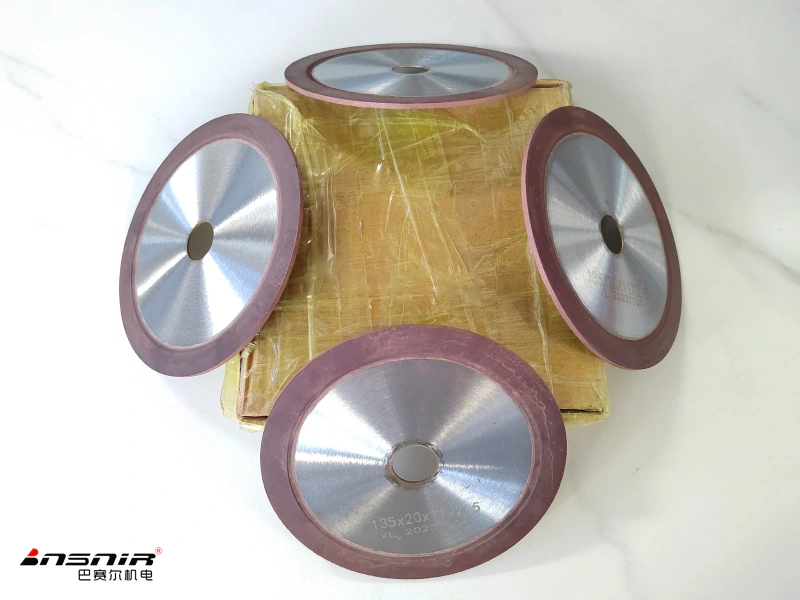
A three-position machine is still a configured system
Each head has its own spindle, guard, approach direction and material-support condition. The first tool changes the load seen by the next one, so cut depth and edge condition must be distributed across the route. A usable review therefore starts with the complete station sequence and installed photos rather than a loose blade photograph.
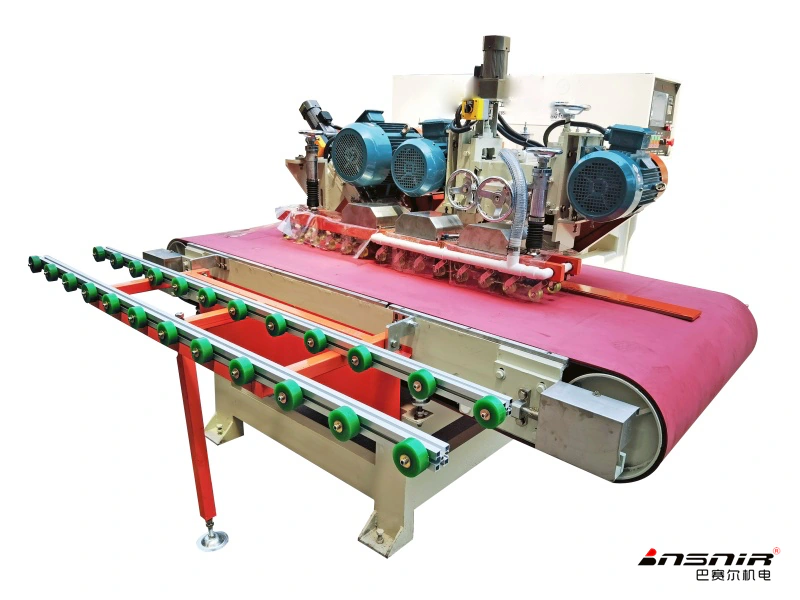
Information required for an engineering identification
| What to send | Minimum useful detail | Decisão que ela apoia |
|---|---|---|
| Machine and sequence | Brand, model, head count, exact head order and the intended duty of every position. | Separates the pre-cut, correction/chamfering, half-cut and full-cut responsibilities. |
| Photos | Each disc or wheel front, back and side; every tool installed; guard and material support; incoming edge and finished cut. | Confirms which physical tool belongs to which machine position and shows available clearance. |
| Dimensões e montagem | Outside diameter, body and rim thickness, bore, flange/recess/shoulder, fasteners, installed side and rotation. | Checks the complete interface rather than matching outside diameter alone. |
| Station duty | Required cut depth, remaining web after partial cut, chamfer angle or edge-correction allowance and final separation direction. | Defines the load and contact task of each tool. |
| Abrasive and rim data | Bond, grit where applicable, rim or segment construction and current tool code. | Provides a comparison starting point without treating the old code as an automatic cross-reference. |
| Material and process | Tile or slab type, glaze, thickness, dry/wet route, spindle speed, feed, cooling and current defects. | Connects tool construction to heat, debris removal, support and edge-quality conditions. |
| Target and quantity | Required cut/chamfer result, tolerance or accepted sample, trial quantity and expected production quantity. | Separates identification, trial planning and production supply. |
Common questions
Do all three-head machines use pre-cut, chamfer and full-cut?
No. Published routes assign different responsibilities to the positions. The actual machine drawing and installed sequence take priority over a generic three-head label.
Can the station be identified from the disc face?
Not reliably. Rim appearance and printed dimensions are useful evidence, but the host head, installed side, rotation, cut depth and upstream/downstream tasks are also required.
Is a resin edge-correction wheel the same as a chamfering disc?
No. Edge correction or glaze breaking, chamfering and full cutting are different duties. They must not be collapsed into one product category simply because the tools are round.
Can BASAIR approve a replacement from outside diameter and bore?
No. Total thickness, rim or working-ring width, flange and recess, fasteners, clearance, rotation, material, cooling and station load still require engineering confirmation.
Are dry and wet versions interchangeable?
Do not assume so. Heat control, debris path, wheel or blade construction and the host machine’s designed route determine whether a proposed tool can be reviewed for that process.