
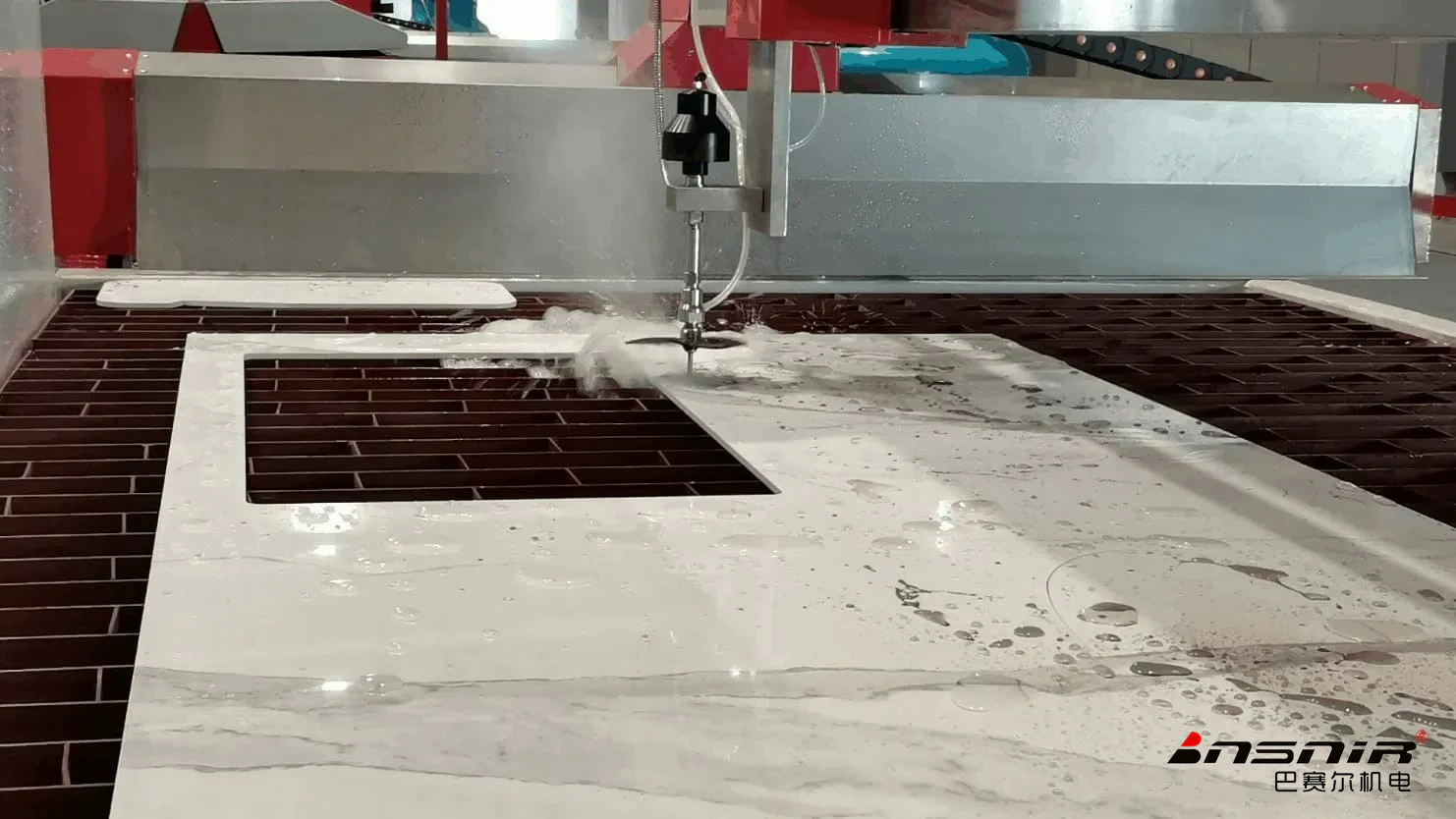
Choose this route when every programmed cut uses a head held perpendicular to the sheet. This three-axis waterjet moves in X and Y to follow straight lines or two-dimensional contours, while Z controls cutting-head height and vertical travel. The head does not tilt. Bevel cutting, taper-compensation motion and 45-degree work belong on the five-axis waterjet carretera.
BASAIR receives the application, drawing and site data, then coordinates the machine and auxiliary-system interface with the selected manufacturing partner. The final travel, table construction, pump, controller, abrasive system, utilities and safety package are confirmed for the quoted configuration.

What the three axes solve
X and Y place the vertical jet along the programmed profile. Z provides lift, pierce positioning and stand-off control where the selected machine supports it. The correct working envelope is not the nominal table size alone: it must contain the largest loaded sheet, the complete toolpath, entry and exit moves, clamps or stops, and safe clearance around the head.
| Decisión | Opiniones de los compradores | What the configuration must settle |
|---|---|---|
| Cut geometry | Marked drawing or CAD file showing straight cuts, holes and closed two-dimensional contours | Vertical-only cutting, lead-in and pierce positions, contour order, corner treatment and part support |
| Material and edge | Material name, grade or composition, thickness range, surface finish, fragile zones and required cut-face condition | Water-only or abrasive route, pierce method, process trials, support layout and acceptable lower-edge/taper condition |
| Tamaño de trabajo | Maximum sheet and part dimensions, loading orientation, usable remnants and sheet weight | Usable X/Y/Z travel, catcher-table area, load access, support grid and floor-loading plan |
| Output and pump | Part mix, batch size, shifts, acceptable cycle time and cut-quality priority | Pump type and duty, orifice/nozzle combination, abrasive rate and planned maintenance window; no fixed output is promised before trials |
| Drawing to toolpath | Native drawing format, revision control, nesting method and operator language | Supported import formats, CAM/post-processor, kerf settings, backups, controller interface and responsibility for final program approval |
Send a complete cutting brief
A model name or sheet size is not enough. The following data set keeps the machine, pump, software and site package tied to one actual cutting task.
| Datos del tercer trimestre | Provide this evidence | Why it changes the offer |
|---|---|---|
| Material | Material, grade/composition, thickness range, sheet condition and representative photos | Sets the process trial, abrasive decision, pierce approach and support method |
| Dibujo / trayectoria de la herramienta | Dimensioned PDF plus editable CAD, critical features, datum, lead-in restrictions and nest example | Confirms that all work is vertical X/Y/Z cutting and defines the programming hand-off |
| Tamaño de trabajo | Maximum raw sheet, maximum finished part, sheet weight and loading direction | Defines usable travel, table, access, lifting and foundation loads |
| Precisión y aristas / superficies | Critical tolerance by feature, perpendicularity or taper acceptance, edge appearance, top-surface protection and inspection method | Determines trial acceptance, speed-versus-quality settings and whether a five-axis route is actually required |
| Bomba | Existing or preferred pump, duty hours, available electrical service, incoming-water data and maintenance capability | Matches pressure/flow duty, motor and cooling without copying one source model’s rating |
| Software | CAD/CAM used, file types, nesting workflow, network policy, operator language and backup requirement | Defines import, post-processing, controller and training scope |
| Sistemas auxiliares | Abrasive storage/feed, water treatment, cooling, catcher clean-out, drainage, sludge handling, guarding and lifting plan | Prevents a usable cutting table from being quoted without the systems required to run and maintain it |
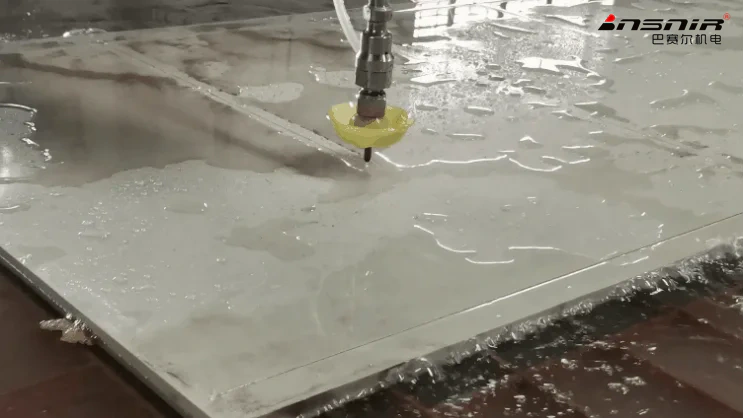
Site and safety interfaces are part of the machine choice
- Agua a alta presión: confirm inlet pressure, flow, temperature, filtration and water-quality limits for the selected pump. The pump, high-pressure tubing, cutting valve and head must be treated as one pressure boundary.
- Abrasivo: confirm garnet specification, storage, dry compressed-air requirement where applicable, metering, refill method and wet abrasive/sludge removal.
- Refrigeración: size the cooling circuit for pump duty and ambient conditions; keep its heat-rejection and water-quality requirements separate from cutting-tank drainage.
- Drenaje: identify catcher-tank overflow, pump waste-water and clean-out points; provide settling or sludge handling and an approved discharge/reuse route for the local site.
- Energía eléctrica: provide voltage, frequency, phases, available load and earthing. Final motor current, cables, breakers, local disconnect and control supply follow the selected pump and machine drawings.
- Foundation and access: verify floor bearing capacity, levelness, anchoring, service clearances, load/unload route and lifting access against the supplier’s final load and anchor plan.
- Mantenimiento: reserve safe access for filters, seals, check valves, orifice, mixing tube, high-pressure fittings, abrasive pot and catcher clean-out; agree consumables and planned downtime.
- High-pressure isolation: lock out all energy sources, isolate high-pressure supply and verify the system is fully depressurized through the specified bleed-down procedure before opening any fitting or changing a high-pressure component. An emergency stop is not an isolation procedure.
- Paradas de emergencia, protecciones y límites del recinto: define interlocked guards where required, emergency-stop stations, splash/noise controls, signage and a restricted-access zone beyond the full motion envelope. Only trained and authorized personnel may operate or maintain the equipment. High-pressure injection injuries require immediate emergency medical treatment.

Related system decisions
Start at Sistemas de corte por chorro de agua when the cutting route is not fixed. Compare this page with five-axis waterjets, definir el sistema de alta presión, abrasivo y de refrigeración, identify ongoing items through waterjet consumable parts, or review the complete sistema de corte por chorro de agua límite.
Plan waterjet inlay as a cutting-and-assembly task
For ceramic inlay and parquet patterns, start with a two-dimensional drawing showing each material and piece identity, the intended joint and the smallest inside radius or narrow connecting feature. A vertical-head waterjet can be considered for the planar cutting task described on this page; angled joint preparation requires the separate five-axis route. A product described as inlay equipment does not by itself establish head tilt or automatic assembly.
Agree cut order, entry locations, kerf compensation, part marking and support of small pieces before the trial. Check both the cut pieces and the assembled pattern, including visible joint consistency and handling losses. Washing, drying, adhesive application and flattening are downstream tasks, with their own material and curing conditions. Use the inlay flattening press for that assembly-stage review, without assigning its duty to the waterjet itself.