
A automação e a embalagem de azulejos consistem em uma sequência configurada para cada projeto que recebe um azulejo ou placa definida, movimenta-a e a armazena temporariamente em condições controladas, aplica qualquer proteção de superfície necessária e libera uma embalagem ou unidade logística aprovada. It is not a fixed package of machines. The buyer’s first decision is which movement, temporary-storage and packaging responsibilities are actually required, then whether every handoff can protect the product and maintain the required line rhythm.
BASAIR can coordinate the interfaces with selected equipment sources, while the final mechanisms, cycle, guarding and acceptance remain tied to the real product, factory and package. Use the Soluções overview to compare this route with other production problems, and the automation, handling and packaging overview to separate the individual equipment responsibilities.

Map the product journey before selecting modules
Draw the current and proposed flow from the upstream machine or stack to the final pack handoff. At every station, record the incoming orientation, datum, working height, product spacing, surface condition, allowed contact zones, required outgoing state and the party responsible for the control signal. This exposes missing responsibilities before equipment is ordered.
| Factory problem | Module to evaluate | Decision data | Não dê nada como certo |
|---|---|---|---|
| Pick from or release to a stack, rack, pallet or line | Tile loading and unloading | Surface, porosity, mass, center of gravity, stack tolerance, permitted grip areas and required axes | A suction, clamp, chain or push method is suitable from appearance alone |
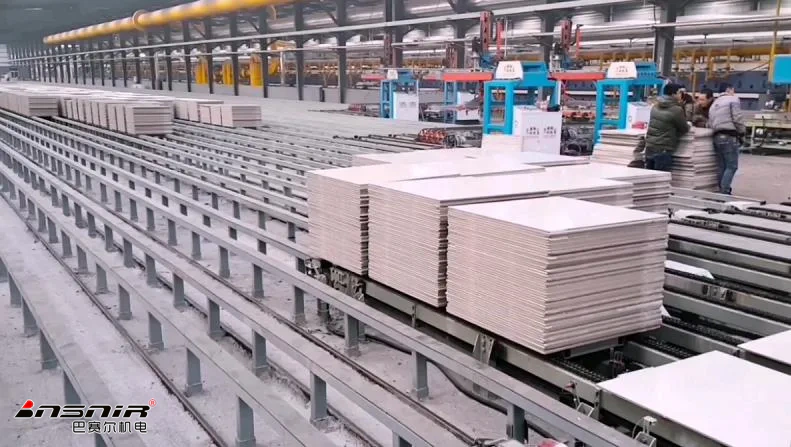
| Move a batch or hold production stock between processes | Tile transfer and storage | Input/output direction, batch/frame identity, storage amount, dwell condition, travel route and site geometry | A source example proves a universal capacity, contact method or storage layout |
| Present each product to the next machine at a controlled datum and spacing | Conveyor and positioning | Belt/roller/chain contact, datum side, transfer gaps, wet/dry environment, speed basis and downstream window | Moving the tile is enough if the handoff cannot position it repeatably |
| Absorb a defined short downstream interruption | Line buffer or accumulator | Stop event, arrival/release rates, protected time, sequence retention, product condition and restart behavior | A larger piece count is better without considering contact risk, footprint and recovery |
| Protect the finished face before final packing | Protective-film laminating | Actual finish, cleanliness, moisture, temperature, film/adhesive, coverage, cut and later peel/storage conditions | Film application replaces edge protection or structural packaging |
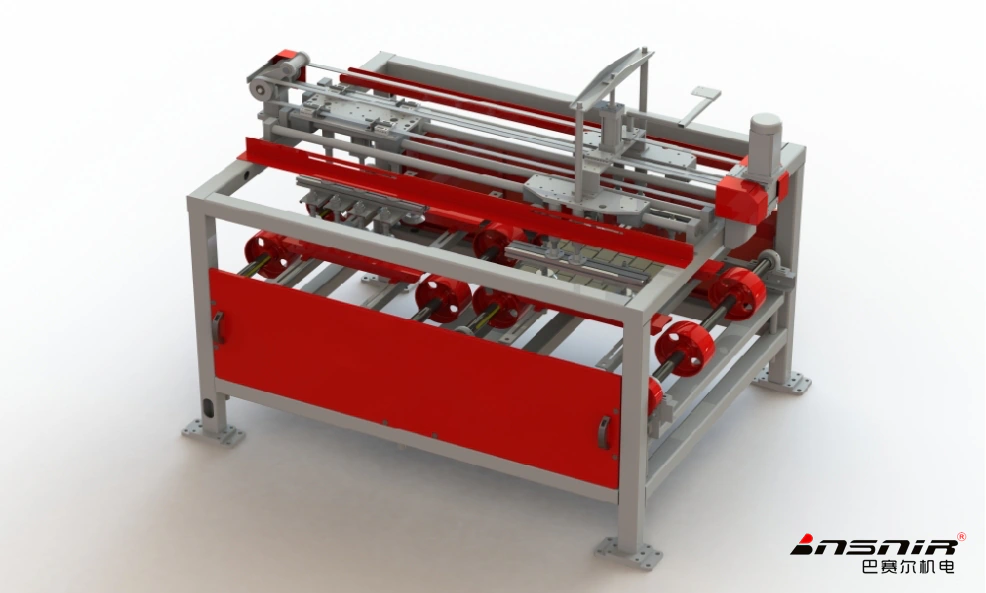
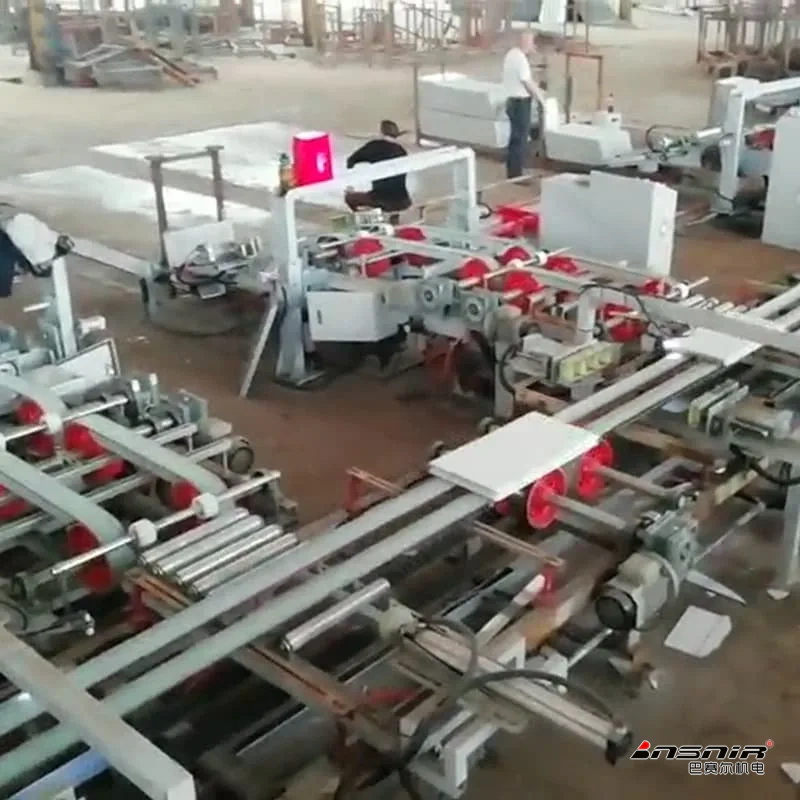
A plane 90-degree large-format tile turner can be evaluated as a project-specific module, but it is not currently offered as a confirmed BASAIR standard product or purchasing entry. It is not linked or presented as an available standard product here. If a layout needs that motion, state that it is a change of travel direction—not face flipping—and provide the product size, weight, orientation, cycle and available space so the actual supply mechanism can be confirmed before it enters the line scope.
Balance the line with operating cases, not one headline rate
Record nominal and peak arrivals, normal gaps, product mix, changeovers, inspection holds, packaging-material replenishment, pallet exchange and fault recovery. Define which upstream process may continue during each event and for how long. This turns “we need a buffer” into a measurable duty and identifies when a storage route, a short accumulator or only controlled conveyor spacing is appropriate.
For each handoff, define ready, occupied, running, blocked, downstream-full, fault and safe-to-transfer states. Assign recipe ownership and line-master responsibility. The restart sequence must prevent an upstream release into an occupied station and preserve batch identity where that matters.
Select the packaging branch from the finished logistics unit
Packaging begins with what the warehouse, carrier or customer must receive. Approve the orientation, pieces per pack, separators, face/edge/corner protection, carton or wrap, straps, label data, pallet pattern and final handoff. The incoming flow must already be inspected and stable; a packaging machine should not be expected to correct random orientation, uncontrolled spacing or damaged edges.
- Conventional tile packaging is evaluated from the approved pack construction, format range, pieces per pack, package materials, pallet pattern and real cycle basis.
- Long and narrow tile packaging needs separate support-spacing, overhang, bending, stack-centering and bundle-stability decisions.
- Large-slab packaging starts with mass, stiffness, sensitive faces, permitted grip zones and a pallet, trestle, crate or other approved logistics unit.


Release the station interfaces and utilities together
| Interface | Information to freeze | Acceptance event |
|---|---|---|
| Product and contact | Material, finish, porosity, dimensions, thickness, mass, flatness, edge condition, holes/relief and permitted face/edge contact | Representative smallest, largest, heaviest and most sensitive products pass with agreed marking, chip and damage criteria |
| Mechanical handoff | Direction, height, datum, gap, support spacing, pickup/release tolerance, orientation, reject route and maintenance withdrawal | Normal transfer, missing/skewed product, failed pickup, blocked downstream and controlled manual recovery |
| Controls and data | Line master, recipes, ready/busy/fault states, tracking, label information, sensors, alarms, bypass and restart ownership | Witness rate changes, format change, accumulator full/empty, pallet exchange, power loss and safe restart without product collision |
| Utilities and site | Power, earthing, compressed air, vacuum, floor loads, pits/drainage, clear height, ambient conditions, packaging-material storage and waste route | Final load and utility schedules match the approved layout and all service/changeover access remains available |
| Final package | Approved pack sample/drawing, materials, count, separators, protection, straps, label, pallet/trestle/crate and logistics handling | Inspect package appearance, stability, product protection and forklift/crane/warehouse handoff under agreed conditions |
Trial film and surface behavior before line release
Film lamination is a surface-contact process, not a generic add-on. Test the actual tile finish, treatment residue, moisture, temperature and film lot. Record web tracking, coverage, wrinkles, bubbles, cut position and edge lift at application, then peel behavior and adhesive residue after the agreed storage condition. Include downstream conveying and stacking so a film that applies correctly is not damaged at the next station.
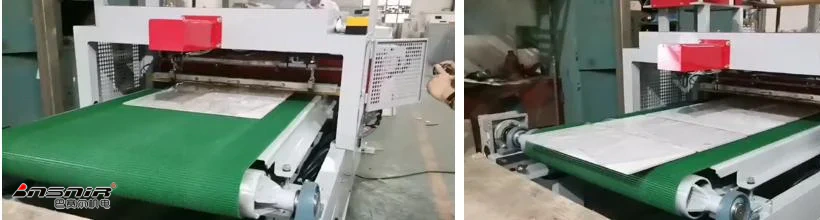
Define safety and recovery for the complete cell
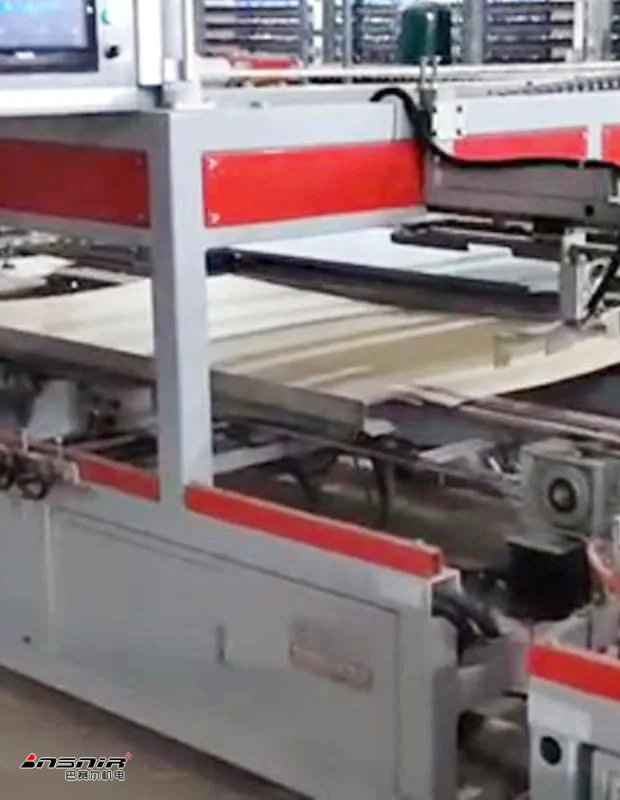
Review nip, crush, shear, lift, suspended-load, robot and stored-energy hazards across module boundaries. Define fixed and interlocked guards, access gates, scanners where engineered, emergency-stop zones, vacuum-loss or load-retention response, lockout points, jam-clearing method and safe personnel entry. Local compliance, risk assessment and final protective measures belong to the actual installed project, not to a generic module photograph.
Use samples and operating cases for acceptance
Agree the product matrix, pickup surfaces, stack and rack tolerances, package samples, film lots and stop/restart cases before the final configuration is released. A useful trial includes minimum and maximum formats, the heaviest or most flexible product, a sensitive surface, the normal pack and a defined fault case. Record pickup/release behavior, marks or chips, datum and spacing, buffer capacity under the stated flow, sequence retention, package quality, changeover and recovery.
Capacity, cycle, damage level, positioning result, film appearance and package stability are project-specific acceptance values. They are not fixed or guaranteed by this page.
Send a complete automation and packaging brief
- Product material, finish, porosity, dimensions, thickness, mass, flatness, edge sensitivity and photos of both faces and all operating orientations.
- Full product matrix, nominal and peak flow, piece spacing, shifts, changeover frequency, batch identity and upstream/downstream rate behavior.
- Required movements from pickup to release, including lift, travel, rotation, tilt or stacking; identify any requested plane-direction change separately.
- Current layout, line direction, working heights, transfer gaps, datum sides, floor/pit/clear-height constraints and service routes.
- Stop cases, required protected time, buffer release order, bypass needs, fault recovery and line-master/control signals.
- Film construction and roll data, tile surface condition, coverage/cut requirement, storage and peel method where surface protection is required.
- Approved package drawing or sample, packaging materials, pieces per pack, pallet pattern, labels and final logistics handoff.
- Power, compressed air/vacuum, drainage/environment, floor loading, guarding expectations, responsible safety parties and acceptance plan.
- Project location and intended timing, plus photos/video of the existing line if the project is a retrofit.
Submit product, flow, package and layout data for a line review
Final handling method, module scope, cycle, controls, utilities, safety design and acceptance depend on the actual product, package, factory layout, selected configuration and engineering confirmation.