
A tile loading or unloading system must grip, lift, move and release the product without marking the surface or losing control of the load. The pickup method is selected from surface condition, porosity, format, weight, orientation, stack arrangement and cycle—not from a generic “automatic loader” label.
This page covers the pickup and release task. Buffers, turners, conveyors and packaging are separate responsibilities within tile automation, handling and packaging.

Choose the pickup method from the load interface
| Pickup method | Useful starting condition | Must be proved on samples | Typical constraint |
|---|---|---|---|
| Discrete vacuum cups | Large, sufficiently smooth areas with known cup positions | Seal, cup marks, bending, center of gravity and vacuum-loss response | Texture, holes, narrow pieces or surface contamination can prevent sealing |
| Sponge vacuum head | A broad pickup area or mixed positions where a compliant sealing face is useful | Leakage, porosity, surface marking, wear and safe release | Sponge condition and dust loading affect repeatability |
| Mechanical clamp | A defined edge can be contacted without damage | Clamp force, edge protection, thickness range and release clearance | Fragile or finished edges may not tolerate the contact |
| Chain, fork or push transfer | The product or stack can remain supported while moving | Support spacing, friction, stack stability and stop position | Not a substitute for a lifting method when the required move changes elevation or orientation |
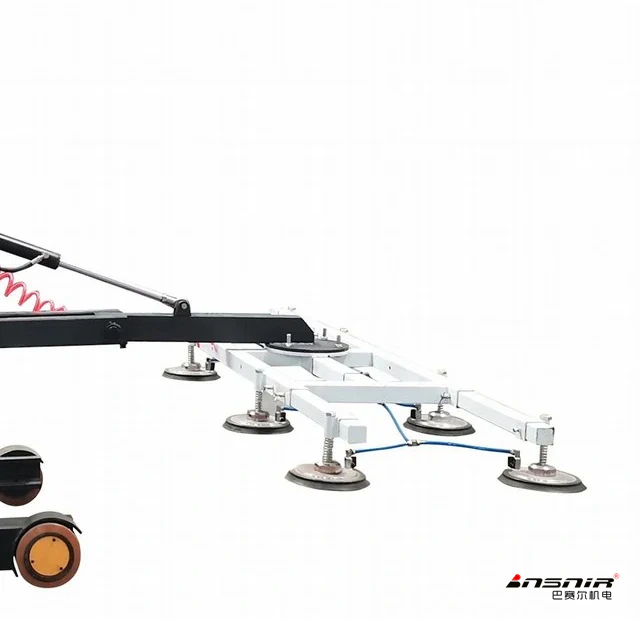

Use representative tiles to prove the contact method
Provide smooth, textured, porous, dusty or coated samples from the actual product range. Test the largest and heaviest tile, the smallest supported tile and any tile with openings or relief. For vacuum systems, record the achieved vacuum behavior, leakage, pickup time, hold time and alarm or safe-state response under the agreed conditions. For clamps, record force setting, edge protection and visible marking.
Safe capacity cannot be inferred from a photograph. Final load and motion limits require the exact machine, pickup head, material, center of gravity, acceleration, safety design and applicable site requirements.
Define every axis and the release condition
State whether the system lifts vertically, travels sideways, rotates, tilts, flips or only transfers between fixed heights. Then define the pickup and release references: stack top, pallet, conveyor datum, rack or machine infeed. A “loading and unloading machine” name does not tell the supplier which of those movements is required.
The control sequence should cover product present, pickup confirmed, permitted motion, destination ready, release confirmed and recovery from a failed pickup. The exact safeguarding and manual-recovery procedure must be engineered for the selected project and local requirements.

Connect the loader to real stacks and conveyors
- Stack format, pallet or rack, separator sheets, maximum stack height and stack tolerance.
- Conveyor height, direction, speed, datum and the supported minimum product.
- Cycle definition from confirmed pickup to confirmed release, including waiting time.
- Electrical, control, vacuum or pneumatic connections and responsibility at each handoff.
- Access for cup, sponge or clamp maintenance and safe manual recovery.
For surrounding material movement, see the planned tile transfer and storage systems e tile conveyor and positioning systems pages. The wider line context belongs to tile automation and packaging.
Make the handling trial representative
Agree on samples, stack conditions, pickup positions, maximum travel, cycle basis and release destinations. Record successful cycles, failed pickups, alarms, tile marks, chipped edges, dropped or manually recovered pieces and changeover time. A cycle rate is useful only with the same move, product and acceptance basis.
Information to send for a loading/unloading review
- Tile material, surface, dimensions, thickness, weight and photos of both faces.
- Product range, holes or relief, surface contamination and permitted contact areas.
- Stack, pallet or rack drawings with tolerances and separator details.
- Pickup point, destination, required lift/travel/rotation and conveyor direction.
- Required cycle, shifts, product mix and changeover method.
- Available power, vacuum or compressed air, control interface and floor plan.
- Applicable site safety requirements and the factory’s preferred recovery procedure.
Request a tile handling configuration review
Match the machine structure to the pickup and placement route
For a fixed line, compare a cantilever pickup where reach and access suit the station with a gantry arrangement where the working span and supported motion justify it. Chain-supported loading keeps the product supported during the handoff; a vertical slab-loading arrangement changes the orientation and therefore the load path. Sponge-head, discrete-cup and edge-clamping choices remain separate from the frame selection. Polishing-line and kiln-tail duties also need the actual product temperature, arrival pattern and compensation requirement. Confirm these conditions before combining a handling module with an existing line.
For completed-stack formation, review the tile stacking machine.