A cutting trial supports exactly the conclusions its recorded scope permits—and no others. When the trial document identifies the tile family, machine, blade type and cutting route, its output describes the performance of that specific combination under those specific conditions. When any part of that record is missing or vague, the usable conclusion shrinks accordingly. The practical risk in most projects is not a dishonest trial; it is an honest trial whose results get applied to situations it never tested. Understanding cutting trial evidence limits before a purchase decision closes is what turns a demonstration into a defensible engineering record.
State what the trial actually covered
A trial report earns its value by being precise about what entered the machine and what came out.
The minimum useful record names the tile material, format and thickness, the blade specification, the machine configuration, the feed rate, the number of passes observed, and the dimensional or edge-quality result. Each item in that list is load-bearing. If the blade grade is noted but the feed rate is not, you cannot reproduce the result with confidence. If the tile size is noted but the material body—porcelain, through-body porcelain, ceramic—is not, you cannot reliably apply the result to a tile that looks similar but processes differently.
Produtos relacionados
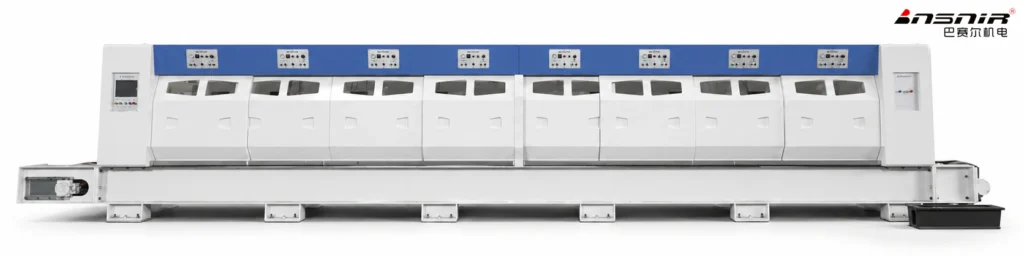
- Máquina de corte de azulejos cerâmicos para linhas de produção — Review the industrial cutting-machine family against the proposed tile, route and transfer requirements.
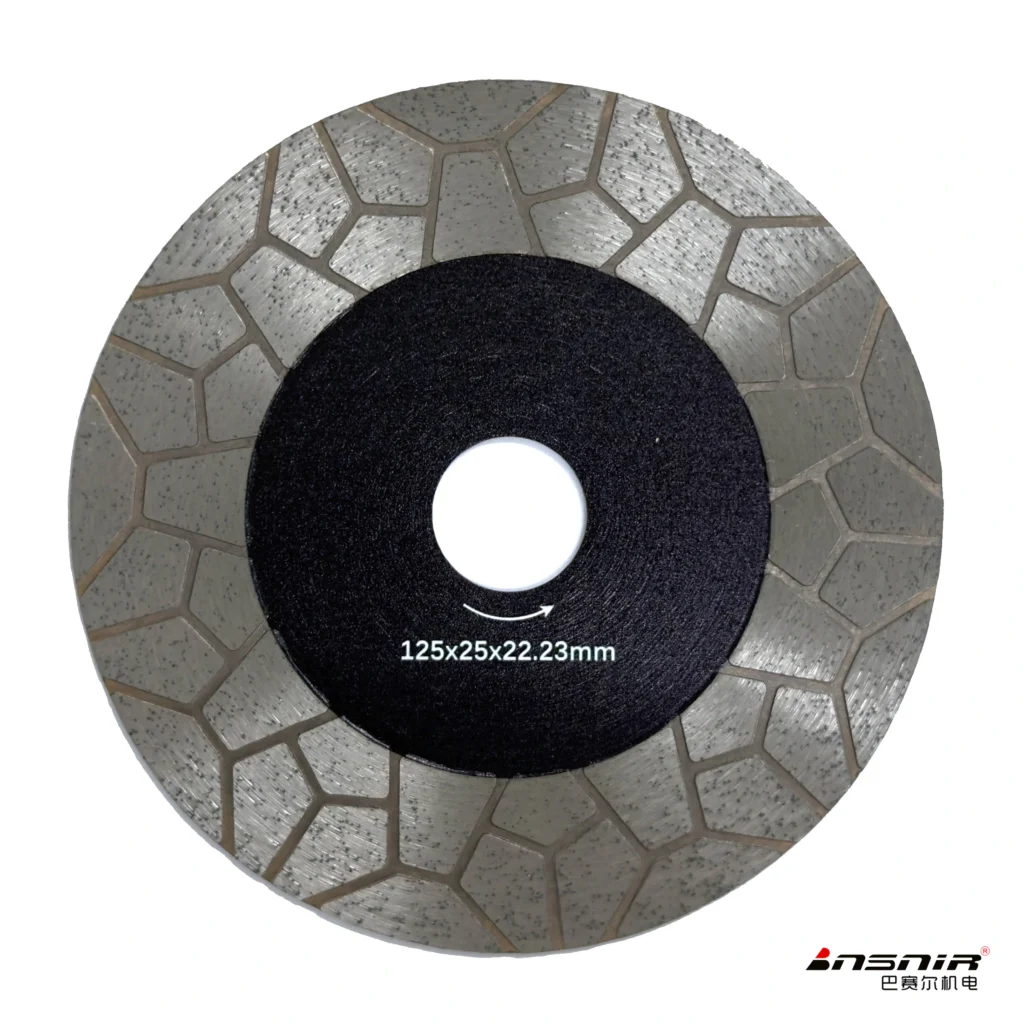
- Lâminas de serra diamantadas para corte de azulejos cerâmicos — Review the blade family and prepare the exact application and mounting questions for the machine quotation.
The cutting route also matters. A single straight cut down a large-format tile loads the blade differently from a grid of cuts on a mosaic blank. If the trial demonstrated one route, it has qualified one route.
A trial report that names the tile, machine, blade and route is a record. Everything else is a demonstration.
Where wet multi-blade sawing was used, the record should note whether cooling water was present throughout and at what supply condition. Dry score-and-split trials carry a different set of variables: scoring depth, anvil position and split geometry. The processing method shapes what the evidence can say, so the method needs to be part of the record.
Separate observations from conclusions
The most useful thing a trial record can do is hold the line between what was seen and what was inferred.
Separate observations from conclusions
| Available evidence | Supported use | Still open |
|---|---|---|
| Identified output sample | Describe that tested combination | Other materials or setups |
| Measured dimension or surface | Compare on the recorded method and basis | Unseen acceptance values |
| Short run | Describe immediate output quality | Sustained wear and stability |
| Several simultaneous changes | Evaluate the combination | Single-variable cause |
Dimensional output e edge quality are observations. What caused them is a conclusion. If a tile left the cut with the right dimension and a clean edge, that observation is real and stands on its own. The inference that a particular blade selection or a particular feed rate caused the result is a separate step—and one the trial may not support unless the test isolated those variables.
Consider a trial where feed rate, blade grade and water pressure were all set at values the supplier had pre-configured. The tiles came out within tolerance. That is a valid observation of a successful combination. It is not evidence that any one of those variables can be changed while maintaining the result, because nothing in that trial tested what happens when they diverge.
The same care applies to surface and edge measurements. ISO 10545-2 identifies which tile characteristics are relevant subjects of measurement—straightness of sides, rectangularity, flatness—and gives a measurement framework. What it does not supply is a machine-specific acceptance threshold or a commitment from any equipment supplier. When a trial report cites a standard, check whether it is describing the measurement method or asserting that the output meets a commercial specification. Those are different claims, and only the second one has teeth in a purchase contract.
When several settings changed together during a trial, the record qualifies the combination. Attributing the result to a single cause requires a controlled comparison the trial did not run.
Identify evidence still missing
A short observed run leaves several important questions unanswered, and naming them specifically is more useful than a general reservation about “long-term performance.”
Wear and blade life cannot be read from a brief trial. A blade that enters the test with a dressed cutting face may cut cleanly for a short run and drift in performance as the bond wears. Consumable cost per square meter is a function of blade life across a production run, not of output quality in a demonstration window. If the purchase decision depends on a cost-per-cut figure, that figure needs either a longer observed run or documented blade life data from a comparable production environment.
Throughput stability is a related gap. A trial run at reduced feed rate to show dimensional accuracy does not confirm what dimensional accuracy looks like at full production speed. If the trial ran at a feed rate below the target production rate, that gap should be recorded explicitly. It does not disqualify the trial; it defines the next question.
Untested tile families are perhaps the most common evidence gap to go unnamed. When one tile format or body passed the trial, the result applies to that tile and that cut pattern. Other sizes, thicknesses, materials and cut geometries in the product range remain unqualified unless an agreed family grouping covers them—and that grouping needs its rationale on record. Extending a porcelain squaring result silently to a ceramic body, or a 600 mm format result to a 1200 mm format, is a scope assumption that the trial data does not support.
Dust management is worth checking specifically for dry cutting operations. A trial conducted with temporary extraction may not reflect what the machine delivers when integrated with the plant’s permanent extraction system. Edge quality observed in a trial with marginal dust control may change when extraction is correctly matched to the grinding heads.
Leitura relacionada
- Um único teste de encaixe pode representar toda a sua linha de azulejos? Como os compradores devem limitar a garantia — Limit trial conclusions to the products and conditions actually represented.
- Como montar um conjunto representativo de amostras de ladrilhos para um teste de alinhamento — Use the representative-sample planning approach when defining what a trial should cover.
- Onde devem ser posicionadas as verificações dimensionais em uma linha de esquadria e chanfro? — Position dimensional checks so results remain associated with the relevant stage.
Choose the next bounded confirmation
When a purchase decision depends on a result the trial did not produce, the most direct path is to name the unresolved claim and request the smallest test or document that would resolve it.
That framing is more useful than either deferring the decision or accepting the gap. An unresolved claim is a concrete decision step waiting for an input. A supplier who can answer it will say what that input looks like. A supplier who cannot answer it has told you something important.
If blade life is the open question, the right request is documented wear data from a production environment running the same material and format—or a commitment to a witnessed extended run with blade measurement at start and end. If throughput at production speed is unconfirmed, the right request is a trial segment run at the target feed rate with the same measurement method applied.
If an untested tile family needs to be covered, a formal family grouping agreement is a legitimate alternative to running every format individually. The grouping should record which tile characteristics were considered—body type, format range, thickness range, cut pattern—and why the tested combination is representative. BASAIR can configure cutting lines around specific tile and production targets, and the conversation about family grouping is a natural part of that configuration work.
Name what is unresolved, then request the smallest evidence that would resolve it. That is a decision step, not a delay.
Where the decision timeline does not allow further trials before commitment, the gap can be managed through the acceptance plan rather than the trial record. Project acceptance criteria set against specific dimensional, edge and throughput targets—agreed and authorized before equipment is released—can carry the unresolved question forward in a controlled way. What matters is that the gap is named in the acceptance document, not absorbed silently into a commercial commitment the evidence does not support.
Before the next supplier conversation, have the following ready: the tile material, format and thickness for every product in scope; the dimensional and edge targets for each; the target line speed; and the cut patterns the machine will need to run. Bring also the trial record as it stands, with its known gaps marked. That preparation converts a general equipment inquiry into a qualified configuration discussion, and it gives any supplier a clear surface to respond against.
Referências
- ISO 10545-2:2018 Ceramic tiles — Determination of dimensions and surface quality — The official abstract specifies methods for ceramic-tile length, width, thickness, side straightness, rectangularity, surface flatness, and surface quality; tiles under 4 cm² are excluded from the abstract’s length, width, straightness, rectangularity, and flatness measurements. Official abstract only; the under-4-cm² exclusion applies to the listed measurements, not automatically to thickness or surface quality. The standard does not set a BASAIR machine tolerance or buyer acceptance limit
- Yongtao — Mosaic Cutting: Strips and Second Cutting Process — Yongtao describes multiple diamond blades making strips that may be turned and fed through a second cutting process to produce square mosaic pieces. Named supplier process example, not a universal spacer/kerf formula, shaft-to-pass equivalence, BASAIR machine capability, tolerance, feed, cooling setting or output guarantee. Keep final dimensions and trial acceptance project-specific.
- IEC 62381:2024 Sistemas de automação na indústria de processos — FAT, FIT, SAT e SIT — A norma IEC 62381:2024 define requisitos e listas de verificação para os testes de aceitação e integração em fábrica e no local, utilizados para demonstrar que um sistema de automação atende às especificações aplicáveis. Âmbito: automação da indústria de processos; os testes de desempenho de equipamentos específicos do projeto e os valores de aceitação ainda exigem um plano de testes acordado
- Gabinete do Governo do Reino Unido — Orientação: Especificações Técnicas — O guia explica que os requisitos técnicos descrevem os bens ou serviços adquiridos, podem incluir qualidade, desempenho, dimensões, embalagem e rotulagem, e proporcionam aos fornecedores um entendimento comum do que é exigido. Guia de compras públicas do Reino Unido atualizado em 13 de julho de 2026; utilize apenas o princípio de comparação de redação de requisitos delimitados, e não uma obrigação legal que regule as vendas internacionais privadas no âmbito da BASAIR. Não são estabelecidos termos de garantia, inclusão de serviços, quantidade de embalagem, limite de aceitação ou compromisso no âmbito da BASAIR.
Perguntas frequentes
P: How should we respond when a trial report contains a claim that the observations do not address?
R: Retain the measured result and mark the additional claim as awaiting its own evidence. Ask for the specific observation or test supporting that claim rather than rejecting all useful trial data or accepting the whole report as one package.
P: Can a supplier video help when the buyer could not attend the trial?
R: It can contribute identifiable observations if its run, samples and configuration are clear. List the checks visible in the recording and those not shown; use the latter to decide what further evidence is needed before the purchase decision.
P: What if a purchase decision combines one well-supported benefit with another untested benefit?
R: Separate the decision into supported scope and assumptions. The buyer can consider the supported scope while making the unresolved benefit an explicit condition for further confirmation, rather than allowing one successful result to validate both.