Cutting-trial variable traceability means assigning every result to a specific, documented combination of machine, blade, tile and process route—so that when output changes, you know which of the four caused it. Without that assignment, a good result is just a lucky run you cannot repeat, and a bad result is a problem you cannot fix. The discipline is not complicated, but it requires deliberate record-keeping from the moment a trial begins, not after the samples come off the line.
Give each trial run a complete identity
Every trial run needs a single identifier that links four things simultaneously: the machine configuration at the moment of the cut, the blade’s identity and condition, the tile batch being processed, and the route sequence the tile follows through the line.
Record all four before the first tile moves. Machine configuration includes head speed, feed rate, coolant flow or extraction setting, and any adjustment made since the last run. Blade identity covers manufacturer, specification, serial or lot number, and the number of linear metres already cut on that segment. Tile batch means the material, format, thickness and fired-lot reference—not just a stack of tiles that look the same. Route is the full sequence: scoring before splitting, single-pass or multi-pass, wet or dry, and any intermediate handling between stations.
Produtos relacionados
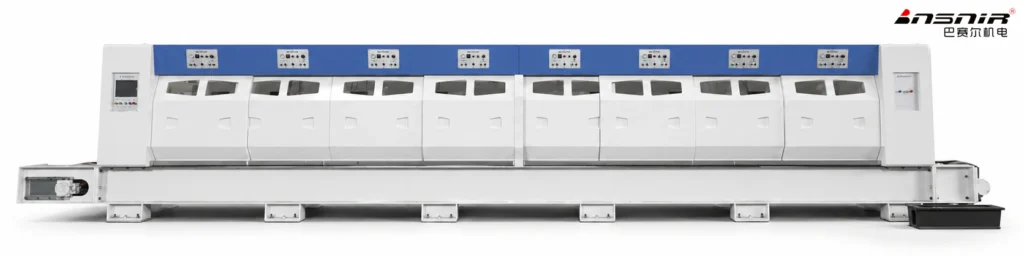
- Máquina de corte de azulejos cerâmicos para linhas de produção — Review the industrial cutting-machine family against the proposed tile, route and transfer requirements.
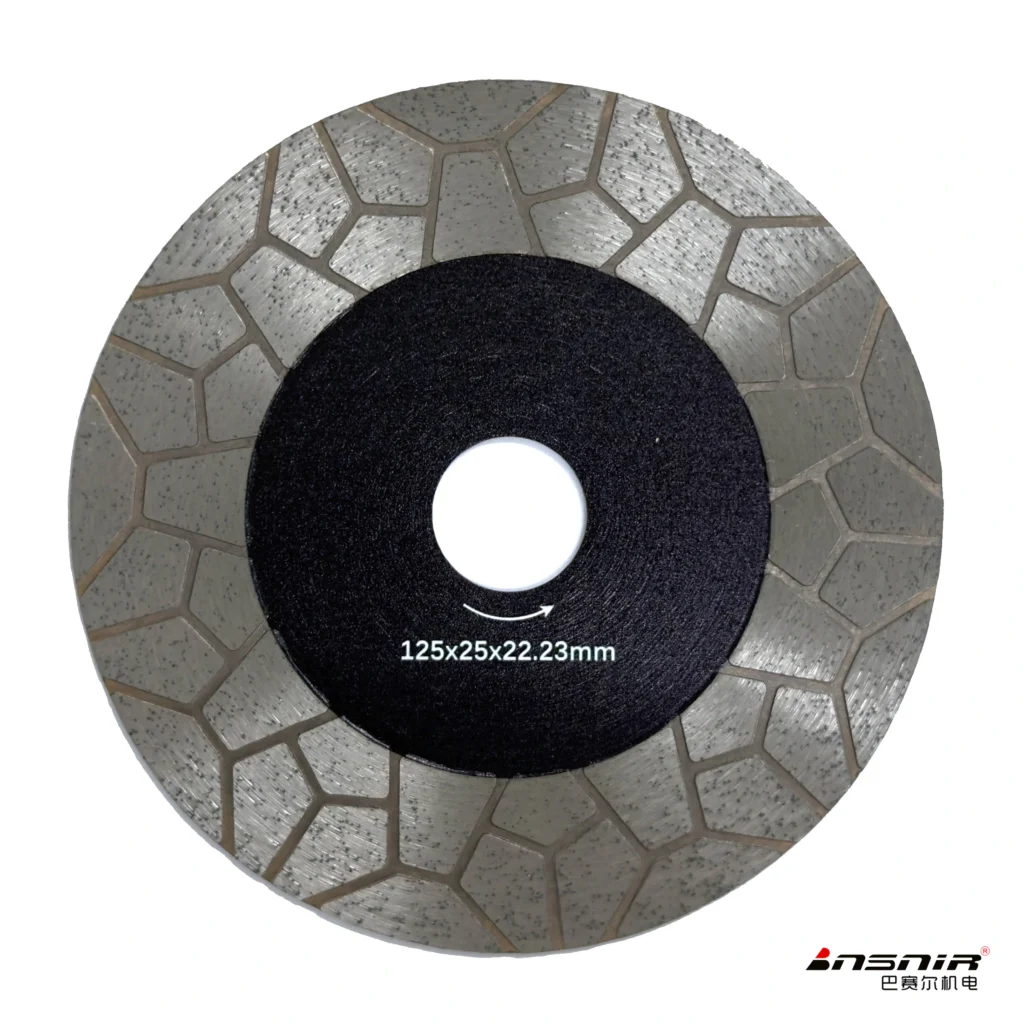
- Lâminas de serra diamantadas para corte de azulejos cerâmicos — Review the blade family and prepare the exact application and mounting questions for the machine quotation.
These four together are the context that makes a result interpretable. If any one is missing, the result is incomplete—not useless, but incomplete, and it should be treated that way in any comparative analysis. A run identifier written on a sample label that cannot be matched back to a full record sheet is not a trial; it is an observation.
Assign the identifier before cutting, not after. Reconstructing a record from memory introduces the kind of ambiguity that makes later disagreements about results unresolvable. Keep the record sheet at the machine, not at a desk.
Keep four variable groups separate
A change in cut output can come from the machine, the blade, the tile or the route—and attributing it to the wrong group leads to incorrect corrective action or, worse, a false confirmation that a setup works.
Keep four variable groups separate
| Variable group | Executar identidade | If changed together |
|---|---|---|
| Máquina | Configuration and relevant conditions | Keep attribution to the tested combination |
| Blade | Designation and condition | Avoid a blade-only superiority claim |
| Azulejo | Batch, geometry and incoming defects | Do not combine unidentified samples |
| Route | Passes and intermediate condition | Retain sequence differences in the comparison |
The practical discipline is to hold three groups as stable as possible while varying the fourth. When comparing blade behavior, keep the tile batch, cut pattern, feed rate and machine settings consistent across runs. Record any difference that could not be avoided—a slight head-temperature rise, a tile batch that crossed a lot boundary partway through—because an unrecorded difference becomes an uncontrolled variable.
When a finished cut deviates from target, the diagnostic step is to inspect machine condition, blade mounting and blade condition in that order through the supplier’s recommended process, not to label the problem immediately as a blade issue. Blade wobble, for example, has several possible contributors: flange condition, mounting torque, segment wear pattern, head bearing play. A deviation in cut geometry can look identical whether the source is a worn segment or a loose flange, so the cut appearance alone does not identify the cause. A visibly damaged blade should not be run again until its condition is assessed; continuing with it conflates blade degradation with whatever else changes in the next run.
A result only isolates a cause when the other three variable groups were held or their differences were recorded.
An exploratory run that deliberately changes more than one variable at once is a legitimate starting point when the goal is to identify a candidate combination—a blade type and feed rate that together look promising—rather than to confirm a cause. That is a valid use of trial time, but the run should be labelled as exploratory and its results should not be carried into a controlled comparison as if they isolate anything.
Wet and dry cutting routes, and one-pass versus multi-pass arrangements, are distinct process routes with different intermediate conditions. Treating output from both as a single method collapses a real variable. If wet multi-blade sawing produces a different edge condition than dry score-and-split on the same tile, that difference belongs to the route, not necessarily to the blade or the machine. Keep each route sequence intact as its own record group, even when both routes are working toward the same dimensional target on the final drawing.
Choose comparisons that answer one question
A well-designed comparison is built backward from the question it needs to answer, not forward from the variables that happen to be available.
If the question is whether blade specification A or B produces a cleaner edge on a particular porcelain body, the comparison needs those two blades run on the same machine, same settings, same tile batch, same route. If the question is whether a two-pass sequence improves dimensional tolerance relative to a single-pass, the route is the variable and the blade and machine should be held. Mixing both questions into one set of runs means neither gets answered cleanly.
Before planning the next run, state the question in one sentence and identify which single variable its answer depends on. That variable changes; everything else holds. This is not always perfectly achievable in a production environment—a tile lot runs out, a machine is needed for a production order—but the target discipline is clear, and any departure from it should be recorded rather than ignored.
Consider a scenario where two cut-route sequences are under evaluation for a large-format rectified tile. Both routes share a common final specification on squareness and edge break. The temptation is to run both sequences back-to-back and compare only the finished tiles. The more informative approach retains the intermediate condition after each pass—edge geometry, surface condition, dimensional reading—so that if one route’s output diverges, the divergence can be located at a specific step rather than attributed to the route as a whole. A common final drawing is a useful target for both sequences; it is not a reason to discard the intermediate records.
Where routes differ in kind—wet cutting with process water and slurry handling versus dry score-and-split with dust extraction—the infrastructure conditions are part of the route record. A wet line’s coolant flow rate and a dry line’s extraction pressure are process parameters, not background noise. Record them alongside blade and machine data.
Leitura relacionada
- Entrada por máquina, roda ou ladrilho? Como estruturar um ensaio de esquadriamento sem misturar variáveis — Use its variable-separation approach to keep material, machine and tool changes identifiable.
- Um único teste de encaixe pode representar toda a sua linha de azulejos? Como os compradores devem limitar a garantia — Limit trial conclusions to the products and conditions actually represented.
- Diagnóstico da variação no tamanho e na retangularidade dos ladrilhos após o alinhamento — Review size and rectangularity drift as a neighboring diagnostic task; it is not proof of a cutting-trial cause.
Preserve uncertain results honestly
A result whose run identity cannot be confirmed is not a confirmed result—but it is not nothing, either. The right treatment is to set it aside from comparative conclusions while retaining it as a labeled observation with its limitation stated.
This situation arises most often when sample labels and run records disagree: a tile sample carries a label that does not match any complete run sheet, or two samples carry the same identifier when they were cut under different conditions. An attractive-looking cut from an unresolved run cannot identify the setup that produced it. Promoting it to a comparative conclusion would make the conclusion unreliable, which is a larger problem than the lost data point.
An honest uncertain result is more useful than a confident one with a broken chain of identity.
Preserving the observation with its provenance stated—”cut appearance consistent with run-3 conditions; label conflict unresolved”—keeps it available for reference without overstating what it proves. If a later run reproduces similar output under a confirmed identity, the earlier observation becomes supporting context rather than primary evidence.
The same logic applies to deviations. A cut defect recorded with its full run context—machine adjustment, blade metre-count, tile lot, route step—can be matched against supplier diagnostic criteria and used to plan a corrective run. A defect recorded only as “edge chip, run 4” cannot. The defect is real; it just cannot be acted on systematically.
Planning the next run from an uncertain result means first resolving what the uncertainty was, not repeating the original conditions and hoping the output clarifies itself. If the disagreement was between two tile lots that crossed mid-run, the next run should use a confirmed single-lot sample. If the disagreement was between blade records, the next run should use a blade with a verified start condition and a fresh metre-count log.
When a trial series surfaces a safety concern or a compatibility question—a blade segment showing abnormal wear pattern, a machine condition outside the specified operating range—that concern takes priority over the next comparative run. Proceeding before it is resolved introduces a confounding condition that will make the next result as ambiguous as the one being investigated.
The last step in any trial sequence is a plan for the next one: which variable changes, which baseline holds, and what the confirming condition looks like. A targeted next run is more informative than repeating an uncontrolled comparison. Before that conversation with a machine or tooling supplier, have the tile material, format and thickness confirmed, the route sequence described step by step, the machine’s current configuration documented, and the specific question the next run is designed to answer written down in one sentence.
Referências
- Norton Clipper — Technical Support: Troubleshooting Diamond Products — The Norton Clipper troubleshooting section identifies blade wobble as potentially associated with worn or damaged bearings or spindle, flange condition, improper operating speed, or a bent blade. Norton Clipper saw guidance is a bounded diagnostic analogy, not a BASAIR industrial tile or multi-blade machine procedure. Do not transfer its tachometer, repair, tolerance, or running-observation steps, infer a confirmed cause or actual blade wobble from a finished-cut deviation, or permit further use of a visibly damaged blade. Actual checks and return-to-use decisions require the applicable blade and machine supplier instructions and qualified project-specific assessment.
- Yongtao — Mosaic Cutting: Strips and Second Cutting Process — Yongtao describes multiple diamond blades making strips that may be turned and fed through a second cutting process to produce square mosaic pieces. Named supplier process example, not a universal spacer/kerf formula, shaft-to-pass equivalence, BASAIR machine capability, tolerance, feed, cooling setting or output guarantee. Keep final dimensions and trial acceptance project-specific.
- Catálogo Geral da BMR — Processos completos de final de linha para cerâmica — O catálogo distingue entre polimento, lapidação, tratamento, esquadramento úmido/seco e corte úmido/seco, além de identificar alimentadores adjacentes, unidades de transferência, módulos de secagem, aplicação, lavagem, limpeza e controle dimensional. Catálogo do sistema BMR de primeira linha; a disponibilidade e os layouts dos módulos são específicos do BMR e não comprovam o escopo do BASAIR, os serviços necessários, o desempenho, a sequência ou a compatibilidade. Utilize-o apenas para distinções de processos/módulos como referência de mercado.
- ISO 10545-2:2018 Ceramic tiles — Determination of dimensions and surface quality — The official abstract specifies methods for ceramic-tile length, width, thickness, side straightness, rectangularity, surface flatness, and surface quality; tiles under 4 cm² are excluded from the abstract’s length, width, straightness, rectangularity, and flatness measurements. Official abstract only; the under-4-cm² exclusion applies to the listed measurements, not automatically to thickness or surface quality. The standard does not set a BASAIR machine tolerance or buyer acceptance limit
Perguntas frequentes
P: What if two technicians record different descriptions of the same trial run?
R: Preserve both observations with their authors and reconcile the run identity before merging them. A disagreement can be useful evidence of an unresolved observation; silently selecting the more favorable note weakens the comparison.
P: Can photos be used when the physical samples cannot be retained?
R: Keep each image linked to its run, piece and viewing context. Use it for the observations it actually shows and state which dimensional or condition checks remain unavailable, rather than presenting the photo as a complete replacement for the sample.
P: What if a run is interrupted and restarted without a planned setup change?
R: Record the interruption and restart as separate events under the run history. Keep the output groups identifiable until the team decides whether the interruption affected the comparison; an unchanged recipe name should not erase the event.