
Stone profile and small-piece processing is a sequence of unfinished surfaces, not one “profile machine.” A thick blank may first be split, calibrated and face-polished before profile shaping; the shaped face may then need a dedicated polishing sequence, while two straight side edges can remain for a separate machine. BASAIR configures the route from the target cross-section, material, part support and every surface that must be finished.
The following modules are selectable project directions. Their arrangement, tools, working range, water system and result must be confirmed against the buyer’s actual stone or quartz, sample and drawing.
Comece pelo Solutions overview or review the broader stone, sintered-stone and countertop equipment map. Square columns and balusters with repeated faces have a separate four-side polishing route; they should not be forced into a small profile flow.
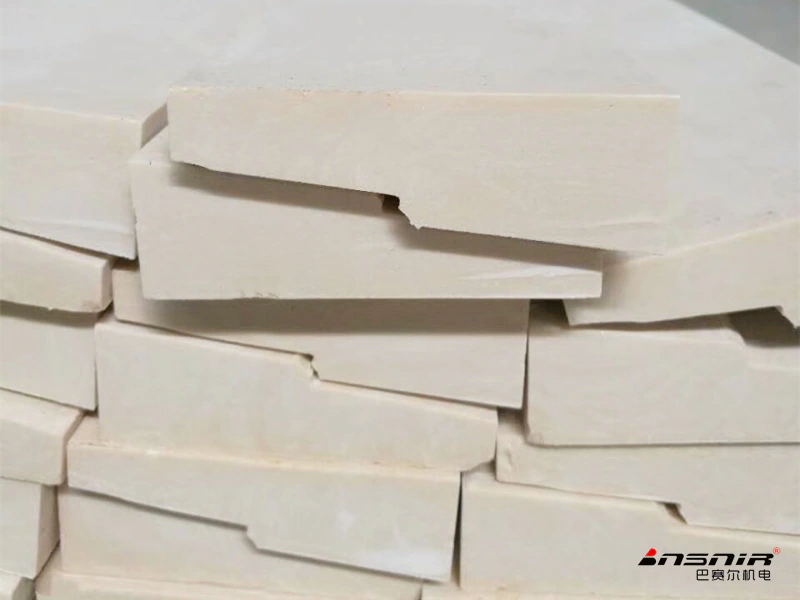
Thickness splitting divides a narrow thick blank into thinner intermediate pieces. It is distinct from calibrating to final thickness and from polishing the surface. Confirm blade kerf, holding, the target split and stock left for downstream calibration.
Start with the blank and mark every finished surface
| Starting condition | Responsabilidade pelo processo | Decision evidence |
|---|---|---|
| Thick strip or block | Split into thinner blanks, then allow for saw condition and later calibration | Original section, target pieces, material defects, cut allowance and support |
| Uneven blank thickness | Calibrate thickness and reference face | Measured variation, removal distribution, flatness method and following process |
| Large face needs finishing | Continuous face polishing ou small-piece polishing according to support and batch | Face size, preceding calibration, material, target appearance and abrasive sequence |
| Mesh-mounted mosaic | Mosaic face polishing after assembly stability is confirmed | Chip size, sheet build-up, mesh/adhesive condition and flatness |
| New profile required | Shape the section, then polish the shaped face | Full-scale cross-section, datum, blank allowance, length and all visible faces |
| Straight side faces remain | Finish the two straight side edges rather than assuming the profile line reaches them | Side-edge width, profile transition, feed reference and required finish |
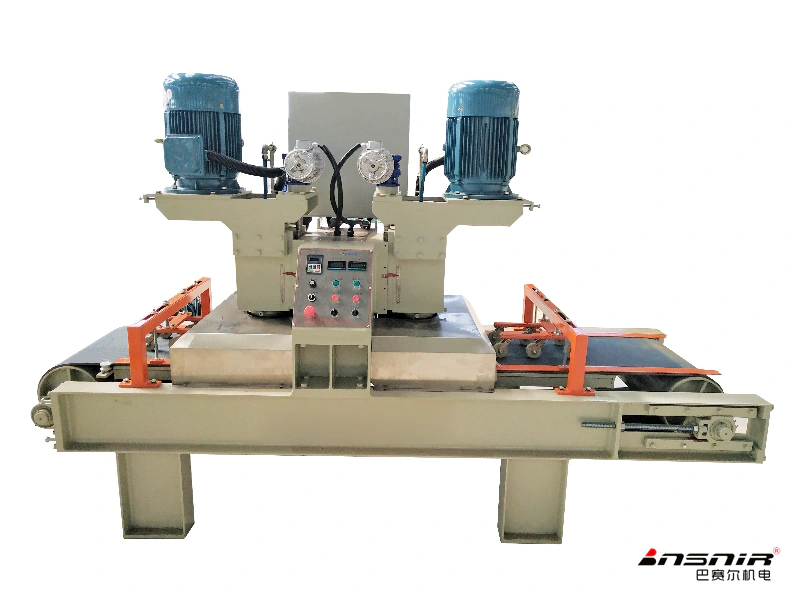

Keep face polishing, shaping and side-edge finishing distinct
Large slabs, loose small pieces and mesh-mounted mosaics present different support risks. A small-piece machine cannot be selected only from the maximum width; the minimum stable contact area, part orientation and risk of lifting or entering gaps matter. Likewise, a profile shaper establishes geometry, while later stations establish the visible surface.
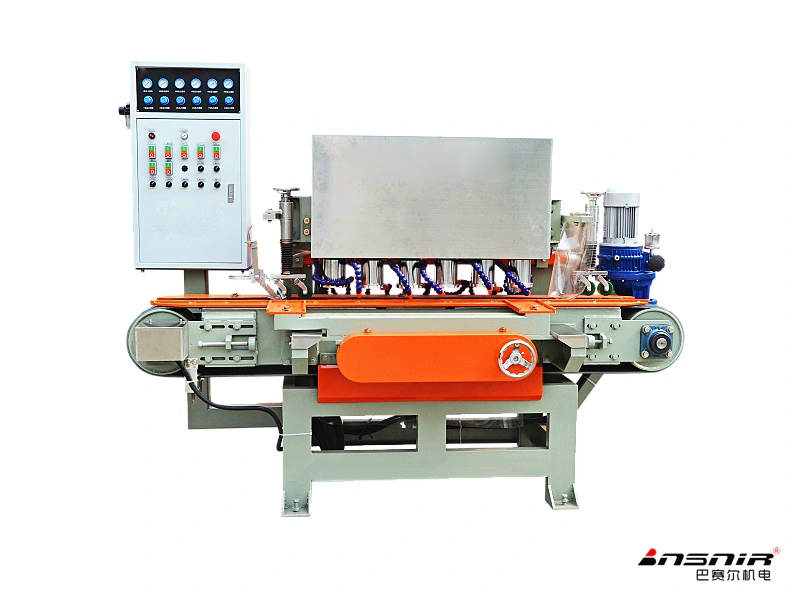
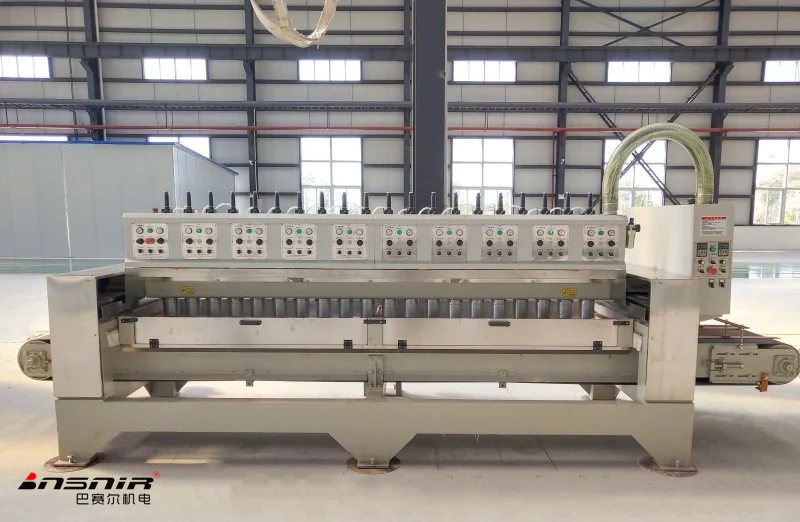
Profile shaping creates the contour; it does not finish the polished face. Submit the finished section, blank allowance and material, then confirm the forming-wheel sequence and the downstream polishing operation.

Interfaces that decide the line arrangement
Stone abrasives remain a project interface: confirm machine position, tool form, material and sequence through the magnesite stone abrasives route rather than applying a glaze-tile sequence by analogy.
| Interface | Define | Verificação de aceitação |
|---|---|---|
| Geometry | Raw and target sections, datum, allowance, length, minimum piece and transition radii | Approved full-scale section and representative blanks |
| Support and flow | Belt/rail contact, overhang, pressure points, feed direction and transfer between machines | Stable trial through each transfer and changeover |
| Tools and water | Blade, calibrating tool, profile wheel, polishing sequence, cooling, slurry and cleaning | Approved tool schedule for each material/profile family |
| Resultado | Thickness, section, straightness, surface, transitions and protected faces | Measured sample and agreed visual reference under stated conditions |
Information for a stone profile or small-piece proposal
- Stone or quartz identity, raw dimensions, photos and material variability
- Dimensioned target section with every surface marked as cut, calibrated, polished or protected
- Required split count, thickness allowance, batch sizes, shifts and product mix
- Existing upstream/downstream equipment, working heights and transfer direction
- Available power, process water, drainage, slurry handling, access and floor plan
- Approved samples and measurable criteria for section, thickness and appearance
Request a stone profile and small-piece process review
This page defines a configurable process route, not one universal machine or a fixed-output package. Final equipment, tools, utilities, performance and acceptance depend on the material, geometry, selected configuration and engineering confirmation.