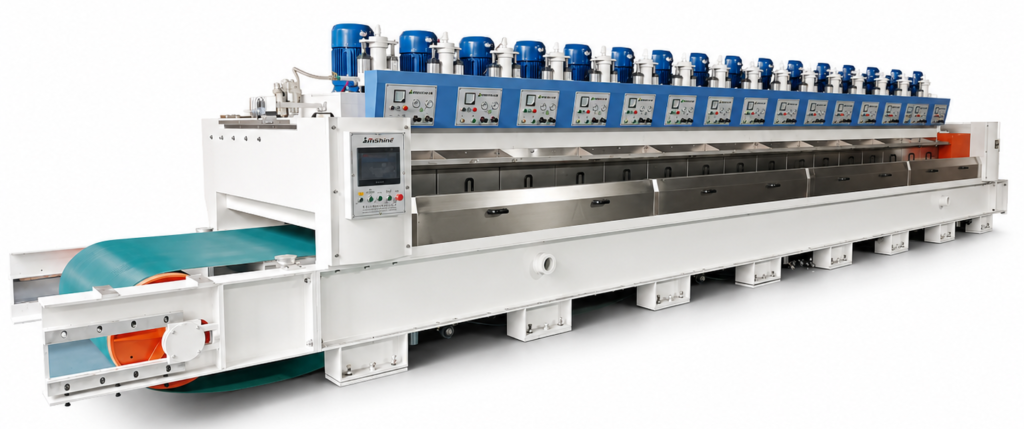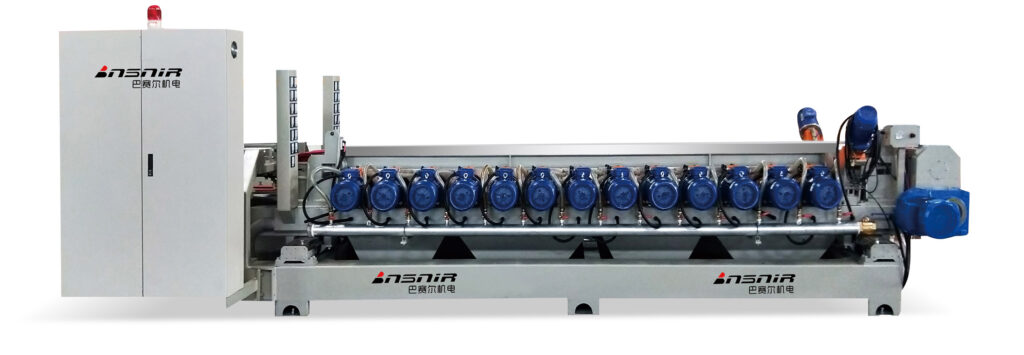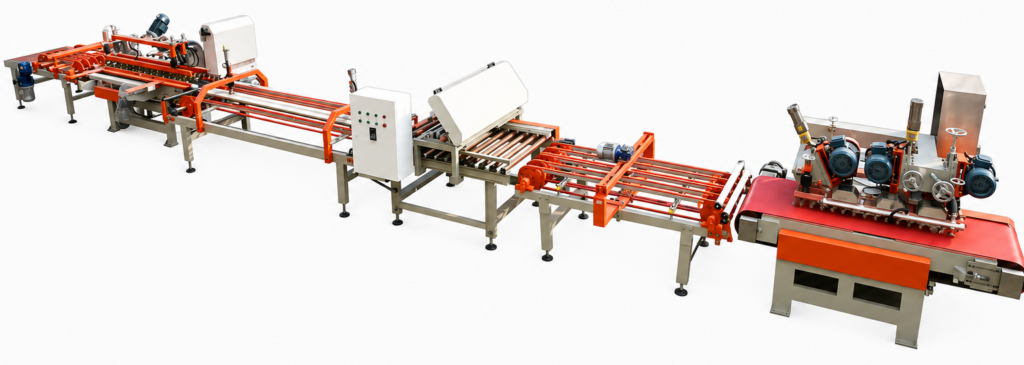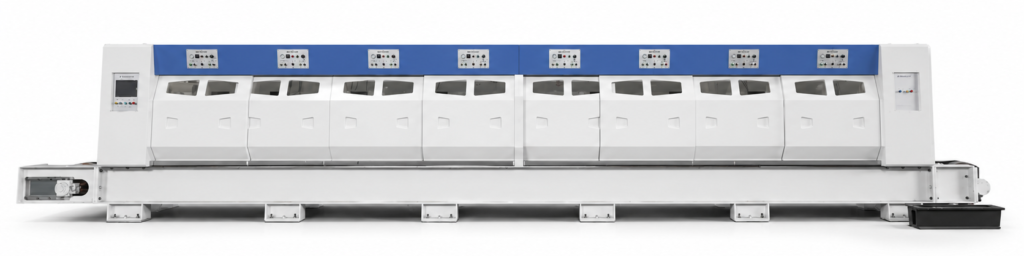
A tile-factory buyer preparing a squaring or chamfering project faces a real drafting problem: describe the finished edge in enough detail that a supplier can propose a suitable configuration, but not so much detail that the buyer accidentally writes the machine specification themselves. Get this wrong in one direction and quotations arrive that cannot be compared because each supplier answered a different question; get it wrong in the other direction and the requirement locks in a layout before anyone has evaluated whether it fits the material, the line, or the result actually wanted. The task is to state the output clearly enough to evaluate, while leaving the architecture open enough for a supplier to propose it.
Describe the Finished Edge as an Output
A finished-edge requirement is easiest to write, and easiest for a supplier to answer, when it describes what the tile must present after processing rather than how a machine should be built to produce it. This distinction matters because a requirement written as a design description quietly forecloses configurations that might otherwise meet the same output. Orientações do Gabinete do Governo do Reino Unido sobre especificações técnicas supports expressing requirements in performance or functional terms rather than prescribing design where that is appropriate, and that principle applies directly here: the buyer’s interest is the tile that comes off the line, not the number of motors or the position of a wheel that produces it.
Ladrilhos cerâmicos – Parte 2: Ensaios de solidez da cor à luz is useful for structuring this description because it treats ceramic-tile dimensional and surface-quality characteristics as separate items rather than one blended impression. Length, width, side straightness, rectangularity, surface flatness, and surface quality are each distinct characteristics, and a requirement that separates them the same way is easier for a supplier to read and price than one that folds them into a single adjective like “accurate” or “clean.” Stating the applicable final dimensions, the geometry the tile must hold, an edge or chamfer reference, and the visible surface or edge quality expected gives a supplier four separate things to design toward, each of which can be evaluated on its own terms later.
What belongs in this description changes with what is actually fixed for the project. Where a tile family, incoming size range, or downstream packing step imposes a real constraint, that constraint belongs in the requirement because it is a genuine boundary condition the supplier’s proposal must respect. Where a value or method has not yet been agreed between buyer and supplier, or where a reference sample has not yet been produced, the requirement should say so rather than assume a number that has no basis yet. Naming a motor count, a wheel arrangement, or a control sequence does not belong in this description unless that detail is a true fixed constraint of the existing line — and if it is, the requirement should say why it is fixed, not simply state it as a preference.
This separation carries directly into how the buyer later discusses the project with BASAIR or any other supplier: the output description is the information a supplier needs to begin proposing a squaring and chamfering machine line configuration, and it is far more useful in that role than a layout the buyer guessed at independently.
| Output dimension | Requirement should state | Keep out of the requirement unless truly fixed |
|---|---|---|
| Final tile dimensions | Applicable target and agreed evaluation basis | Unjustified machine dimensions or module count |
| Retilineidade lateral e retangularidade | Required finished condition and measurement approach | Assumed wheel positions or adjustment logic |
| Edge or chamfer form | Drawing, profile description, or agreed reference sample | Unverified tool sequence or universal geometry |
| Surface and visible edge quality | Observable criteria and inspection basis | Guaranteed appearance without representative evidence |
| Production duty | Applicable tile envelope, process context, and required output | Unsupported throughput or tool-life promise |
Define How Each Output Will Be Evaluated
Stating an output is only half the requirement. The other half is saying how that output will be checked, because an unmeasured requirement cannot be accepted, rejected, or compared across suppliers. GOV.UK guidance on technical specifications links requirements to proportionate evidence, and the same logic applies whether the buyer is a public authority or a tile manufacturer: every requested outcome needs a named measurement or inspection approach attached to it, not just a description of the result wanted.
ISO 10545-2 again offers a structuring tool here, since it supplies a method scope for the dimensional and surface-quality characteristics it defines. That scope is useful for organizing which characteristic gets which kind of check — dimensional characteristics generally call for a measurement method and a sample basis, while an edge or chamfer profile that cannot be reduced to a single number calls for a drawing or an agreed reference sample instead. It matters that this standard supplies structure, not an acceptance value: nothing in ISO 10545-2 tells a buyer or BASAIR what tolerance is acceptable for a given project, and the requirement should not imply that it does.
The evaluation approach changes with what kind of output is being checked. A dimensional characteristic can usually be paired with an instrument, a sample basis, and a recorded result, and once those three are agreed the decision rule becomes mechanical. A visible edge or surface condition resists that treatment because appearance depends on lighting, viewing distance, and reference context; where a visual outcome cannot be captured safely in prose, the practical answer is a drawing or an agreed reference sample against which the finished tile is compared, rather than an attempt to write the visual criterion out in words. Output under intended production duty needs a third kind of evidence again — trial conditions tied to the actual tile and process records, because a duty claim that is not linked to the material and settings it was demonstrated under does not transfer to a different project.
What the buyer still owns at this stage is the specific instrument, sampling plan, tolerance value, and visual acceptance language, along with who is responsible for keeping the records. None of that is supplied by ISO 10545-2 or by any general principle; it has to be agreed between buyer and supplier for this project before the requirement can function as an acceptance basis.
| Requirement type | Evidence element to agree | Project-specific decision still needed |
|---|---|---|
| Dimensional characteristic | Measurement method, sample basis, and recorded result | Value, tolerance, instrument, and decision rule |
| Edge or chamfer profile | Drawing or reference sample plus inspection record | Profile definition and permitted variation |
| Visible edge or surface condition | Inspection method, lighting or reference context, and result record | Acceptance language and sample coverage |
| Output under intended duty | Trial conditions linked to tile and process records | Represented production envelope and exclusions |
State Applicability Conditions and Exclusions
A finished-edge requirement that states an output and its evaluation method still says nothing about where that requirement applies. Orientações da HSE sobre a aquisição de novas máquinas advises that buyers define where and how machinery will be used and discuss complex or custom-built requirements directly with suppliers, and the reasoning transfers cleanly to a tile line: a requirement written without an applicability envelope invites a supplier, or a later reviewer, to assume it holds across every tile family, thickness, and process route the factory runs, when in fact it may have only been discussed for one.
The envelope is not a list of independent conditions that can be recombined at will; it is a connected set. Tile material and incoming geometry determine what the abrasive and machine encounter in the first pass. Thickness changes how the tile behaves under processing loads and how much material can be removed before the target geometry is reached. Incoming edge condition and surface state change what the finishing step is actually correcting versus what it is refining. Whether the line runs wet or dry changes both the abrasive behavior and the water and slurry handling the line requires. Process speed context changes contact time and therefore what result is achievable from the same nominal configuration. None of these conditions determines the outcome on its own; they interact, and a requirement that fixes only one of them while leaving the others unstated has not actually defined its scope.
This is why a requirement should state explicitly what is included and separate that from what is excluded or untested. Where a factory runs a narrow, well-characterized tile range through one process route, the applicability statement can be narrow too. Where a factory intends to extend a line to a new tile family, a new thickness, or a different process route later, that intention should be named as a future condition rather than folded silently into the current requirement, because no adopted source establishes that a result demonstrated for one tile family, size, or process route transfers automatically to another. A requirement that omits this envelope does not stay neutral — it invites the assumption of full-range performance, which is a claim nobody has actually agreed to or evidenced.
Ask Suppliers to Propose Architecture and Evidence
Once the output, its evaluation method, and its applicability envelope are stated, the remaining task is to let suppliers propose how to achieve it rather than prescribing that architecture in the requirement itself. GOV.UK guidance on technical specifications distinguishes functional and performance requirements from design choices, and allows the two to mix only where a descriptive constraint is genuinely needed — for example where an existing line imposes a real interface limit. That distinction is the organizing principle for this final step: fix what the factory genuinely cannot change, and ask each supplier to explain everything else.
What the buyer fixes should be limited to actual constraints: the finished output and its evaluation basis already defined, the real incoming-tile conditions the line will process, factory space, utilities, and handoff points that are genuinely immovable, and the production duty the project needs to support. Everything beyond that — line, wheel, and control configuration; the method for handling the stated variation in incoming material; the interfaces proposed to satisfy the fixed constraints; the project configuration intended to meet the stated duty — belongs to the supplier’s proposal, not the buyer’s requirement. Where a mandatory design constraint genuinely exists, it should be labeled as such along with the reason it is fixed, so a supplier can see clearly which parts of the brief are negotiable and which are not.
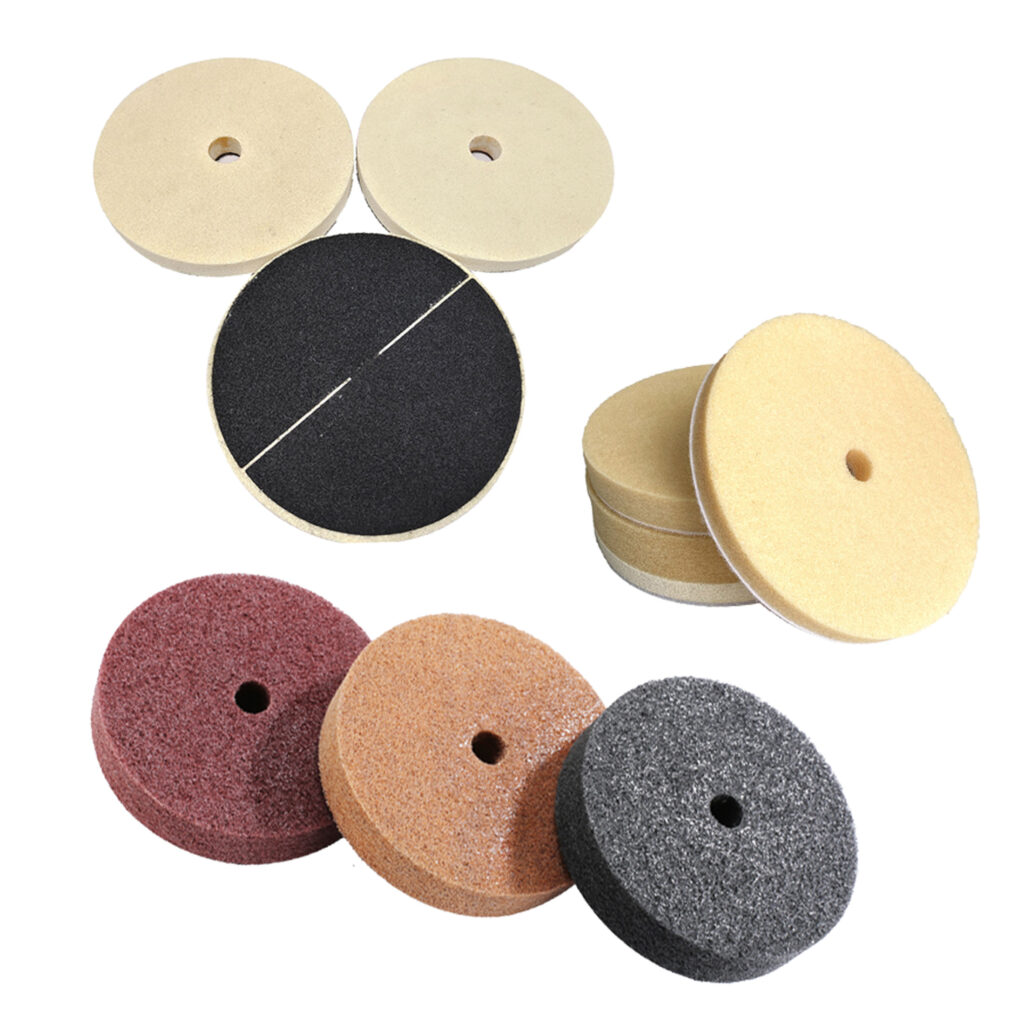
This is the point where a buyer’s own requirement work meets a supplier’s configuration and quotation review: BASAIR or any other supplier evaluates the stated output, evaluation basis, and applicability envelope against the equipment and abrasive options available, including matched discos de esmerilagem diamantados suited to the stated tile and process conditions, and returns a proposed architecture rather than accepting a layout the buyer guessed at. A sitemap or product-family page — for BASAIR, a squaring and chamfering machine line page, for instance — indicates a relevant destination for that conversation; it does not itself establish a configuration, a tolerance, or a performance commitment, and a buyer should not read a product-family listing as if it already answered the project’s applicability or evidence questions.
The final exchange between buyer and supplier should confirm four things together: the applicability envelope and its exclusions, the evidence package and trial scope that will support any performance commitment, the drawings, responsibilities, and change-control process for the project, and the conditions attached to whatever performance the supplier proposes. Where the buyer’s fixed constraints are narrow and clearly labeled, the supplier has room to propose the configuration best matched to the stated output; where the buyer has, without realizing it, described a specific layout instead of an output, the supplier’s proposal will simply mirror that layout back — which defeats the purpose of writing a functional requirement in the first place.
| Buyer fixes | Supplier proposes | Both sides confirm |
|---|---|---|
| Finished output and evaluation basis | Line, wheel, and control configuration | Applicability envelope and exclusions |
| Actual incoming-tile conditions | Method for handling the stated variation | Evidence package and trial scope |
| Factory space, utilities, and handoff constraints that are genuinely fixed | Interfaces that satisfy those constraints | Drawings, responsibilities, and change control |
| Required production duty | Project configuration intended to address it | Conditions attached to any performance commitment |
Perguntas frequentes
P: Do we need to specify head counts and wheel positions to request a particular finished edge?
R: You can define the finished outcome without prescribing those design choices. State the applicable dimensions, geometry, edge or chamfer form, and visible quality, then ask suppliers to propose the line and wheel configuration and the evidence supporting it.
P: How can we describe an edge appearance that is hard to express in words?
R: Use an agreed drawing or reference sample with an inspection approach and result record. Pair it with the relevant tile conditions and sample basis so the supplier can assess the same visible or profile outcome rather than interpreting a broad phrase such as “good finish.”
P: Should the same finished-edge requirement apply to every tile family?
R: Apply it only within an explicitly defined envelope. Attach the requirement to material, size, thickness, incoming geometry, surface, process route, wet or dry context, speed context, and required output, and distinguish future or untested conditions from the included scope.
P: When is a machine design constraint justified in an outcome-based brief?
R: Include one when a genuine fixed factory or interoperability constraint makes it necessary, and state the reason. Fix the space, utility, and handoff outcomes you actually require while asking suppliers to explain how their proposed architecture meets them and what exclusions remain.