
1. Define the visible outside edge before choosing heads
This page covers external countertop-edge shaping and polishing: straight edges, specified upper/lower chamfers and selected rounded profiles. It does not cover a sink’s internal edge, retained-end 45° mitering or backsplash-strip processing.
Straight-edge production and rounded-edge configurations
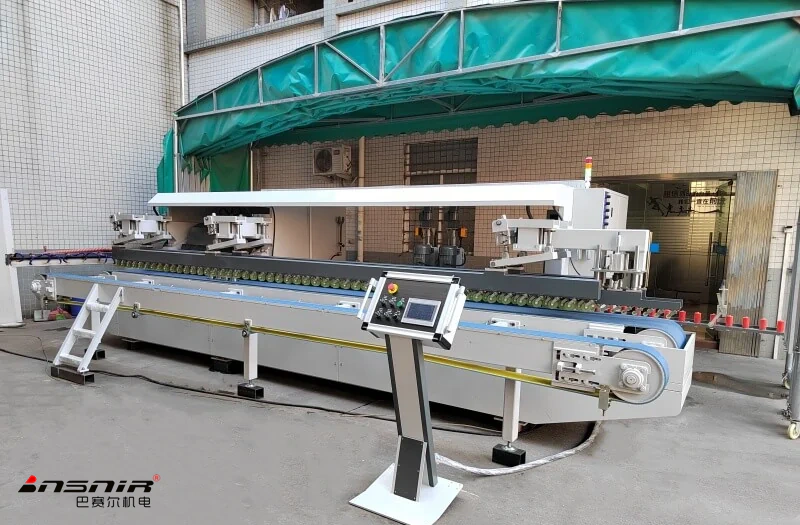
A straight-edge line assigns successive heads to edge correction and polishing. Ten- and twelve-head layouts are useful comparison points, but a longer line should be justified by removal, abrasive sequence and the finished edge sample. Straight-edge polishing does not itself prove every rounded profile.
A dedicated countertop arrangement may add calibration, grooving and upper/lower small-radius polishing to flat-edge stages. Specify whether each top and bottom corner needs a radius, chamfer or untouched reference surface. The pressing system and leading/trailing support matter when widths or thicknesses vary within a batch.
One referenced countertop arrangement lists 600–2500 mm width, up to 60 mm thickness and 0.3–4 m/min feed. These figures apply to that particular arrangement, not every machine on this page. Confirm minimum piece support, required stations and a material trial before using a feed figure to calculate saleable output.
Two genuinely different architectures are available. A continuous belt-feed line suits repeatable outside edges and steady batches. A CNC platform holds the workpiece while programmable heads follow selected edge geometry. They are not interchangeable simply because both are called edge polishers.
A feed-through line follows a straight presented edge; it does not turn around a concave corner. A CNC platform may address selected external-perimeter corners only when the minimum radius, tool reach, clamp clearance and path are proven. A sink’s internal perimeter still belongs to the sink inner-edge route.
Comece pelo countertop equipment route if the upstream blank and downstream operations are not yet allocated.
2. Choose between a feed-through line and a CNC platform
| Architecture | Melhor ajuste | Trade-off | Evidence-bound reference |
|---|---|---|---|
| Continuous multi-head line | Repeated straight, upper/lower chamfer and rounded outside edges with stable feed direction | Needs adequate leading/trailing support and does not become an internal-edge machine | The reference configuration source describes a 23-head configuration; its 300–2500 mm size, 20–40 mm thickness and 1–3 m/min figures apply only to that referenced model |
| CNC platform with selectable grinding heads | Lower-volume or varied external profiles where the workpiece can be securely located | Tool changes and programmed paths add flexibility but need a proven tool library, post-processor and cycle plan | The cited platform is 3200 × 1600 mm; that value is not generalized to other quoted machines |
3. Match clamping, abrasives and wet-process interfaces
- Incoming blank: provide the edge cross-section, lamination or build-up, thickness range, longest/shortest length, internal/external corners, surface protection and the faces that must remain visible.
- Holding: for a line, confirm belt contact, upper pressure rollers, auxiliary support and feed direction. For a CNC platform, confirm vacuum/mechanical restraint, overhang, tool clearance and collision zones.
- Tooling: freeze the forming wheel, upper/lower chamfer tools, straight-edge polishing sequence, rounded-profile tools, grit progression, pressure and dressing method against a sample. A “23-head” count does not define the finished profile by itself.
- Control/software: line recipes must store feed, head position and pressure by edge family; CNC work needs accepted drawing format, tool library, offsets and post-processor. Neither route proves an untested profile.
- Process hand-off: receive a dimensionally accepted blank. Route retained-end mitres to the mitering machine, sink openings to the cut-out route, and backsplash strips to the backsplash edge machine.
- Serviços públicos e local: confirm voltage/frequency and connected load, clean cooling water, water pressure and flow, compressed air for any pneumatic heads/pressure units, drainage and slurry treatment. Provide loading, unloading, maintenance, guard-opening and wheel-change clearances, lifting and lockout arrangements, anti-slip drainage and locally required silica/slurry controls.
4. Prove the edge with a profile sample
Acceptance should name the profile template, straightness and size method, visible surface, edge transition, acceptable chips/scratches, target appearance sample and inspection lighting. Run the actual material, thickness, lamination and grit sequence; a head count or nominal speed cannot substitute for the sample.
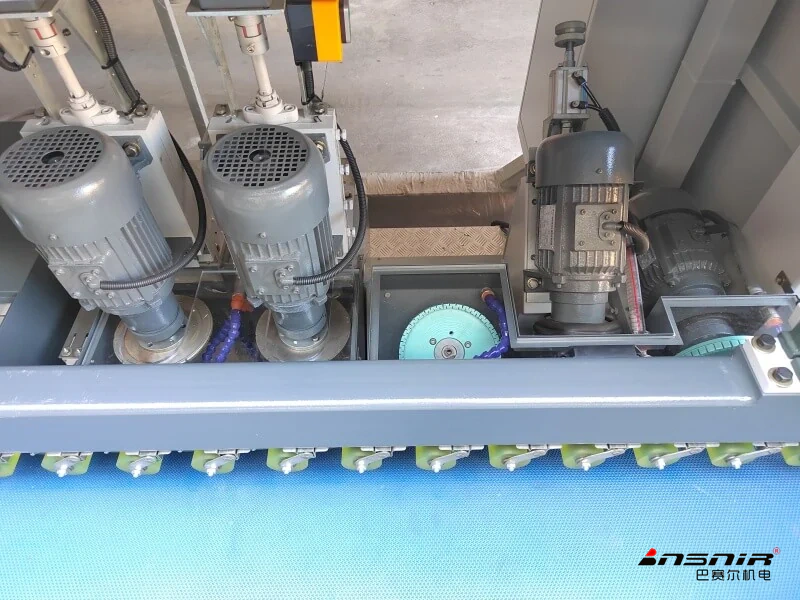

Internal sink edges remain the responsibility of hole preparation and the downstream inner-edge process. See the solução para fabricação de bancadas for the complete route.
5. Send the edge package for configuration
| Entrada | Detalhe obrigatório | Decisão que ela apoia |
|---|---|---|
| Edge definition | Full-size cross-section, top/bottom face, sample or finish reference, straight/rounded/chamfer list | Architecture, forming tools and head sequence |
| Gama de peças | Material, thickness, length/width, lamination, weight, corners and quantity per shift | Clamping, feed support and usable range |
| Quality target | Inspection method, allowed chips/scratches, dimensional method and representative sample | Trial and acceptance plan |
| Factory conditions | Upstream/downstream machines, floor plan, loading direction, power, water, air, drainage and slurry route | Interface instalada e divisão do escopo |
Submit your edge drawing, material range and finish sample for configuration review.