
Calibrating and grinding tools prepare tile or stone surfaces by correcting thickness, flatness or roughness before later finishing stages. Calibrating rollers, cylindrical or satellite wheels, and Fickert-form abrasives use different machine motions and mounting interfaces; a tool should be selected from the actual head and process stage.
This page separates preparation and rough/intermediate grinding from final lappato or surface finishing. Some roller and satellite families are project-configured and require supplier and machine-interface confirmation before a specific product can be offered.
Separate calibrating, grinding and finishing duties
| Stage/tool path | Primary responsibility | Before selection |
|---|---|---|
| Diamond calibrating rollers | Controlled removal for thickness/flatness preparation on a compatible calibrating machine | Supply and actual roller/shaft interface must be confirmed for the project |
| Cylindrical or satellite wheels | Surface grinding through the head motion and contact path designed for that machine | Head motion, spindle, mounting, tool envelope and machine supply must be confirmed |
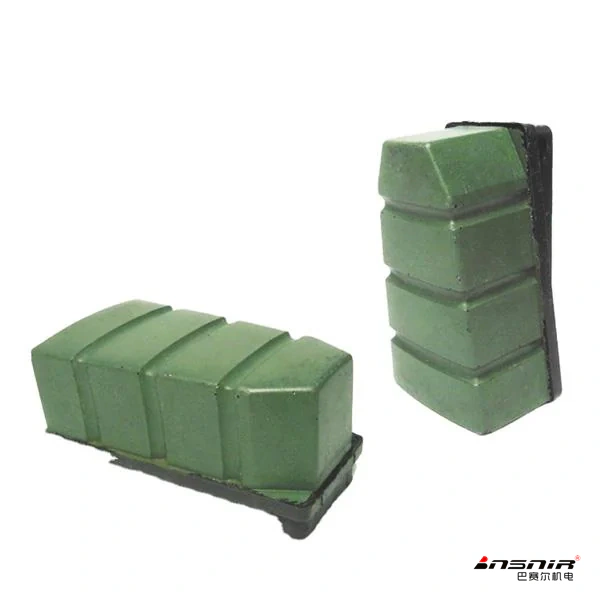
| Diamond Fickert abrasives | Metal/resin-bond rough or intermediate grinding in an approved long-block holder | Length family, base, holder, bond, grit, tooth form, material and stage |
| Abrasivos elásticos do tipo “lappato” | Later elastic finishing for compatible glazed tile routes | Do not use this category as a substitute for calibrating or heavy rough removal |
| Magnesite stone abrasives and project-confirmed silicon-carbide blocks | Stone or approved grinding/polishing stages with their own machine and material route | Do not transfer a stone specification to glazed tile from appearance or nominal grit alone |
Machine motion determines tool geometry
A roller presents a long rotating working surface across the product. A cylindrical wheel and a wheel mounted on a satellite head follow different paths. A Fickert block rocks or moves in its holder as the polishing/grinding head operates. These motions distribute contact and removal differently, so dimensions and grit labels cannot make one form replace another.
For a tile surface calibrator, define incoming thickness variation, target removal, width and coolant/slurry arrangement before asking for rollers. For a máquina de polimento em linha, identify the head, holder length and station sequence before selecting Fickert tools.
A project-confirmed round glaze polishing wheel belongs to a later finishing route on a compatible round or satellite spindle; it should not be substituted for a calibrating roller or a long Fickert grinding block.
Fickert tools need stage, bond, size and holder confirmation
Current family planning includes metal- and resin-bond Fickert forms and length families commonly described as L90, L140 and L170. These designations are selection inputs, not proof that one block fits every holder. Measure the base, locating features and working height, and photograph the installed holder.
Metal-bond tools are commonly evaluated for stronger cutting or earlier positions; resin-bond tools can be evaluated for later or finer grinding roles. The final sequence depends on material, incoming surface, removal, head pressure, line speed, coolant and the result of the preceding position.
Build a controlled tool sequence
- Record the incoming thickness, flatness and surface condition using an agreed sampling method.
- Assign a defined removal or surface responsibility to each machine/head position.
- Confirm tool form, holder fit, bond and grit for that position.
- Run representative material under recorded line speed, pressure and water conditions.
- Measure the output after each relevant stage; do not judge only the final gloss.
- Record tool wear, surface defects, removal stability and any change to later positions.
A trial should change one defined variable at a time. Replacing several tools while changing machine pressure or feed makes the result difficult to attribute.
Information needed to match calibrating or grinding tools
- Material/body, surface, incoming thickness/flatness and target after the requested stage
- Machine manufacturer/model, head type, station numbers, tool motion and current tool code
- Desenho da ferramenta ou medidas de comprimento, largura, altura, base, porta-ferramenta e características de posicionamento
- Tipo de ligante atual, sequência de grãos, remoção por etapa, velocidade da linha, pressão do cabeçote e condição a seco/molhado
- Fotos de ferramentas novas e desgastadas, porta-ferramenta instalado, padrão de desgaste e defeitos representativos
- Amostra de produção aprovada e critérios mensuráveis para testes
Solicite uma revisão da ferramenta de calibração ou retificação
O fornecimento de rolos e rodas satélites é confirmado pelo projeto. O tipo de ferramenta, ligante, granulometria, sequência, remoção e vida útil dependem do material, da máquina, das condições do processo e do teste controlado.